|
|
CONTENTS
|
|
To The Editor, I was pleased to enjoy another fine issue of Voyage. Mention of the recent Brad Matsen book Titanic’s Last Secrets brought to mind a number of claims (from various sources) that have been made against Titanic’s structural design in recent years; so many of which are not true. Unfortunately, it is not possible to do justice to them in a short letter or article, but I would like to offer some very brief comments upon a mere two of them, if I may:
A ship’s hull is a complex structure. Hull plating is merely one structural element of many. The plating varied in thickness throughout the hull. Generally speaking, it was one inch thick amidships, doubled for extra strength at areas such as the turn of the bilge and the bridge sheer strake. The claim that Titanic’s hull plating was too thin is demonstrably false. Looking at similar large vessels built around the same time, from Lusitania (1906), Homeric (ex. Columbus, 1913), Aquitania (1913) and Majestic (ex. Bismarck, 1914), we can make some comparisons. And, generally speaking, we see a variation in thickness from 0.94 inches (Homeric); 1 inch (Olympic and Titanic); 1.02 inches (Majestic) to 1.1 inches (Lusitania and Aquitania). A general thickness of 1.25 inches would have been exceptionally heavy for a large vessel of this type. Aquitania was very similar in size to Titanic. Even though Cunard erred very much on the side of caution, sometimes increasing one of her specifications over and above what their shipbuilders thought was needed, Olympic’s scantlings (and plating generally) were only ‘somewhat lighter’ than Aquitania’s in the words of Cunard’s naval architect Leonard Peskett. Olympic’s design was very much in line with the highest standard.
Olympic and her sister need to be understood within the context of their time. As liners grew in size, it was particularly important that their long superstructures were able to ‘work’ at sea while the hull girder flexed. Earlier White Star liners had not employed expansion joints: the number of expansion joints, their location and design were all a matter for consideration. Olympic and Titanic’s design featured two expansion joints, dividing the superstructure into sections. At a basic level, the design served Olympic fairly well over a quarter of a century’s service. However, shipbuilding and engineering involve continuous improvement, as practical experience with newer and larger vessels supplemented past theoretical knowledge. It was in this context, early in 1912, that Harland & Wolff examined Olympic. After a harsh winter on the Atlantic, including a storm in January 1912 that Captain Smith had described as the worst he had seen in forty years at sea, it was clear that the number of expansion joints could be increased; and the design improved by altering the shape of the base of the joint. Although they performed their intended purpose, the two expansion joints were not sufficient to prevent small, localised cracks at the corners of deckhouse windows in close proximity to the expansion joints. These were not a major concern, as the light plating of the superstructure was not part of the structural hull, yet it was hoped an additional expansion joint would improve the design. Harland & Wolff were aware of this information before the Titanic disaster, and it seems entirely probable that the changes to Britannic stem from that. No primary source evidence has been produced to the contrary. (See my article Olympic’s Expansion Joints.) There is a long list of further claims that are equally questionable or demonstrably false – whether they relate to the ‘true’ purpose of the new inner skin on Olympic and Britannic; other claims that the hull was unduly ‘weak’; or that the aft expansion joint was a cause (rather than a symptom) of Titanic’s break-up – but I hope that some of my comments above will help put some of them into context. It is often worthwhile to cast a very sceptical eye on some of the rather sensationalist claims that inevitably appear with such a famous subject matter. Yours truly,
Mark Chirnside. |
Titanic Commutator 2008: Volume 31 Number 180: Page 209. Dear THS, |
|
Voyage September 2007: Issue 61; Page 45. [Published as a short article.] To The Editor, The reports of the bravery shown by the Sea Scouts onboard Britannic (Voyage 58) bring to mind some documentation that I ran across fairly recently, in the course of my continuing Britannic research. It seems that, as a result of the sinking, interest in serving onboard hospital ships increased. Writing to the Secretary of State for War, on January 19th 1917, Lieut-Gen. Sir Robert-Baden Powell, K.C.B., K.C.V.O., (Chief Scout and Chairman of the Council, The Boy Scouts Association) noted:
Seven days later, the Admiralty’s Director of Transports wrote to inform him:
In the subsequent list of shipping companies, an address for Cunard was given but not one for the White Star Line, for their only remaining hospital ship Britannic had foundered. Another example comes from March 28th 1917, when W. J. Bayliss, a sixteen-year-old Scout of 10 Bournevale Road, Streatham, SW 16 wrote to the authorities to offer his services:
On April 2nd 1917 the Director of Transports and Shipping presented ‘his compliments to Mr. Bayliss, and begs to inform him, with reference to his letter of the 28th ultimo, that he should apply to the Chief Scout, who has had the question of the employment of boy scouts in Hospital Ships under consideration.’ The bureaucratic distinctions could be blurred. Baden Powell’s correspondence to The Secretary of State for War was forwarded onto the Admiralty’s Director of Transports, who had to respond and state that it was the owners of Hospital Ships i.e. the shipping company who were duty bound to provide them. Contrary to popular misconception, Olympic and Britannic were not commissioned into the Royal Navy during their war service. When Yours truly,
|
|
Atlantic Daily Bulletin March 2006: Pages 11-12. Dear David, I really enjoyed the latest issue of the Bulletin, and I did want to comment on one of Trevor Platt’s points in his article ‘The Importance of Double-Skinned Hulls.’ He writes: ‘Far too much attention regarding glitter, opulence and sophistication was afforded to the upper decks and superstructure of these luxury liners, and far too little attention given to the orlop area down below regarding adequate safety and protection for the Engineers and “Black Gang” in the event of a calamity.’ While the omission of a ‘double skin’ in the initial design is an interesting area for debate, in my view a lot of the criticisms of the ‘Olympic’ class’s design come from hindsight. Olympic’s survival of the Hawke collision was seen, at the time, as an impressive vindication of the ship’s ability to remain afloat and stable with major flooding. Two large watertight compartments completely flooded, and several hundred tons of water in a third compartment. There are a lot of points that could be made about the safety of the original design, if space was plentiful, but I wanted to comment about the double skin. Trevor states: ‘…without the essential box honeycombing (two skins only) the huge liner would have taken on a huge list to starboard with water flowing freely between the two hulls along the entire length of the liner and causing her to capsize rapidly. This is precisely what happened to her sister ship Britannic, which hit a mine and sank within an hour in the In fact, the double skins fitted to Olympic and Britannic did have watertight subdivision within. When the Olympic was refitted in 1912-13, it was reported that: ‘The inner shell, or hull as it might be called, consists of strong steel plating. The space between the outer and inner hulls has been specially subdivided, both vertically and horizontally, by retaining out to the inner shell and the introduction of immediate watertight vertical subdivision between the two shells, while the top…of the structure and upper longitudinal have been specially fitted as watertight flats, so that each side of the ship has been converted into a series of watertight compartments.’ (When Olympic was it by a torpedo that failed to explode in the closing stages of the war, it only flooded a small section of the double skin thanks to this subdivision.) Looking at Britannic’s builders plans, the watertight bulkheads penetrated the double skin (as was to be expected since they extended from side-to-side of the ship); and there was a watertight division (midway between the two watertight bulkheads of each boiler room, marked ‘W.T. division’) further subdividing the double skin. There is no evidence that water flowed freely along the Britannic’s double skin, nor was it capable of doing so. Unfortunately, it is a myth which has been and continues to be uncritically accepted. Mark Chirnside. |
|
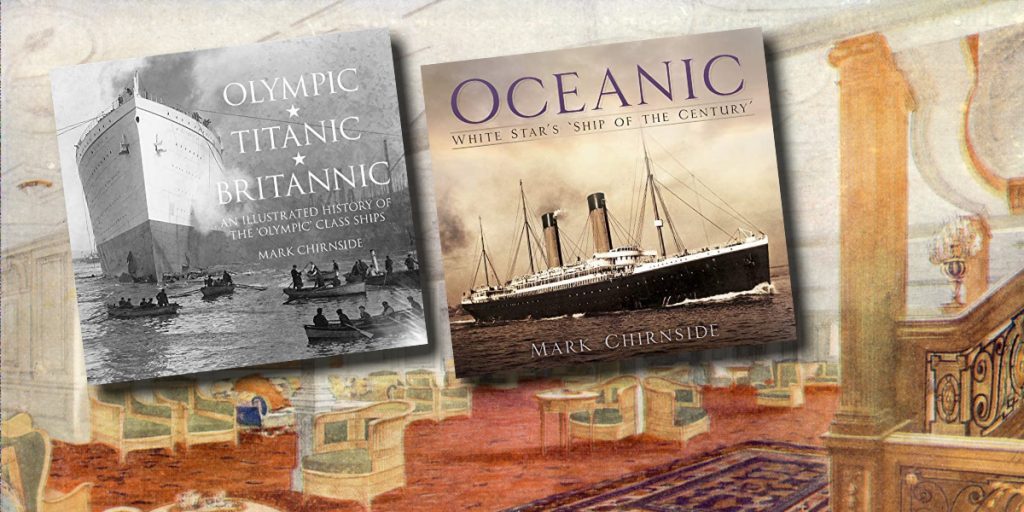
Atlantic Daily Bulletin December 2005: Pages 9-10. Dear David, Thanks for your note, re.: Britannic’s hospital ship number. I was very pleased to hear that your correspondent enjoyed reading my book, The ‘Olympic’ Class Ships Olympic, Titanic & Britannic. There is an interesting discrepancy with regard to the Britannic’s number. Prior to 2004, to the best of my knowledge there was a historical consensus that Britannic’s number was G618. Simon Mills’ latest book, Hostage to Fortune, even noted that the number ‘G608’ (as written by Captain Bartlett in his report following the sinking) was incorrect. It was in January 2003 that the manuscript of my book was delivered to my publisher, complete with the solitary reference to ‘G618.’ However, in 2004 the photograph that is reproduced on the back of my book surfaced, and as your correspondent rightly noted it shows the number ‘G608’ on Britannic’s bridge front; the discrepancy was unnoticed by me prior to the book first going to press in October 2004. The photograph was taken early in 1916, and so shows the Britannic during the earlier phase of her career. With this photo available, it then seemed to be a historic fact that the number ‘G608’ was displayed on the Britannic, and that therefore this was her correct number. (Based on this new information, I even commissioned a painting of the Britannic from maritime artist Stuart Williamson which showed the number ‘G608.’) However, nothing is clear with this ‘ship of mystery’ and there has been another twist to the debate in recent months: Britannic researcher Michail Michailakis (webmaster of www.hospitalshipbritannic.com) came into possession of an October 1916 photograph which showed the number G618 on the ship’s bridge front. Although I had thought it too ‘neat’ for the ship’s number to change by a single digit, it does appear at the moment that the Britannic’s number was changed sometime between early 1916 and October 1916, from ‘G608’ to ‘G618.’ There is no known reason for the change as yet, and it is currently taxing the minds of a number of Britannic researchers. What is a matter of historic record is that the number displayed on the Britannic changed (as shown by the photographic record), but exactly when this happened and why it happened, it is not yet possible to say. (I have been keeping a record of the debate on the news section of my website at www.markchirnside.co.uk) Best regards,
|
|
Titanic Commutator 2001: Volume 25 Number 156: Page 262. Dear THS, Thank you again for a magnificent Commutator, number 154, 2001. I have enjoyed reading it and, as always, learnt something new. On page 98, there is a question by Mr. Barry Hummel about medical facilities. There is a very long, detailed answer to the question, but it just so happened that I had been in front of my computer before I read the issue, looking at a work I am writing about Olympic which had some information about hospital décor and equipment:
I enjoyed the two book reviews [in the previous issue] and can personally vouch for Paul Louden-Brown’s extensive research. In Mark |
Home / Books Index / Interviews Index / Articles Index / News Index / Updates / Sitemap
Mark Chirnside's Reception Room ©2004-