The Yacht-Like Olympic

The Yacht-Like Olympic


As [Olympic] lay abreast the stage yesterday the general opinion among the many thousands of sightseers who thronged both banks of the river was that the Mersey had never borne a ship of more beautiful proportions or more graceful lines. So exceedingly well balanced are the proportions of the vessel that at first glance her vast bulk is hardly realised; indeed it is impossible for the eye to form any complete vision of the tremendous size of the vessel without comparison; that is until some other vessel becomes dwarfed by her vicinity.

The Journal of Commerce describes Olympic‘s visit to Liverpool, June 1911


There were many compliments about Olympic‘s profile when she entered service in 1911, but she also won favourable reviews for the way she handled.  On more than one occasion, mariners commented positively on how she steered, likening her to a ‘catboat’ and a ‘yacht’.   

‘She steers like a catboat. I went onboard from […] the pilot boat, at half past two this morning off the lightship, and we were anchored in Quarantine an hour later. She handled beautifully’.

Pilot J. J. Adler, New York Harbour Pilot, June 1911.

‘Does the Olympic steer well?’

‘Very well.’

Captain Edward J. Smith, Olympic’s commander, November 1911.

‘We all observed the marvellous rapidity with which this prodigious ship turned from side to side, answering to its steering gear like a yacht answering to the tiller’.

Account of manoeuvres in May 1912, published in The American Marine Engineer, June 1912. 

‘…she came out along the Turbot Bank like a small yacht would, and answered her helm just like a yacht’.

Captain James Tobin, who commanded mail tenders at Queenstown over four decades, describing one of Olympic’s visits to the port

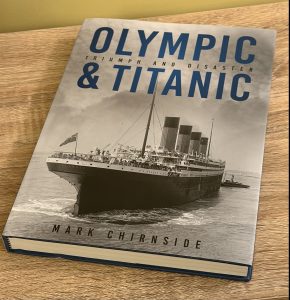
These quotes are among many nuggets of information in Olympic & Titanic: Triumph and Disaster.  (Thanks to Mike Poirier.)


Mauretania Revenue & Profit Analysis 1910

Mauretania Revenue & Profit Analysis 1910


A new article of mine, Mauretania Revenue & Profit Analysis 1910′ (external link) has been published on Encyclopedia Titanica.

It seems to be a common claim that the large transatlantic express liners such as Cunard’s Mauretania or White Star’s Olympic made the bulk of their profit from third class passengers. The available evidence does not support this conclusion.

This detailed analysis of Mauretania‘s financial data in 1910 demonstrates that first class revenues accounted for 59 percent of the total.  Even allowing for the fact that a first class passenger enjoyed a higher standard of service and cost more to look after – the average *profit* per first class passenger was more than the average *revenue* of a third class passenger, even on the most cautious assumptions.

The number of third class passengers was 89 percent higher than the number of first class passengers, but it is not mathematically possible for them to have contributed more profit than first class, because the cost of the average third class ticket was simply not high enough.

It was first published in the Titanic International Society’s Voyage March 2026: Pages 78-79. 


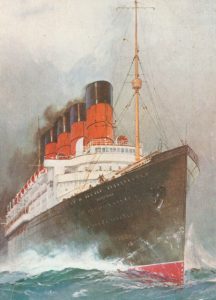
Above: Cunard’s formidable Mauretania.  (Author’s collection)


Titanic In Popular Media: A Case Study (2012)

Titanic in Popular Media: A Case Study (2012)


Naturally enough, there was a surge in interest around the one hundredth anniversary of Titanic‘s loss, just as there had been when her wreck was discovered in 1985 and after the release of the Cameron film in the late 1990s.  Unfortunately, many of the articles and books published in 2012 contained a number of errors.  Given the significant interest in the subject at the time, it’s particularly unfortunate that many of these errors probably found a large audience.

An example of this is an article, ‘The Extraordinary Story of the White Star liner Titanic‘, which was published by the Scientific American on 4 April 2012.  Here is a short extract:

The master of the Titanic was the commodore of the White Star Line, Captain Edward John Smith. He had also been the first master of the Olympic and, therefore, had had a year’s familiarity with the flaws and qualities of the new White Star floating palaces. He learned that they responded slowly to their rudders, partially because one of the three propellers was positioned immediately behind the rudder. Thomas Andrews, designer of the ships, brought up this issue with Ismay, but the White Star president expressed his reluctance to delay the construction in order to refine the design. He reportedly commented that the only place these liners would have to maneuver quickly would be in port and that was what you had tugboats for.

Andrews wanted another change as well: a second row of lifeboats that could be launched as soon as the first set was in the water. The result would have been enough lifeboats for all the passengers and crew. Ismay protested that they already had more than the legally required number of lifeboats (16) and the extra boats simply would clutter up the beautiful open expanse of the upper deck, where first-class passengers would want to stroll. Hence, the Titanic sailed with 16 lifeboats

Although Smith was White Star’s senior captain in 1912, the title commodore was not formally in use at the time.  Therefore using it is somewhat misleading, but perhaps this is a relatively minor quibble.

More concerning is the claim that Smith had ‘learned that they responded slowly to their rudders, partially because one of the three propellers was positioned immediately behind the rudder’.  There is no evidence whatsoever to support this claim.  In 1911, Smith said actually said that Olympic steered ‘very well’.  Moreover, the fact that the rudder was behind the turbine-driven centre propeller was potentially a benefit when the propeller was in operation.  Experience with Olympic during her early years of service was that she was more manoeuvrable when the turbine was running!  (These subjects are covered in Olympic & Titanic: Triumph and Disaster. )

It follows from this that the claim ‘Thomas Andrews, designer of the ships, brought up this issue with Ismay’ is also incorrect. How, too, could construction be delayed ‘in order to refine the design’?  Olympic was in service from June 1911 and Titanic was already launched and outfitting at Belfast.  The question of refining the design in this sense is clearly not possible, because one ship was already in service and the hull and rudder arrangement of the second already complete. It is not as if they were both on the drawing board with the opportunity to change the design of their stern.  It also speaks volumes that their younger sister, not yet laid down, had exactly the same stern and rudder configuration.

There is no evidence Andrews ‘wanted another change as well: a second row of lifeboats’ or that ‘Ismay protested’. Quite the contrary. Nor would a second row of lifeboats have provided ‘enough lifeboats for all the passengers and crew’. Even if we make the generous assumption of a further 16 boats with a 65-person capacity, that would have provided 1,040 extra lifeboat seats.  Perhaps that might have been enough for the number of people onboard at the time of the disaster, but it was not enough for all the passengers and crew Titanic could carry.

The article also noted that ‘Titanic sailed with 16 boats’. In fact, she had 20 – comprising 14 standard lifeboats, two cutters and four semi-collapsible boats.

It is not the purpose of this blog post to single out this particular article or its author for criticism, but it does serve as a good case study of the danger of inaccurate information disseminated in secondary sources. It appeared in a well-regarded publication and was part of a series of articles published for the centennial.  Many people will, in all likelihood, have seen it and taken its claims at face value, but the study of history requires an interpretation and understanding of the past which is evidence-based.  
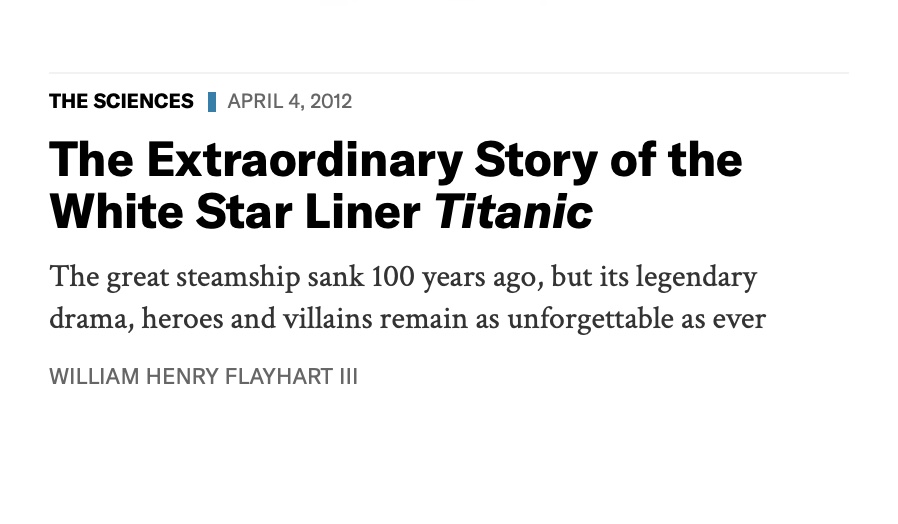
Above: One of many articles published for the centennial of the disaster, by William H. Flayhart (1944-2019).  (Scientific American, 2012)


FAQ: Majestic’s ‘Record’ Passenger List

Did Majestic Carry the White Star Line’s Highest Ever Number of Passengers in September 1923?

It has sometimes been reported that Majestic set a record in September 1923, carrying the White Star Line’s ‘highest ever’ passenger list of 2,625 passengers. There are several discrepancies. The statement, or a variation of it taken from several websites, appears to be traceable to Duncan Haws’ Merchant Fleets Volume 19: White Star Line (Starling Press Ltd; 1990), page 90:

1923 Sept: Fastest then crossing 5 days 5 hours 21 minutes. Average 24.75 knots. Only Mauretania was faster. On one crossing carried 480 first, 736 second, 1,409 third = 2,625, the company’s highest ever.

The first problem is that Majestic only made one westbound departure from Southampton that month, on 12 September 1923. She carried 1,774 passengers, including 815 in first class (her highest that year, westbound). She did, however, make two eastbound departures from New York – on 1 September and 22 September 1923 – with passenger lists in all three classes totalling 607 and 657, respectively. None of these three September departures had such a record list, although they did include the best first class passenger list that year for the westbound crossing, and (eastbound) Majestic carried 853 in first class on her 23 June 1923 New York departure.

The report appears to refer to the 26 October 1923 westbound departure, when Majestic carried 475 first class, 731 second class, and 1,416 third class passengers for a total of 2,622 passengers, her highest that year in either direction.  When Majestic arrived in New York on 1 November 1923, the figures given in America by the North Atlantic Passenger Conference were:

  • 480 first class
  • 736 second class
  • 1,411 third class

That total was 2,627 passengers, which is also very close to the ‘record’.  (Any of the figures represented a record for Majestic herself.)  If Majestic did carry that many passengers, albeit the following month, was it right to claim it was the highest passenger list of a White Star Line vessel?

No. We know that Celtic carried 2,957 passengers in September 1904.  That appears to be the highest passenger list ever recorded for a White Star liner.


Article from the Archives: ‘Britannic: The Length and Breadth of The Ship’

Even today, precisely 107 years after Britannic‘s loss, her history is often misunderstood.  Many popular beliefs about her are demonstrably false.  Among them are two basic points about her dimensions:


  • The belief that she was 903 feet long (overall length), whereas she was exactly the same length as her older sisters.
  • The belief that her beam (breadth) was increased following the Titanic disaster in order to make room for the ‘inner skin’ which was fitted along the length of her boiler and engine rooms.  In reality, the decision to increase her beam had been taken already prior to the keel being laid.  

This detailed article provides an analysis of the evidence about her length and discusses the reasons her breadth was increased. It was first published in the Titanic Historical Society’s Titanic Commutator February 2020: Pages 171-76.


Aegean Sea 2016

Above: The sea above Britannic‘s wreck is a beautiful, deep blue (photographed in 2016).  (Author’s collection)