FAQ: A Sound ‘Like a Cannon Shot’ – Why Did Majestic Crack?

FAQ: A Sound ‘Like a Cannon Shot’ – Why Did Majestic Crack?


On the night of Sunday 14 December 1924, the White Star liner Majestic (1922) was running through heavy seas en route to New York when a sound ‘like a cannon shot’ rang out.  Incredibly, the C-deck plating had fractured from the inside of the second funnel uptake on the starboard side, running right across the deck, past the second funnel uptake on the port side and out to the ship’s side.  The fracture then continued through the heavy plating at the side of the ship (the sheer strake) and partly down the ship’s side.  It was particularly serious because C-deck formed the ship’s strength deck and the sheer strake plating at the side of the ship was also specifically strengthened.
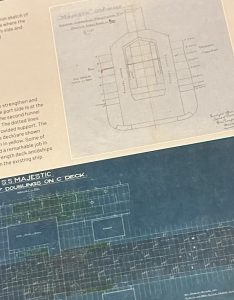
 

Above: Detailed blueprints and surveyors’ sketches showed the full extent of the damage and subsequent repairs (see RMS Majestic: The ‘Magic Stick’).  The sketch seen at the top of this extract, above, gives an idea of the split funnel uptake arrangement.  Unlike a traditional configuration with the ship’s funnel uptake extending directly upwards amidships, the designers chose to split the funnel uptake into two – one on the port side and one on the starboard side – to allow for spacious passenger accommodation amidships.


What had caused the problem?

The issue is explored in detail in RMS Majestic: The ‘Magic Stick’, however multiple factors were considered by the naval architectural firm Roscoe & Little, as well as the Board of Trade surveyors.  She had been designed and built in Germany by Blohm & Voss.  Roscoe & Little understood that the ship had been running at a deeper draught than her builders originally intended, increasing the stresses on the hull by 7-8 percent. (They put forward several schemes of repair work, one of which would simply restore Majestic to her original strength, but the White Star Line and Harland & Wolff thought this was inadequate because it would leave her 20 percent weaker than Olympic, which was taken as a benchmark example of a strong ship.)

The Board of Trade were surprised to receive test results on samples of the steel plating removed from Majestic‘s sheer strake.  They revealed a ‘surprising deficiency’ in the material’s ultimate tensile strength, because the steel bore a stress of only 23.2 to 25.4 tons.  The replacement plating was tested to 32.5 to 34.5 tons, which was in line with what it needed to be.  The samples of the original material which were tested had been almost 30 percent weaker by comparison.

The Principal Ship Surveyor was concerned that the split funnel uptake design involved not just cutting into the strength deck plating twice, but that sufficient ‘compensation’ (additional strengthening measures) had not been included in the design to make up for it. The position of the ship’s lifts (elevators) was criticised and there were also ventilator openings at the corners of the funnel uptakes.  The placement of the expansion joints also coincided with a weaker area of the deck. All of these features were far from ideal and served to collectively weaken the strength deck.

They did calculations which indicated that, owing to her greater weight and length, Majestic‘s tendency to bend (‘bending moment’ in naval architectural terms) was about 33 percent greater than Olympic‘s.  This should not have been a problem because ship designers took into account a ship’s bending moment in the structural design of the ship, but Majestic‘s strength had not been increased to the same extent.  She was, comparatively, significantly weaker.  The North Atlantic passenger liners all encountered particularly severe storms in the winter months and she should have been able to withstand this, but a combination of all these factors and the fact that Majestic had been driven at high speed put such a stress on her hull that it lead to a serious structural failure.

She was out of service for repairs over the course of several months early in 1925.  Harland & Wolff got to work effectively rebuilding the strength deck over a length about 233 feet.  This work included substantially thicker steel plating on C-deck, with some areas of double plates replaced with treble plating and other areas which were originally single plating doubled up to provide greater strength. It set her up for more than a decade of further service! 


FAQ: Was Bismarck/Majestic ‘Given’ to the White Star Line as Compensation for Britannic?

FAQ: Was Bismarck/Majestic ‘Given’ to the White Star Line as Compensation for Britannic?

No.

Contrary to popular belief that the German-built HAPAG liners Imperator/Berengaria and Bismarck/Majestic were simply ‘given’ to Cunard and White Star by the British government following Germany’s defeat in the First World War, in fact they had to be purchased.  These German ships were allocated to the United Kingdom as one of the winning Allied countries, but the British Lines then had to arrange to purchase them from the British government:

On 27 January 1921, Cunard and White Star signed an agreement with the British government. It provided for a joint purchase with a total purchase price of £1.5 million (£500,000 for Imperator/Berengaria and £1 million for Bismarck). Each ship would be bought in ten equal instalments, with interest (at a minimum of 4 per cent) charged on the cost outstanding. Each company would own their ship in its entirety, but pay the other 50 per cent of their ship’s profit. On 12 March 1921, Harland & Wolff noted that ‘White Star Line have made an offer for her to Lord Inchcape (acting on behalf of the government), which offer has been tentatively accepted.’ In April 1921, Cunard’s annual report noted that they had purchased Imperator and renamed her Berengaria. By 16 November 1921, Cunard and White Star had signed an agreement about how they would operate both ships on a joint account.

The White Star Line had already received full cash compensation from the British government for the loss of Britannic.  She was less than a year old when she was lost in November 1916 and so her value was reckoned at approximately £1,947,000.  During the war, there was significant inflation.  Harland & Wolff produced estimates for the Holland America Line which compared June 1919 shipbuilding prices with April 1916 prices.  By their estimates, the cost of building a replacement for the Holland America Line’s Statendam/Justicia (lost in 1918) had risen about 109 percent. Using the same rate of increase in a hypothetical scenario where White Star had ordered Harland & Wolff to build a new Britannic, the cost would have been over £4 million.

In this respect, the company got a very good deal by purchasing Bismarck/Majestic at approximately £1 million, because it was much cheaper than building similar new tonnage.  To make matters even better, they did not have to pay it all straight away but rather in instalments over 10 years. And, the profit-sharing agreement diversified earnings over two ships instead of one.  What this meant was that if one ship was out of service (such as Majestic in the first quarter of 1925), the White Star Line still received some earnings from Cunard from the operation of Berengaria. (The agreement on a profit sharing arrangement between Cunard and White Star ran until Cunard terminated it just over ten years later, on the grounds that their ship had earned more profit.  That meant that they were paying White Star more than they were receiving in return.)

Further details, including a detailed analysis of both ships’ financial results, are included in Appendix Four of the revised and expanded edition of RMS Majestic: The ‘Magic Stick (The History Press; 2024).


FAQ: Was Leviathan More Popular than Majestic?

FAQ: Was Leviathan More Popular Than Majestic?


How can popularity be defined? By the total number of passengers carried, or the average number of passengers carried on each crossing? The difficulty arises when trying to establish if one liner was more popular than another.

Average Passenger Lists

Taking the average passenger list for Berengaria over the 1923 to 1932 period (covering 300 crossings), she averaged 980 passengers; Leviathan averaged 1,035 passengers in the same period (over only 264 crossings), and Majestic led the way with 1,067 passengers (292 crossings). In this respect, then, when information for a comparable period is available then Majestic had the edge over both of her older sisters.

Total Passengers Carried 

Leviathan’s total of 40,539 passengers carried in 1927 eclipsed Majestic’s best showing of 37,949 passengers in 1928.  Berengaria’s best year of 1928 was slightly further behind. On the basis of the most passengers carried in any one year, Leviathan had the record.

Overall, Majestic had the edge in carrying higher numbers of passengers on average. Leviathan was not consistent in the 1920s, carrying the lowest average number of passengers of any of the three sisters in 1924 (983 passengers), and then the highest average of 1,448 passengers on each crossing in 1927.

(Further information can be found by referring to RMS Majestic: The ‘Magic Stick’).


FAQ: Majestic’s ‘Record’ Passenger List

Did Majestic Carry the White Star Line’s Highest Ever Number of Passengers in September 1923?

It has sometimes been reported that Majestic set a record in September 1923, carrying the White Star Line’s ‘highest ever’ passenger list of 2,625 passengers. There are several discrepancies. The statement, or a variation of it taken from several websites, appears to be traceable to Duncan Haws’ Merchant Fleets Volume 19: White Star Line (Starling Press Ltd; 1990), page 90:

1923 Sept: Fastest then crossing 5 days 5 hours 21 minutes. Average 24.75 knots. Only Mauretania was faster. On one crossing carried 480 first, 736 second, 1,409 third = 2,625, the company’s highest ever.

The first problem is that Majestic only made one westbound departure from Southampton that month, on 12 September 1923. She carried 1,774 passengers, including 815 in first class (her highest that year, westbound). She did, however, make two eastbound departures from New York – on 1 September and 22 September 1923 – with passenger lists in all three classes totalling 607 and 657, respectively. None of these three September departures had such a record list, although they did include the best first class passenger list that year for the westbound crossing, and (eastbound) Majestic carried 853 in first class on her 23 June 1923 New York departure.

The report appears to refer to the 26 October 1923 westbound departure, when Majestic carried 475 first class, 731 second class, and 1,416 third class passengers for a total of 2,622 passengers, her highest that year in either direction.  When Majestic arrived in New York on 1 November 1923, the figures given in America by the North Atlantic Passenger Conference were:

  • 480 first class
  • 736 second class
  • 1,411 third class

That total was 2,627 passengers, which is also very close to the ‘record’.  (Any of the figures represented a record for Majestic herself.)  If Majestic did carry that many passengers, albeit the following month, was it right to claim it was the highest passenger list of a White Star Line vessel?

No. We know that Celtic carried 2,957 passengers in September 1904.  That appears to be the highest passenger list ever recorded for a White Star liner.