Olympic & Titanic: Triumph and Disaster – Chapter 1

Olympic & Titanic: Triumph and Disaster – Chapter 1


The first copies of Olympic & Titanic: Triumph and Disaster will be landing on readers’ doormats over the coming weeks!

It is an enormous book 416 pages in length (excluding the colour section) and so it is divided into three main parts.  The first part opens with Chapter 1, ‘The North Atlantic Run’ (34 pages), which examines the early history of the modern White Star Line from its purchase by Thomas Henry Ismay.  It is a remarkable story of a newcomer’s success on the highly competitive North Atlantic route.  We trace the basic details of the company’s early history as it orders a new fleet of ships exclusively from the Belfast shipbuilder Harland & Wolff, which competitors scramble to match.  Although the company’s policy turned to focus on comfort rather than speed in later years, data for 1872 shows their fleet’s average crossing times as being significantly less than their older, long established rival Cunard.

The Atlantic disaster was the first serious blot on the company’s record and involved a heavy loss of life.  We see Thomas Henry Ismay and his company making strenuous efforts to clear themselves from the charge that the ship had left port without sufficient coal.  The heartbreaking conclusion is that she had plenty of coal onboard when Captain Williams took the fateful decision to divert to Halifax.  This was based on erroneous information from his Chief Engineer, whose figures substantially under-represented the amount of coal onboard.  The diversion was the first in a chain of events that led to his command being wrecked on the rocks.  What emerges from the disaster is the impression of a strong, well-built ship which was lost through poor navigational practices and extraordinary complacency.

White Star survived the calamity and continued to grow.  There was even a suggestion in the late 1870s of a merger with Cunard.  We follow the company becoming immensely prosperous even though it faced tough economic times and see J. Bruce Ismay join the management in the early 1890s, followed by Harold Sanderson in 1895.  Cunard’s annual reports for this period read like a tale of woe and contrast with the White Star Line’s financial strength.  We see that White Star was not alone in experiencing ill-fortune: Cunard experienced a number of shipwrecks in the late 1880s. J. Bruce Ismay’s previously unpublished comments about the loss of Norddeutscher Lloyd’s Elba in 1895 illustrate that he was well aware of the potential risks in a shipowner’s business, perhaps even more so after the baffling loss of Naronic in 1893.

The increasing competition from German Lines and the move to a policy of comfort rather than speed are covered in some detail. Comments from White Star and Cunard personnel show clearly the benefits of larger, slower ships such as the ‘Big Four’ from the point of view of their seakeeping qualities and the financial results they generated.

The acquisition of a controlling interest in the White Star Line by IMM illustrates how keen the American combine was to get its hands on the shipping line.  There were many critics of the move and plenty of concern that British interests were being sold out to a foreign country.  These prompted comments from Lord Pirrie to a newspaper reporter in 1902:  

The first is the interests of the country – and I wish, by the way, you would invent some comprehensive word which would, unlike Briton, include Irishmen – my second is in shipbuilding, and my third in shipowning. In which of these capacities could I possibly be an assenting party to a scheme which threatened injury to Imperial interests and ruin to British shipbuilders and shipowners?

J. Bruce Ismay’s own discussions about the combine’s future show his shrewd eye for detail as a businessman.  We see him considering exactly the sort of strategic questions essential to IMM’s future, including consideration in 1902 of making Southampton the terminal for the fast passenger and mail service to New York – something which has particular relevance to the decision to order Olympic and Titanic five years later.  He looks at issues such as the amount of debt the combine will have (a prescient question considering its later history) and how they can make it run more efficiently, such as using bulk purchasing of coal supplies to try and negotiate better prices.

The details of the White Star Line’s relationship with Harland & Wolff and the growth of the shipbuilder in the late 1880s are covered, ending with the expansion of the shipyard’s facilities which enabled the new large ships to be built.  We then see Cunard’s perspective competing against the White Star Line through little-known correspondence from company management.  By 1902, Cunard was in dire need of capital and felt paralysed against its competition (White Star and the major German Lines):

The result was that if the Government did nothing, the Company must face either absorption or annihilation.

State support from the British government saved Cunard but left White Star with a choice of how to respond to both their principal British competitor and continental lines including HAL, HAPAG and Norddeutscher Lloyd. Their decision to move their express service to Southampton in 1907 leads into the strategic rationale for Olympic and Titanic.  No shipping company could realistically match the speed of Cunard’s new Lusitania or Mauretania.  It was simply not feasible economically.  White Star’s strategic choice was to opt for new ships which would nonetheless be competitive from a speed point of view, as well as providing more luxury and comfort for passengers – with a particular eye on the continental passenger traffic they were now competing more directly for. 

How they and Harland & Wolff went about meeting those objectives that is covered in Chapter 2…  


Edward Wilding’s Hawke Collision Testimony

Edward Wilding’s Hawke Collision Testimony

Edward Wilding had probably been looking forward to 17 April 1912.

It was expected that Titanic would have docked in New York on the conclusion of a successful maiden voyage.  Perhaps he was anticipating news from Thomas Andrews concerning any of the observations he had made about the new ship’s progress.  (A year earlier, Andrews had made 56 notes concerning Olympic’s maiden voyage.)

Instead, he was digesting the news that Titanic had foundered with a heavy loss of life, including his colleague Thomas Andrews and the other members of Harland & Wolff’s ‘guarantee group’.  There was little time to try and process the news before he found himself in court that day, testifying as part of the appeal hearings following the Olympic-Hawke collision.  The channel in the vicinity of the collision had been swept and wreckage from Hawke recovered.  The White Star Line were hoping to use its location as evidence pinpointing the location of the collision, as part of their appeal against the December 1911 verdict (which allocated blame to Olympic but absolved her of liability on the basis of the defence that she was compulsory pilotage when the collision occurred).

He was asked about the damage to Olympic and the collision repairs.  Harland & Wolff had sold the damaged hull plating to a scrapyard and ‘nearly all of it’ had subsequently been recovered for examination.

Wilding thought that the main wreckage now recovered from the bottom of the channel had fallen from Hawke ‘at the conclusion of the third cut, and just as the next blade [of Olympic’s starboard propeller] was beginning the fourth cut on the body of the Hawke’. His evidence emphasized the enormous stresses on Olympic’s structure and starboard engine as the collision occurred:

I find some difficulty in saying that it absolutely did jam, but there was no question that the plating, when the vessel arrived in Belfast, was driven hard in, and the frames doubled up inside by pressure of the fore foot on the boss plating, and that the boss plating and framing had been driven down on a big loose coupling which was beneath them, and that the [Olympic’s starboard] engine, in its effort to go round, or to continue going round, when the pressure came on it, had torn and done very considerable damage to the framing inside the structure of the Olympic; and it is quite in my mind conceivable – although, of course, it is not certain – that that was sufficient to bring up the engine momentarily. Then, as the pressure of the Hawke’s fore foot was lifted off by her movement over the big propeller casting, that the engine was sufficiently free to be enabled to go on again. I do not think many people who have not been there, realise the enormous power that there is got from the steam pressure in these engines; they move comparatively slowly even when at full power, and the power behind them is, I think I am correct in stating, larger than the power behind the biggest rolling mills in the world. That is, the biggest mills that are used anywhere for the rolling of steel plates, as distinct from the forging of armour plates; consequently, the power that is available for doing damage is enormous, so that it is almost impossible to say that the comparatively modest damage, such as the damage on the boss plating, did bring up the propeller. But, allowing for the fact that the weight of the Hawke, the whole weight of the forward end…, was sitting momentarily on the loose coupling, it is at least conceivable that it was brought up there… I may say that as far as we could tell – we made some estimate of it – the starboard engine of the Olympic, when running at 64 revolutions, was probably giving something like 12,000 horsepower…

Wilding faced a whole series of daunting tasks in those weeks. He would go on to give exhaustive information and testimony before the British Wreck Commissioner’s court, providing information about all the fundamental aspects of Titanic’s design…


Did You Know Who Used Olympic’s Turkish Baths?

Did You Know Who Used Olympic‘s Turkish Baths?


The first class leisure facilities including the swimming pool, Turkish and electric baths on Olympic were heavily promoted by the White Star Line.  Adriatic (1907) had introduced a Turkish and electric bath complex with a plunge bath.  Their success and popularity encouraged the White Star Line to provide similar facilities on Olympic, including what was the first true swimming pool on an ocean liner.  Both ships had a gymnasium and Olympic also introduced a squash court.  Passengers travelling first class on Olympic had far more options to keep them occupied compared to ships a mere few years earlier.

However, data available from Olympic‘s first three round trip voyages to New York in the summer of 1911 shows a distinct gender divide in the number of female and male passengers who used these facilities:


Number of Passengers Gender Split
Swimming Pool (paid) Ladies (56) 7%
Gentlemen (785) 93%
Swimming Pool (free) Ladies (528) 24%
Gentlemen (1636) 76%
Turkish Baths Ladies (90) 20%
Gentlemen (358) 80%
Electric Baths Ladies (38) 51%
Gentlemen (37) 49%


The passengers using the swimming pool were 81% male (on a combined basis including both the paid and free uses of the pool) and those using the Turkish Baths were 80% male.  Only in the case of the Electric Baths, which were much less popular, were the numbers fairly evenly balanced with female passengers accounting for 51%.

A full gender breakdown of the total number of first class passengers carried during these three round trips is unavailable.  It may well be that there were more male passengers in first class, in general.  However it seems unlikely that this would be to the same extent of the 80/20 split in male/female passengers using the swimming pool and Turkish Baths.  All the indications are that these facilities were significantly more popular with male passengers.


Olympic & Titanic: Triumph and Disaster – Adding Some Colour

Olympic & Titanic: Triumph and Disaster – Adding Some Colour!


History did not happen in black and white, even though we may sometimes visualise it that way through watching old movies or looking at pre-colour photographs.

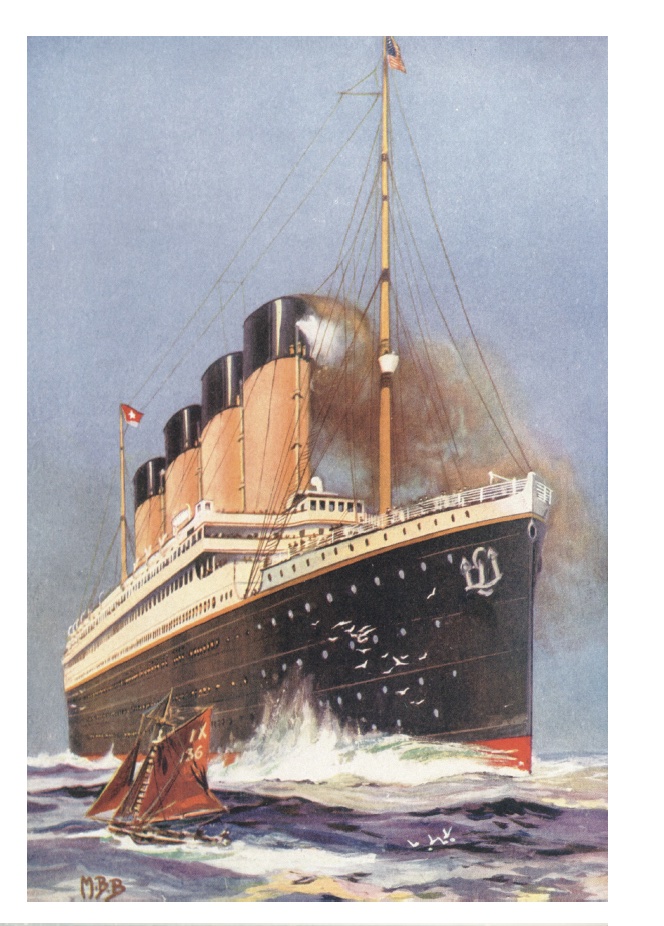
I’m therefore very pleased that the book’s 416 black and white pages are supplemented by a 12 page colour section which includes stylish period advertising produced for the White Star Line; the ‘Design “D”‘ concept signed off in July 1908; key documents (including entries from one of Harland & Wolff’s series of five engineering notebooks related to Olympic and Titanic); blueprints and original plans; and modern recreations of both ships’ interiors.


Above: One of the colour section’s pages includes a stunning illustration of Olympic (left); another shows a comparison of Harland & Wolff plans and blueprints, produced as they formulated a scheme to expand Titanic‘s first class accommodation on B-deck (right).


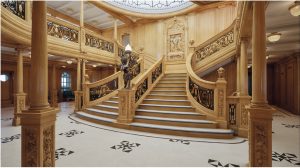
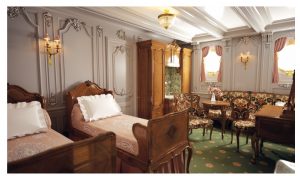
The interior recreations include eleven interior images kindly supplied by Matt DeWinkeleer and the team at Titanic Honor & Glory, covering first, second and third class interior spaces modelled using the most up to date research (grand staircase image, below).  Three further interior recreations were kindly supplied by Giovanni Castro, including first class interior spaces showcasing comparisons between Olympic and Titanic (first class stateroom image, below).


Many details seen in these images tie in to information included elsewhere in the book, such as the curved line at the base of the grand staircase’s bottom step on A-deck.  The book includes an account from the Holland America Line’s Willem Piek Jr., who commented on this feature and thought it might make passengers more careful when descending the stairs.

To learn more about Titanic: Honor & Glory’s work and see the stunning interior recreations, click on the logos below!


To see Giovanni Castro’s work and and his incredible interior images, checkout his Instagram and Patreon:


Olympic & Titanic: Triumph and Disaster Quotes

Olympic & Titanic: Triumph and Disaster – Three Parts


The book contains seventeen chapters as well as seven appendices.  There is an incredible amount of information and so we decided that the book would work well divided into three parts, each containing between five and six chapters.

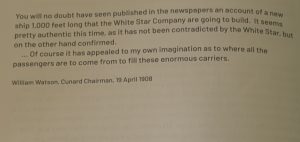
Each part is introduced by its own section, differentiated by a black strip running down the page.  They are populated by quotes from the various chapters which give a flavour of the material. They have been chosen to support the narrative and are from material which is either rare or previously unpublished.  One example is a quote included in the introduction to Part 1, which is from William Watson, Cunard’s chairman, writing in April 1908.  He discussed a number of issues at that time and commented on recent press reports claiming (inaccurately) that the White Star Line were going to built a new 1,000-foot liner.  The potential implication he saw in such a large ship was that she would carry a very great number of passengers, leading him to ponder ‘where all the passengers are going to come from’.


In reality, the White Star Line opted to use the greater size of their new ships to increase the number of first and second class passengers, rather than third class.  What that meant was that they carried fewer passengers compared to what they might have done if third class had been prioritised.  Indeed, Olympic carried fewer passengers than some ships far smaller than her.

By January 1909, Cunard had a much better idea of the true scale of White Star’s new ships, as well as vessels under construction for Norddeutscher Lloyd.  Throughout 1909 and 1910, they followed developments closely and tried to understand what HAPAG, Norddeutscher Lloyd and White Star were planning. All of this effort helped underpin the design of their new Aquitania


Olympic & Titanic: Triumph and Disaster – Judging a Book by its Cover

Olympic & Titanic: Triumph and Disaster – Judging a Book by its Cover


There is a cliche that you should not judge a book by its cover, but many people probably do exactly that!

Getting a book’s cover design correct is very important.  This includes not just the front, but the rear cover as well.  Imagery catches the eye.  The cover also needs to convey the content of the book.  The process is a collaborative effort between the author and the design team at the publisher.

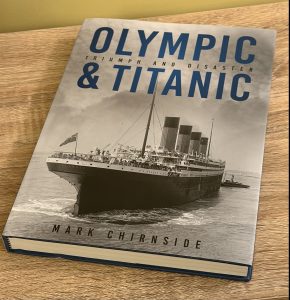
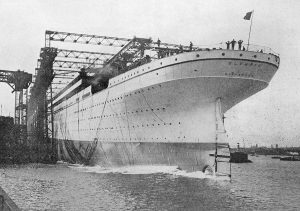
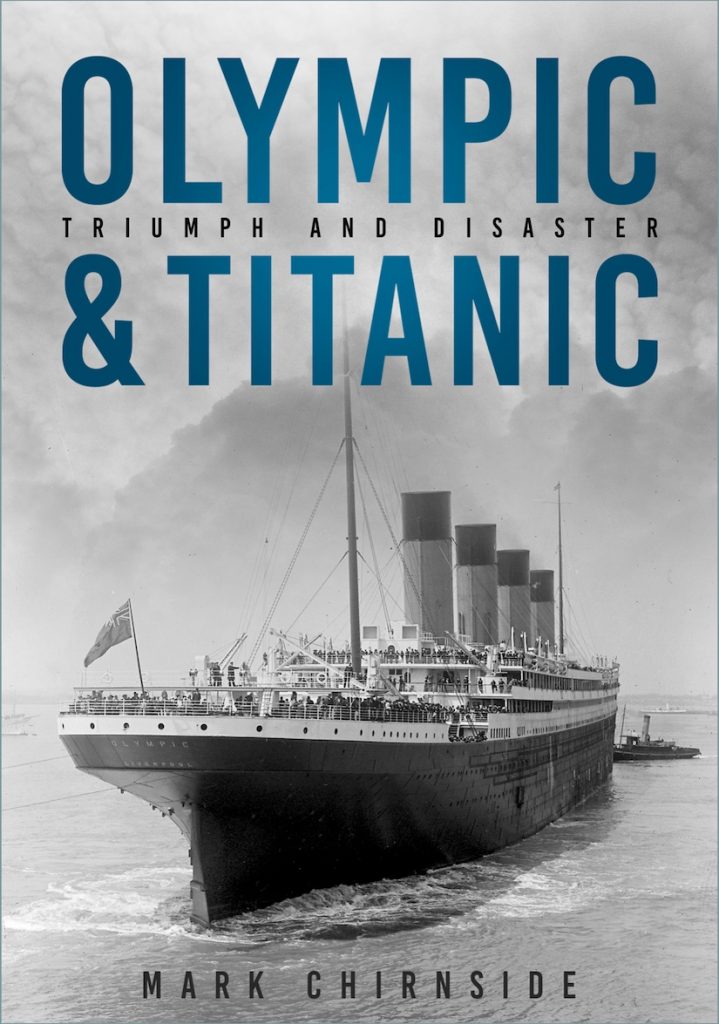
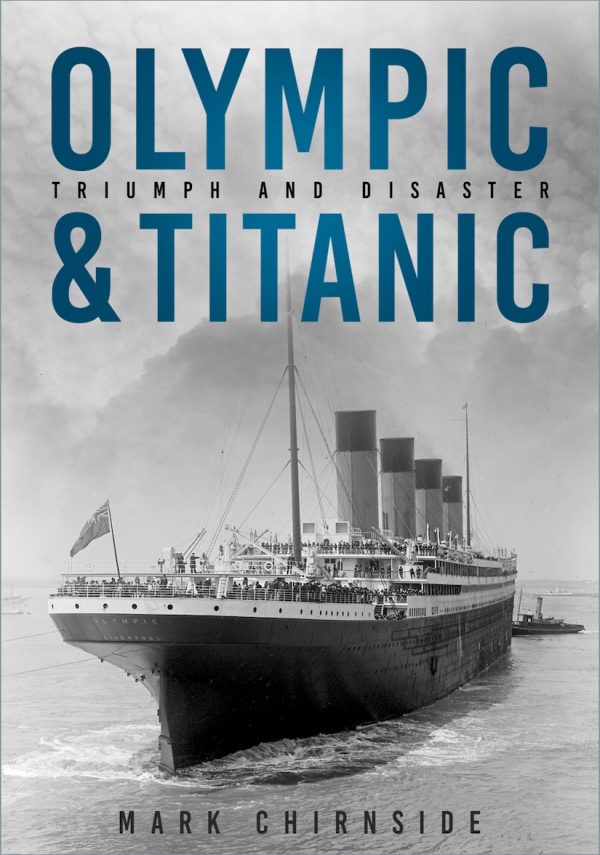
The title of the book, Olympic & Titanic: Triumph and Disaster, is intended to draw the contrast between the first two of the three ‘Olympic‘ class ships.  A theme throughout is how similar these ships were from a design perspective and how their stories diverged so significantly.  It seemed appropriate that Olympic should be on the front cover, as the more successful of the two.  We see her depicted in a wonderful, sharp photograph as she sets out for New York.  Everything portends a long, successful career which is exactly what lay ahead of her.

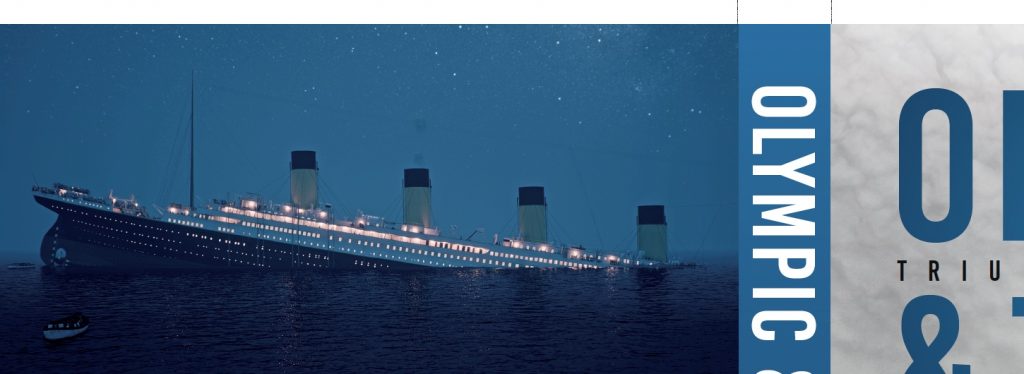
To complete the comparison, Titanic found her place on the rear cover.  She represents the opposite of her successful sister – the ‘disaster’ in the final word of the book’s title. There are illustrations from 1912 depicting the sinking but I thought that a colour image would be a better representation and form a contrast with the black and grey colouring of the front cover.  It was a pleasure to work with Tom Lynskey and Levi Rourke from HFX Studios, who kindly permitted us to use an illustration from their most recent Titanic sinking animation.  As an added bonus, they had worked with the publisher before in providing imagery for other book covers, so were well acquainted with the process.   


I think the cover designer, Martin Latham, and the History Press team did an excellent job.  I feel the whole combination works well, with the blue lettering on the front cover, blue spine and dust jackets, and then the darker, blue sea extended down the rear cover to provide space for reviewer’s quotes. 

To learn more about HFX Studios’ work or watch their stunning YouTube documentaries, click on the logos below!


Olympic & Titanic: Triumph and Disaster Pre-Orders

Olympic & Titanic: Triumph and Disaster – Pre-orders are open!


Olympic & Titanic: Triumph and Disaster will be published by the History Press in April 2026.


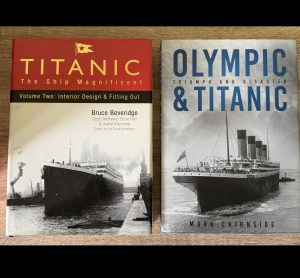
This hardback volume, similar in scale to the acclaimed Titanic: The ‘Ship Magnificent’ books, is 416 pages (including c. 160 black & white and c. 20 colour images).  The text contains a treasure trove of little known information and previously unpublished anecdotes.  Whether your interest is in the design and engineering, financial, social or technical aspects of these ships’ history, you will learn something new.

Check out the book page for a preview and further information.


Signed and personally inscribed copies are now available for pre-order through this website.  The intention is that all copies ordered in March will ship soon after the book’s official release and before the end of April.  If you want a personal inscription as well as a simple author’s signature, please make sure to specify this when placing your order.  (Due to the book’s size and value, it will be shipped by tracked UK and global shipping services only.)

April is ‘Titanic Month’ and lots of new posts are planned, including many showcasing the new book.   For all the latest news, be sure to follow Mark Chirnside’s Reception Room through this blog and on social media! 


Happy New Year – 2026

Happy New Year – 2026!

Wishing you all a happy and healthy New Year!

It’s not every year that I post a ‘Happy New Year’ message, but it seems appropriate as we enter 2026.

2025 was a very busy period in so many ways.  It’s great that the number of visitors to Mark Chirnside’s Reception Room increased by 115 percent compared to the previous year.  New features such as ‘FAQ Fridays’ in July were very popular and I have had a lot of positive feedback from readers who have enjoyed the Frequently Asked Questions blog posts.  They address common questions but also serve as a myth-busting tool, because they discuss topics which are often subject to inaccurate information and explain why that information is inaccurate, using the primary source evidence.  Sadly, the reality of modern media and the internet is that inaccurate, sensationalised information so often goes viral, but putting the available evidence out there does go some way to remedying that for the discerning reader who values quality of information rather than quantity.

It was great to announce in September 2025 that the new book, Olympic & Titanic: Triumph and Disaster, will be published by the History Press in April 2026 (UK release).  This book has been in the works for a long time but the completed manuscript was only submitted to the publisher at the start of May 2025.

It might be helpful to explain the process of taking a book from idea to reality.

Authors are typically self employed and so each book project is written under its own contract and to a particular specification.  The author and publisher will have already agreed a format (which might be a lavishly illustrated paperback book with fewer words or a large hardback book with a focus on the information in the text).  Common practice is that there will be a range of tolerance for both the word count and the number of illustrations.  For this book, the image count came in right in the middle of what had been agreed but the upper limit of the word count was 200,000 words.  The finished manuscript ended up one word short!
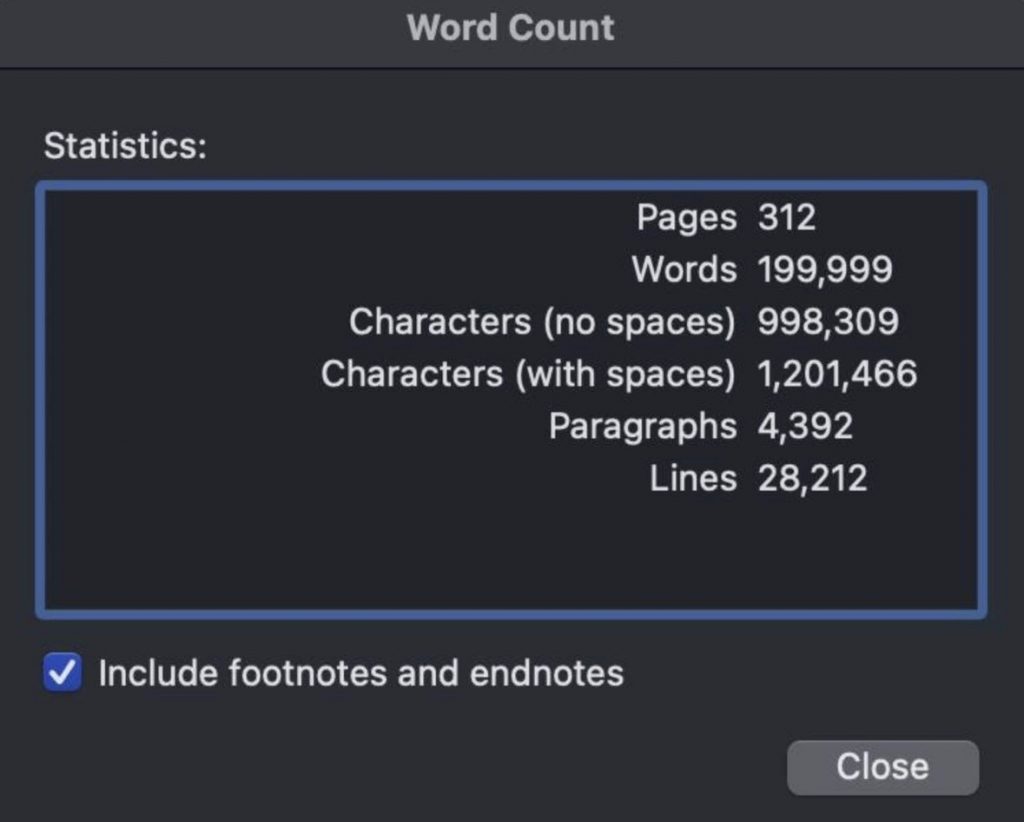
 

The complexity of a project such as this is only appreciated fully by those directly involved.  I was horrified to see I had burst through the maximum word limit and run to over 240,000 words.  This entailed slashing the manuscript before it could even be submitted to the publisher.  Cutting about 40,000 words required a disciplined editing effort on my part, but the end result was a sharpened focus on the key themes of the book.  (To help visualise the extent of the cuts, these words are the equivalent of the Majestic book.)  The cuts will not be wasted because they provide material for blog posts or articles in the future!

On submission of a book to the publisher, they will typically check over the manuscript and give it an initial read through to make sure that its content fits the original pitch.  They will map out how it will all fit together in the finished product and how many pages will be required, taking into account the word count, number of images and intended use of those images. (As the author, I personally find it helpful to make recommendations concerning each image submitted.  There might be some images which could be cut out if necessary, whereas another image might be rare or previously unpublished, meaning that it should be prioritised if space is at a premium during the book design process.  In other cases, images are directly referenced in the main text itself so making sure that they are used in the final book is essential!  The book designer will not necessarily be someone who knows the book’s subject and so it’s an important partnership between the author and designer to make sure we have a common understanding.)  In the case of this book, although the word count was (just) within the upper limit and the image count was in the middle of the range, the page count rose from the projected 368 pages to 416 pages (plus the colour section).  It’s a very big book!

Whipping the manuscript into shape typically involves a number of different editors.  They might come back to the author with queries if they feel a certain statement is unclear, or where a section of a chapter might benefit from being restructured.  In this case, I was relieved to hear that they thought the text was already in very good shape, but they made a number of recommendations which improved it a lot.

After months of work and queries back-and-forth, the author receives an initial set of page proofs to check over.  This is where they see for the first time how the text and images have all been moulded together into the book design template by the design and editorial teams at the publisher. Proofreading is a mammoth task and usually involves multiple sets of page proofs.  Initial comments / corrections are sent back to the publisher to be addressed; then a corrected set of page proofs is returned to the author to be checked and re-checked.  It is amazing how many errors come to light only on the third read-through!  A major challenge for the author is that they ‘know’ what they have written and so skim reading is not an option.  It is a very tiring, focused process to try and read what is actually on the to-be-printed page rather than what the author thinks it says.

This book was researched and written over an extended period of time.  One of my greatest pleasures was in learning new information about these ships from proof-reading my own book, because I ran across information again which I already knew but had slipped out of my memory!  I benefited from the input of a number of colleagues who kindly reviewed sections of text pertinent to their particular expertise before the manuscript was submitted to the publisher.  There were also others who were generous with their time and undertook pre-publication reviews based on the final product.  Some of these reviewers came back to me with specific queries and in many instances I checked and re-checked the source material underpinning a particular statement.  It goes without saying that any errors are the author’s ultimate responsibility.

Each book brings its own challenges.  My own experience is that there will always be something that is missed (hopefully a very small detail such as a comma being used somewhere instead of a full-stop), which can be frustrating given how hard all the individuals have worked to try and eliminate that sort of error.  Way back in 2006, when the first edition of the Majestic book was about to be signed off and sent to the printer, I realised to my horror that the page headers with the book title had ‘HMS’ Majestic rather than ‘RMS’.  It was a last-minute correction that saved a considerable amount of embarrassment!

In this case, one of the illustrations provided by a photo archive was incorrect.  The image (supplied directly to the publisher) showed the first class reading room rather than the first class smoke room. Although the archive reference number I had provided for the image was correct and I had fully intended to use a smoke room image, a well meaning individual at the archive had noticed that the archive catalogue description for that image incorrectly referred to the reading room and they substituted the image for the ‘correct’ one.  This necessitated sourcing the image again – and explaining that the ‘incorrect’ image was the one required!

Formatting rules can create complexity. Should a particular word be in italics or not? It’s often the case that foreign language terms (such as the name of a dish on a French menu) will be italicised. However, each publisher will have their own ‘house’ style guide to ensure consistency between all of their titles.  Some terms which are now in widespread use in English language publications are no longer appropriate for italics but should be formatted in roman.  Changing the formatting from the original manuscript to the text in the book design template can introduce inconsistencies if one term is changed but another is missed.  Therefore, it’s essential during the proofreading stage to make sure that all terms are formatted the same way.  In the case of original source quotations where I have emphasised a particular point in italics, it is always necessary to make sure that a notation has been included to explain it is the author’s emphasis (rather than the original source document) and that the italics made it through to the final book.

Ship names represent a particular problem.  By convention, they are always in italics but the formatting can be lost when the original manuscript is being transferred into the book design template.  The most obvious ones are easy to spot but reviewing the entire text to make sure any ship names have not been missed is always a challenge – and there is always one which will be missed.

Indexing presents its own challenge.  Indexing the content of the book can only be done very late in the process, because the layout needs to be 99 percent complete.  We need to have confidence that any page numbers will not be changing after the material has been indexed.  The process is laborious, but essential to help readers locate the material they want and to do justice to the sheer quantity of information in the book.  A whole series of decisions need to be taken.  Firstly, a judgement call on which subjects should be indexed.  Titanic is an obvious example of a subject which should be included, but such a large entry necessitates numerous sub entries beneath the main topic.  My approach was to cover the basic generalities first, then focus on areas where the book presents particularly important or new research and information.  Then there are other issues to consider – should a person’s title be used, or just their surname and first name?  What should be done in those instances where someone’s title changed?  For example, William James Pirrie only became a Lord in 1906.  He appears in the book decades before he had the title.  Then there are ship’s officers.  If an officer was promoted and appears in the text in both their junior and senior roles, which should be used?  Arguably, their most senior role, but it does create its own complications.  To keep things simple, I ended up using the simple surname, first name and/or initials for people’s index entries.  All of this minutiae might not be apparent to someone who picks up the book and skims the index for topics.

Another last-minute job is checking all of the cross references (‘see page X’), where the main text itself refers the reader to another section that is relevant, or to an image.  In some cases, image captions also refer the reader to the main text. Again, the final page numbers can only be confirmed once we’re confident nothing is going to be moved around or deleted for any reason.  For the final sign off before the book goes to print, the author and publishing team have to be as confident as they can be that no significant errors have been missed.

After weeks of intense collaboration on the page proofs, sending masses of corrections / comments back and forth, it was great to go on leave for Christmas, set the out of office email and drink some mulled wine!    


What’s planned for 2026?

There are more FAQs and other blog posts in the pipeline.  (If you have any suggestions for particular topics, do get in touch.  It might not be possible to respond to each individually, but all will be considered.)  April is naturally a busy Titanic month and you will see lots of new posts reflecting that.

Announcements about the new book and ordering options will all be published on this website – if you have not yet subscribed for regular updates via this blog, be sure to do so in order that you won’t miss out! 


Olympic & Titanic: Triumph and Disaster

Olympic & Titanic: Triumph and Disaster

Mark Chirnside’s eagerly anticipated new book, Olympic & Titanic: Triumph and Disaster, will be published by the History Press in April 2026!

This hardback volume, similar in scale to the acclaimed Titanic: The ‘Ship Magnificent’ books, will comprise of approximately 368 pages (including c. 160 black & white and c. 20 colour images).  The text (200,000 words) is the result of years of research and the use of substantial primary source material.  Needless to say, it contains a treasure trove of little known information and previously unpublished anecdotes.  Whether your interest is in the design and engineering, financial, social or technical aspects of these ships’ history, you will learn something new.

Signed and personally inscribed copies will be available for purchase through this website and we will be sure to keep you updated over the coming months.

If you can dream—and not make dreams your master;
If you can think—and not make thoughts your aim;
If you can meet with Triumph and Disaster
And treat those two impostors just the same


Rudyard Kipling.


It is impossible to understand Titanic without appreciating the broader context: the development of the White Star Line and its competitors in the preceding decades; Anglo-German competition; the British fear of the ‘American peril’ as foreign capital increasingly controlled British shipping companies; and the relentless advance in shipbuilding and technology. This definitive reference volume explores the lead up to the construction of Olympic and Titanic; providing a step-by-step account of the design process; looking at the financial, logistical and political obstacles they had to tackle; the ups and downs of Olympic’s maiden season in 1911 and 1912; and summarising Titanic’s disastrous end. Relying on extensive primary source research and presenting much unpublished data, this new book is not only a valuable reference tool, but provides an essential insight into understanding this period of history.

For all the latest news, be sure to follow Mark Chirnside’s Reception Room through this blog and on social media!