FAQ: A Sound ‘Like a Cannon Shot’ – Why Did Majestic Crack?

FAQ: A Sound ‘Like a Cannon Shot’ – Why Did Majestic Crack?


On the night of Sunday 14 December 1924, the White Star liner Majestic (1922) was running through heavy seas en route to New York when a sound ‘like a cannon shot’ rang out.  Incredibly, the C-deck plating had fractured from the inside of the second funnel uptake on the starboard side, running right across the deck, past the second funnel uptake on the port side and out to the ship’s side.  The fracture then continued through the heavy plating at the side of the ship (the sheer strake) and partly down the ship’s side.  It was particularly serious because C-deck formed the ship’s strength deck and the sheer strake plating at the side of the ship was also specifically strengthened.
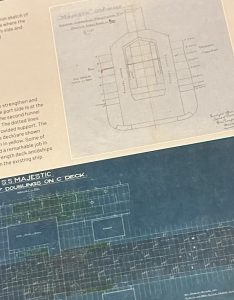
 

Above: Detailed blueprints and surveyors’ sketches showed the full extent of the damage and subsequent repairs (see RMS Majestic: The ‘Magic Stick’).  The sketch seen at the top of this extract, above, gives an idea of the split funnel uptake arrangement.  Unlike a traditional configuration with the ship’s funnel uptake extending directly upwards amidships, the designers chose to split the funnel uptake into two – one on the port side and one on the starboard side – to allow for spacious passenger accommodation amidships.


What had caused the problem?

The issue is explored in detail in RMS Majestic: The ‘Magic Stick’, however multiple factors were considered by the naval architectural firm Roscoe & Little, as well as the Board of Trade surveyors.  She had been designed and built in Germany by Blohm & Voss.  Roscoe & Little understood that the ship had been running at a deeper draught than her builders originally intended, increasing the stresses on the hull by 7-8 percent. (They put forward several schemes of repair work, one of which would simply restore Majestic to her original strength, but the White Star Line and Harland & Wolff thought this was inadequate because it would leave her 20 percent weaker than Olympic, which was taken as a benchmark example of a strong ship.)

The Board of Trade were surprised to receive test results on samples of the steel plating removed from Majestic‘s sheer strake.  They revealed a ‘surprising deficiency’ in the material’s ultimate tensile strength, because the steel bore a stress of only 23.2 to 25.4 tons.  The replacement plating was tested to 32.5 to 34.5 tons, which was in line with what it needed to be.  The samples of the original material which were tested had been almost 30 percent weaker by comparison.

The Principal Ship Surveyor was concerned that the split funnel uptake design involved not just cutting into the strength deck plating twice, but that sufficient ‘compensation’ (additional strengthening measures) had not been included in the design to make up for it. The position of the ship’s lifts (elevators) was criticised and there were also ventilator openings at the corners of the funnel uptakes.  The placement of the expansion joints also coincided with a weaker area of the deck. All of these features were far from ideal and served to collectively weaken the strength deck.

They did calculations which indicated that, owing to her greater weight and length, Majestic‘s tendency to bend (‘bending moment’ in naval architectural terms) was about 33 percent greater than Olympic‘s.  This should not have been a problem because ship designers took into account a ship’s bending moment in the structural design of the ship, but Majestic‘s strength had not been increased to the same extent.  She was, comparatively, significantly weaker.  The North Atlantic passenger liners all encountered particularly severe storms in the winter months and she should have been able to withstand this, but a combination of all these factors and the fact that Majestic had been driven at high speed put such a stress on her hull that it lead to a serious structural failure.

She was out of service for repairs over the course of several months early in 1925.  Harland & Wolff got to work effectively rebuilding the strength deck over a length about 233 feet.  This work included substantially thicker steel plating on C-deck, with some areas of double plates replaced with treble plating and other areas which were originally single plating doubled up to provide greater strength. It set her up for more than a decade of further service! 


Majestic’s Propellers

Majestic‘s Propellers

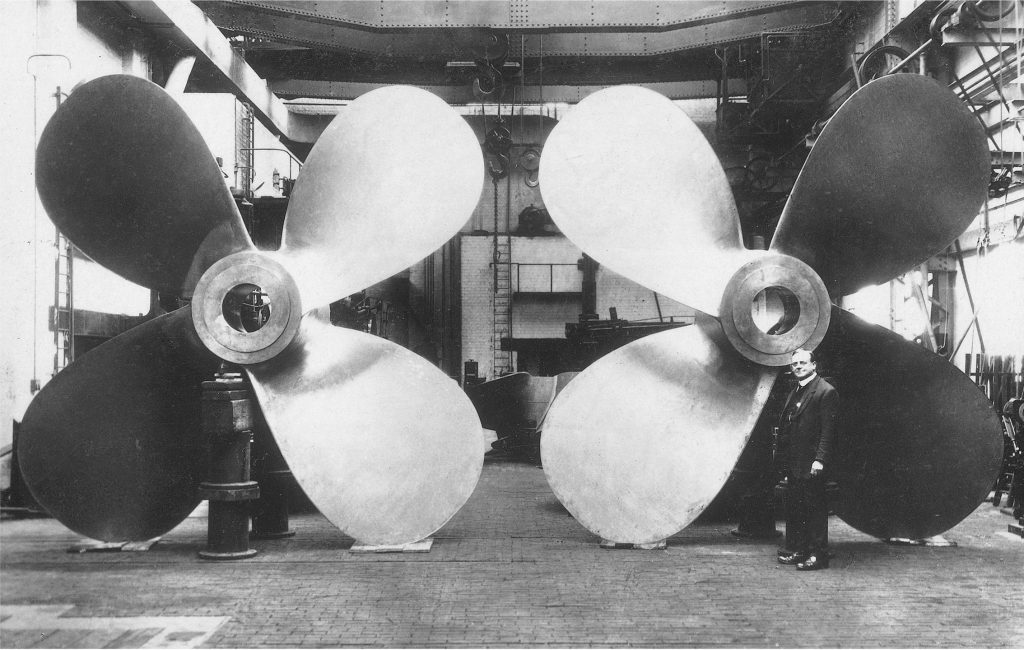
Bismarck/Majestic‘s construction was completed in Germany after the First World War.  She was a quadruple screw steamship and so her four propellers were an essential component of her propulsion system, but her builders Blohm & Voss were faced with many logistical challenges. One of them was shortages of various materials. In July 1920, Edward Wilding had reported that the ship’s propellers were ‘being made of cast steel, in view of the shortage of bronze’. This was only a temporary measure rather than a long term solution.  Majestic entered service for the White Star Line in May 1922 and her original propellers were replaced by a new set in November 1922.  She went through a number of different propellers during her career:   

A period postcard showing two of the ship’s propellers c. 1928.  The reverse reads: ‘Casting Weight 30 tons each; Finished weight 15. tons each; Diameter 16 feet; Revolving at 200rpm [revolutions per minute]; Each transmitting approx. 20,000shp [shaft horsepower], made of STONE’s Turbiston Bronze.’ (Author’s collection)


RMS Majestic: The ‘Magic Stick’

It was great to be invited to give a presentation at Public Record Office Northern Ireland (PRONI), in conjunction with the Belfast Titanic Society.  Although Belfast was a hive of activity, with scores of fans queuing for the Jonas Brothers (who were performing on the same evening just a quarter of a mile away), the lecture was well attended. It was wonderful to see so many familiar faces!   

‘RMS Majestic: The “Magic Stick
(September 2024)

The presentation discusses Majestic‘s life, covering her conception and construction as HAPAG’s Bismarck; to her completion as White Star’s Majestic; her service as the Royal Navy training ship Caledonia and her loss to fire in September 1939.  It bears the same title as the revised and expanded edition of RMS Majestic: The ‘Magic Stick’ which was released in March 2024. 


RMS Majestic: The ‘Magic Stick’ – What Are You Waiting For?

RMS Majestic: The ‘Magic Stick’ – What Are You Waiting For?

If you love ocean liners…what are you waiting for? Get this on your bookshelf now!

I am grateful to Captain Phill for his very positive review on his YouTube channel!  

It is packed with a wealth of additional photos…The colour section has also been expanded with some wonderful colour postcards and colour views of its lavish interiors and the two big things that need to be highlighted about this edition is that more information as come to light about its life as HMS Caledonia, the training ship, and so there is more information about what life was like for boys on that establishment and also what work had to be undertaken in order to convert the Majestic into the Caledonia… In addition to this he has found some wonderful nuggets of correspondence, letters, recollections from people who have travelled on the Majestic and their information about what it was like to be on this ship in the 1920s is pure gold…It adds a touch of warmth to the tale of this wonderful ship.

For those familiar with Mark’s work, you’ll know that he has a wonderful easy flowing style…You also know that all his information and statements are backed up with rigorous research.

Copies are still available with a signature and personal inscription, with secure payment options through this website.  If you have any queries before purchasing, please get in touch using the contact form.


RMS Majestic: The ‘Magic Stick’ – The Reviews Are In!

RMS Majestic: The ‘Magic Stick’ – The Reviews Are In!

Since its release early last month, the long awaited revised and expanded edition of RMS Majestic: The ‘Magic Stick’ has been selling very well.  I am grateful to all those who purchased a copy, because it is this support that makes it possible to continue researching, writing and publishing books about these great liners.  All the research and time involved in producing something like this makes it an expensive enterprise.  It is something that the vast majority of authors can only do part time, because it is not feasible as a full time occupation (if it were, I would probably have written a hundred books by now!)

The reviews are coming in and are very positive:

Just finished reading this book, after missing out on the first print, this was worth the wait, an absolutely fabulous book!

Copies are still available with a signature and personal inscription, with secure payment options through this website.  If you have any queries before purchasing, please get in touch using the contact form.


The Name Majestic

FAQ: Was Majestic The First Name White Star Chose for Bismarck?

A gorgeous artist's view of the White Star liner Homeric.
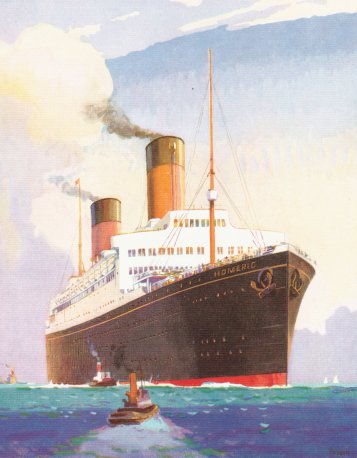
Above: Homeric entered service for the White Star Line in 1922.  She, too, was a former German liner reassigned to the United Kingdom after Germany’s defeat. (Author’s collection)

In February 1921, it was reported that White Star Line officials had told a newspaper that Bismarck (as she then was) would be named Oceanic – the same name as White Star’s pioneering steamer.  It is not clear whether this is true or whether the name was seriously considered. The name Oceanic held a special place in the company’s history for a number of reasons.  The White Star Line’s full legal name was the Oceanic Steam Navigation Company Ltd.  As well as their first steamer, they had also used the name Oceanic for their renowned ‘Ship of the Century’ completed in 1899.  The company were particularly proud of her and she remained a sentimental favourite.  Although Bismarck was destined to be the largest liner in the world and a fine addition to the fleet, she was a German-built ship and had been a former competitor.  Perhaps the company would have been reticent to use the name for a foreign-built ship.

The following month, correspondence between Edward Wilding and Board of Trade officials referred to ‘SS Majestic ex-Bismarck,’ and subsequent documents continued to use the name. In June 1921, there was even speculation that Homeric would be called Oceanic. (In the event, the name was not used until Harland & Wolff laid down a new express liner for the White Star Line in the summer of 1928.)


Man Overboard: Majestic, October 1926

Man Overboard: Majestic, October 1926

In the early hours of 13 October 1926, Majestic was experiencing stormy weather during one of her many crossings of the North Atlantic.  First class passenger David P. Davis and a younger female companion, Lucile Gehring, had been together since dinner the previous evening.  They were sat talking in the sitting room of Davis’ suite, D42, while Davis’ ten year old son George lay asleep in the bedroom, D44, next door.

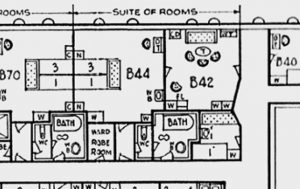
One of Majestic’s first-class ‘suite of rooms’ on the port side of D-deck, comprising a bedroom (D44) and sitting room (D42), wardrobe room and private bathroom facilities. The location of the sofa and the two portholes is clearly visible in the sitting room. (The deck designation later changed from D-deck to B-deck, as shown on this 1933 deckplan, so that B42 became D42 and B44 became D44). (Author’s collection)


They ‘had an occasional drink’ (a quart bottle of champagne between them) and Davis drank ‘half a bottle of rye whiskey’. Lucile ‘tried to leave on three separate occasions but he pulled her back after she had reached the door’. (Night watchman R.W. Tyrell ‘did not intervene as there was no violence and he knew the parties to be friends, who sat late as a rule’.)  Davis remarked: ‘If you go away and leave me, I’ll go through there,’ and pointed through the porthole. She thought it was ‘bravado’. He put his money on the table and ‘told her to keep it as she’d need it’. He ‘sat for a time in the recess of the port with his feet on the sofa’. She was ‘somewhat confused’ what happened next. He said ‘catch me honey, I’m slipping’ and ‘goodbye dearie here I go’.

She ‘caught his arm for a second’ but ‘almost before realising it he was gone’. She was ‘sure he slipped’. Her scream alerted Tyrell, who ‘immediately responded and reported to the bridge’. It was 5 a.m.: ‘The ship was immediately turned round, two lighted life buoys thrown overboard, emergency boats manned, officers and men stationed to keep a lookout…’ Majestic steamed 1½ miles to the westward of the buoys and circled slowly for an hour, but he could not be found. There was a ‘strong wind … accompanied by heavy rain and rough sea’.

This and other incidents, forming a rich social history of life onboard, are included RMS Majestic: The ‘Magic Stick’ , released later this month.

FAQ: Majestic’s ‘Record’ Passenger List

Did Majestic Carry the White Star Line’s Highest Ever Number of Passengers in September 1923?

It has sometimes been reported that Majestic set a record in September 1923, carrying the White Star Line’s ‘highest ever’ passenger list of 2,625 passengers. There are several discrepancies. The statement, or a variation of it taken from several websites, appears to be traceable to Duncan Haws’ Merchant Fleets Volume 19: White Star Line (Starling Press Ltd; 1990), page 90:

1923 Sept: Fastest then crossing 5 days 5 hours 21 minutes. Average 24.75 knots. Only Mauretania was faster. On one crossing carried 480 first, 736 second, 1,409 third = 2,625, the company’s highest ever.

The first problem is that Majestic only made one westbound departure from Southampton that month, on 12 September 1923. She carried 1,774 passengers, including 815 in first class (her highest that year, westbound). She did, however, make two eastbound departures from New York – on 1 September and 22 September 1923 – with passenger lists in all three classes totalling 607 and 657, respectively. None of these three September departures had such a record list, although they did include the best first class passenger list that year for the westbound crossing, and (eastbound) Majestic carried 853 in first class on her 23 June 1923 New York departure.

The report appears to refer to the 26 October 1923 westbound departure, when Majestic carried 475 first class, 731 second class, and 1,416 third class passengers for a total of 2,622 passengers, her highest that year in either direction.  When Majestic arrived in New York on 1 November 1923, the figures given in America by the North Atlantic Passenger Conference were:

  • 480 first class
  • 736 second class
  • 1,411 third class

That total was 2,627 passengers, which is also very close to the ‘record’.  (Any of the figures represented a record for Majestic herself.)  If Majestic did carry that many passengers, albeit the following month, was it right to claim it was the highest passenger list of a White Star Line vessel?

No. We know that Celtic carried 2,957 passengers in September 1904.  That appears to be the highest passenger list ever recorded for a White Star liner.


Article from the Archives: Majestic Specification File

Majestic was the largest ship in service from 1922 until 1935.  The new edition of RMS Majestic: The ‘Magic Stick’ will be published shortly and so it is worth taking a look at her key specifications and statistics.  This specification file was published in November 2007 and gives a good idea of the scale of the ship. It illustrates that Majestic carried up to 1,093 crew, including almost eight hundred in the victualling department, who were tasked with looking after the passengers in all three classes.  Her oil consumption per day was typically 840 tons (indeed, she burned 4,550 tons of oil during the course of her 189th westbound crossing in January 1935) and her engines developed an average of about 66,000 shaft horsepower.  Her gross tonnage (a measure of the ship’s size by the total enclosed space, not weight) was about 22 percent greater than Titanic‘s.  

RMS Majestic: The ‘Magic Stick’

RMS Majestic: The ‘Magic Stick’ second edition

RMS Majestic: The ‘Magic Stick’  was published by Tempus Publishing in November 2006.  Unfortunately, the initial print run soon sold out and, following a change of ownership of the publisher, it was never reprinted.  For years, it has been rare to come across a second hand copy.  One was even advertised on Amazon UK for the grand total of £3,827.24 (plus postage) in 2014!

The good news is that this much sought after book is being released as a revised and expanded edition by the History Press.  The original book consisted of 96 pages and this has been increased to 144 pages, with new information and rare illustrations (particularly relating to her time as the naval training ship HMS Caledonia). There is an extensive colour section with previously unpublished images and deck plans. It is anticipated that the new edition will be available in spring 2024.

We will keep you posted. This blog will be updated as soon as signed copies are directly available, so stay tuned.