‘Niet Schuldig’: Studies in Language

‘Niet Schuldig’: Studies in Language
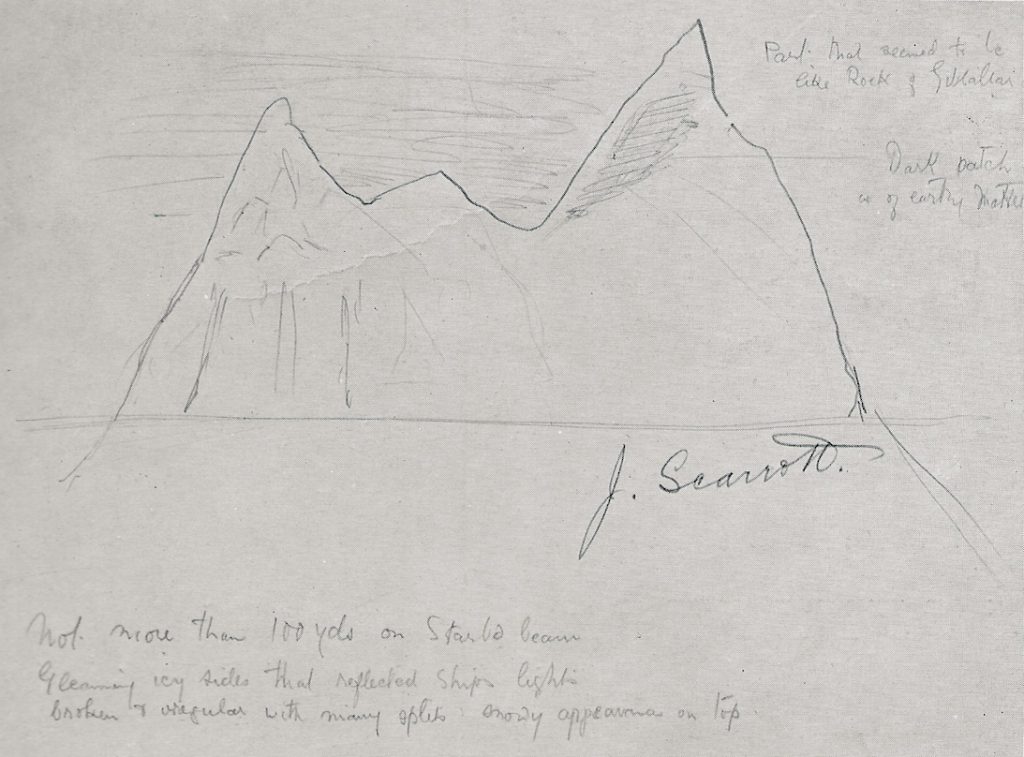
 

Above: Able Bodied Seaman Joseph Scarrott’s sketch of the iceberg which fatally wounded Titanic.  (The Sphere, May 1912/Author’s collection)


Several years ago, a friend of mine who is a native German speaker noticed the term ‘niet schuldig’ on an item of clothing I was wearing.  They asked me about it, because the German translation could have been taken as a reference to guilty rivets. (It would have been very badly written, lacking a capital ‘N’, using a singular rather than a plural, and using the male version: a better construct would use the female form and be ‘Nieten sind schuld.’)  In fact, the language was Dutch and the term translated as ‘not guilty’.  A key part of the confusion was that the word ‘schuldig’ is common to both languages and had the same meaning, whereas ‘niet’ was also common to both languages and had a different meaning!

Understanding the language something is written in is simply a starting point.  Even in modern American English and British English, misunderstandings can arise through different use of words.  An American’s definition of ‘fanny’ is very different to a British person’s!  It is also true that the meaning of some words or expressions may change over time or stay the same.

An example of this comes in relation to Titanic comes from the late American writer, David G. Brown, in the early 2000s.  He rightly argued about the importance of understanding changes in language over the years and highlighted that the meaning of words can change over time.  The problem was that he laid a wholly inaccurate argument on top of that.

David argued that the use of the word ‘struck’ or ‘strike’ in 1912 was used solely by mariners to describe a vessel striking something on its bottom.  His argument came from a definition in a dictionary published many decades afterwords. He used it to support his contention that Titanic‘s interaction with the iceberg was primarily a grounding event, arguing that if a survivor had used either word then they were deliberately indicating that they thought the ship had grounded on a portion of the iceberg .

It is important to be clear that this post is not an analysis or discussion of the grounding theory, which deserves serious discussion.  Instead, it is an analysis of a very specific claim. David’s argument that these terms were used exclusively to describe a ship touching bottom (i.e. grounding on an underwater portion of an iceberg) is demonstrably false.

There are numerous contemporaneous examples of sailors in both the merchant and royal navies using ‘struck’ or ‘strike’ to describe a contact with the ship’s side, either from two moving ships colliding, a ship being torpedoed, or a ship making contact with a mine.

These include the Olympic-Hawke collision in September 1911.  Hawke struck the White Star liner aft on the starboard side:

HMS Hawke log extract:

‘12.45. Helm jammed[,] full speed astern[.]

Struck SS Olympic on starboard quarter. Collision stations.’

And the accompanying entry in Olympic’s log:

‘12.46: Struck on starboard quarter by His Majesty’s Ship.’

Immediately before the collision, Pilot Bowyer had asked Captain Smith if Hawke was going to ‘strike’ Olympic.

Captain Smith later noted that the naval vessel: ‘turned very quickly, and struck us on the quarter – apparently to me, a right-angle blow almost.’

Chief Officer Wilde, First Officer Murdoch, Fourth Officer Alexander and Sixth Officer Holehouse all used the word ‘struck’ with reference to the collision and Fifth Officer Tulloch used ‘strike’.

A number of Hawke‘s crew also described the collision and used the same terminology.

Three years after the collision, Hawke was torpedoed.  A gunner reported ‘We were struck a little abaft the starboard beam by a torpedo’.

As another of many examples, in 1917 the White Star liner Laurentic’s acting captain concluded ‘that the ship struck two mines’.

Whether any individual Titanic survivor was correct or not in what they interpreted from their observations of the collision, it is factually incorrect to claim that the survivor’s use of either ‘struck’ or ‘strike’ meant that they were deliberately describing a grounding unless they specifically made this clear in their account.  (There was, for example, an account quoted in A Night to Remember where somebody in one of the boiler rooms thought the ship had gone aground off Newfoundland.)

David’s argument has undoubtedly seemed compelling to a number of people over the years and he certainly argued it passionately. However, the claims in that argument are demonstrably untrue.


Harland & Wolff Canteen Menus and Idle Workers

Harland & Wolff Canteen Menus and Idle Workers


This post is two short, edited extracts from my article ‘Thomas Andrews: In Court, In Rotterdam, In Belfast and Standing in: November 1911 to March 1912’ which was published in the Titanic Historical Society’s Titanic Commutator December 2024: Pages 18 to 28.  


CANTEEN MENUS AND IDLE WORKERS
On 6 February 1912, the Harland & Wolff managing directors meeting considered ‘the question of improving the Staff Dining Room menu’ which was ‘left to the Chairman and Mr. Andrews to deal with’. It is not clear specifically what needed to be improved with the existing menu options, but it was certainly something else adding to Andrews’ workload.

They also discussed the problem of workers ‘idling’ on Titanic:

Incidentally to the completion of No. 401 it was arranged that the managing directors should consider what was the best course to adopt to prevent the idling of the men on board this steamer, which has become very marked, and meet again on Friday, the 9th instant, at 12 o’clock to further discuss the matter…

STANDING IN FOR LORD PIRRIE
Lord Pirrie was not in the best of health in the early months of 1912. It fell to Thomas Andrews to stand in for him on at least one occasion. Late in March 1912, the Belfast Steamship Company’s Patriotic left on her sea trials. She proved herself ‘a handsome, commodious and seaworthy’ vessel, reaching eighteen knots on the ‘measured mile’. Lunch was served onboard afterwards.

Andrews rose to speak for Harland & Wolff. He said he was ‘very sorry that Lord Pirrie could not be present, as otherwise the duty with which he was entrusted would have been in much abler hands’. Harland & Wolff’s prosperity ‘was never greater’ and they were expanding elsewhere, but he was sure their headquarters would always be in Belfast. The workforce had reached over fifteen thousand men and he said that the total wages bill had just set another record:

A good deal of that had been involved in the completion of the two first class passenger ships – the Patriotic and the Titanic [laugher]. It was a heavy task for the firm to complete the two ships in one week.

He looked forward to the successful completion of Titanic’s own sea trials, scheduled for 1 April 1912…


Article from the Archives: Britannic: A Glimpse from John Riddell’s Album


This post is from an article which was published originally on the Titanic Research & Modelling Association (TRMA) website in February 2008 by Mark Chirnside and Michail Michailakis.  This was the first time that John Riddell’s many Britannic photos were made publicly available. Readers interested in Britannic can learn more about her history in Olympic Titanic Britannic: An Illustrated History of the ‘Olympic’ Class Ships , which includes Riddell’s images. Michail’s website is the leading online Britannic resource.


Britannic’s life was all too short. Consequently, researchers have access to far fewer photographs than they would like. As an added difficulty, during wartime the issue of security was very much at the forefront of the British authorities’ concerns. Nurses and Royal Army Medical Corps (RAMC) personnel were warned that the use of cameras was forbidden at the docks and it was technically illegal to photograph His Majesty’s vessels after 1914. Nevertheless, private photographs have survived and occasionally another photograph is discovered which adds to our knowledge of the ship.


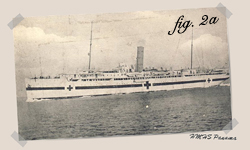
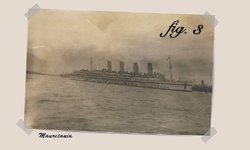
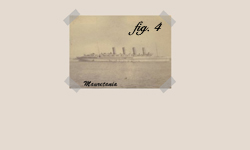
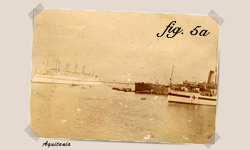
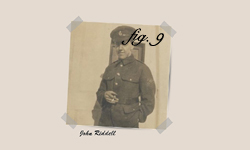
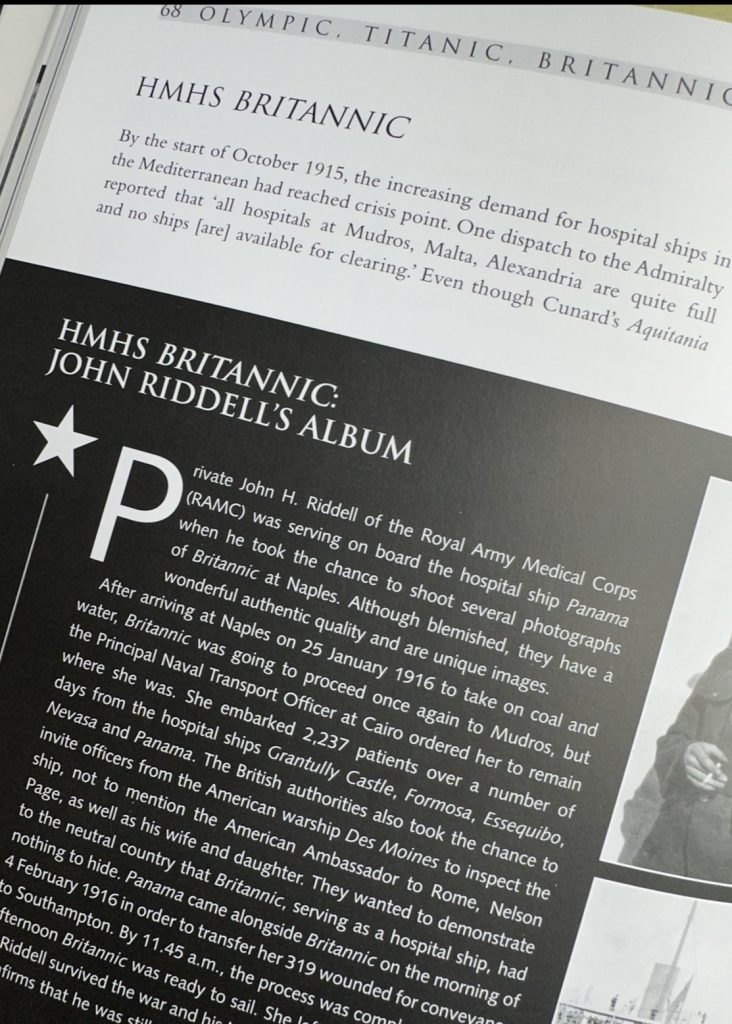
Private John Riddell, of the RAMC, served onboard HMHS Panama during the war.  He kept a photograph album which has survived to this day. The album has been identified by his own RAMC card, and a National Identity card issued during World War II which survived with the album. In early January 2008, the album was purchased by the present authors: Michail Michailakis and Mark Chirnside. It is a true gem, as it contains several rare Britannic photographs. We feel that these remarkable photographs – including four unique and apparently hitherto-unpublished images of Britannic – deserve a wider audience. Intriguingly, additional photographs of Mauretania and Aquitania have survived in the album, although – rather disappointingly for the Britannic researcher – two photographs that are captioned as ‘HMHS Britannic’ actually depict the smaller Mauretania!


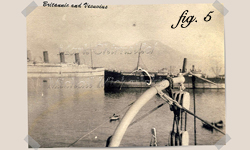
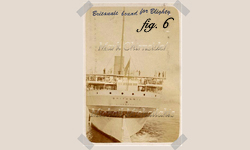
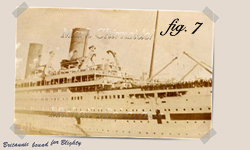
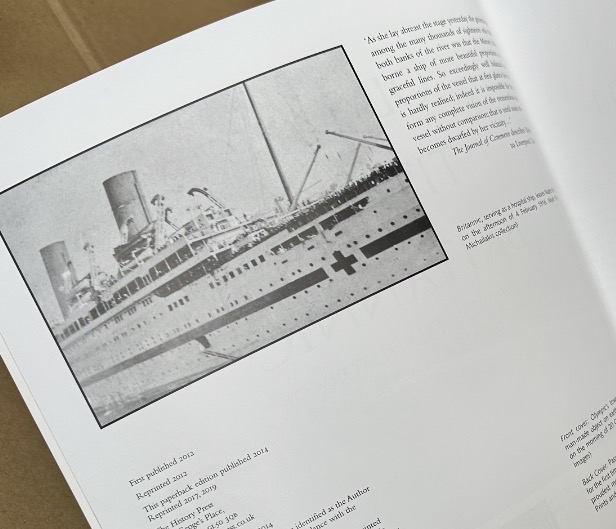
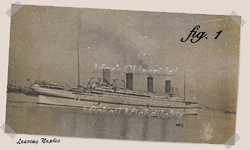
We know that four of them were taken when Britannic was preparing to leave, and then leaving, Naples (see Figures 1, 5, 6 and 7). Riddell captioned them specifically and there is nothing in the photographs to suggest that Riddell’s captions were mistaken. It is possible to identify when they were taken, right down to the hour, by examining several aspects of the historical record:


1: Draft


Although part of the stern is missing from the photograph (Figure 6), it is possible to estimate the ship’s draft using this photograph in combination with other images. We can then compare this estimate to the known draft each time Britannic left Naples, and this helps to narrow down the possibilities:


Draft of water aft at the time of proceeding to sea, on each Naples departure:

29 December 1915: 36 feet 1 inch.
4 February 1916: 34 feet 8 inches.
27 March 1916: 36 feet 6 inches.
1 October 1916: 36 feet 3 inches.
26 October 1916: 36 feet 8 inches.
19 November 1916: 36 feet 5 inches.


If the differences were merely a matter of inches, then this data would not be very helpful, but fortunately it is more than a foot. Britannic does not appear to be drawing any more than 35 feet, and so this narrows the date down to her 4 February 1916 departure.


2: Britannic at Naples


Britannic arrived at Naples for the second time in her career on 25 January 1916. She took on coal and water, before embarking patients from several smaller hospital ships between 27 January 1916 and 4 February 1916. She left at 3.15 p.m. on 4 February 1916, to return to Southampton.


3. Panama at Naples


His Majesty’s Hospital Ship Panama transferred 319 wounded to Britannic, between 9.45 a.m. and 11.45 a.m. on 4 February 1916. Riddell appears to have photographed Britannic when he was serving onboard Panama and, given that Panama had only arrived that morning, then it is likely the Britannic photographs were taken as she was leaving Naples at 3.15 p.m.


4. Aquitania at Naples


Two similar single-funnel vessels appear – one in a photograph of Aquitania (Figure 5a), and then another one in another photograph (Figure 5). However, the historical record shows that the Cunarder was at Naples around the same time as Britannic. It is known that Aquitania arrived at Naples on 7 February 1916. (She departed at 7.20 a.m. on 11 February 1916 and arrived at Southampton five days later.)


This information demonstrates that the photographs of Britannic were taken as she was departing on the afternoon of 4 February 1916, nine and a half months before she sank on 21 November 1916.


Above: Readers interested in Britannic can learn more about her history in Olympic Titanic Britannic: An Illustrated History of the ‘Olympic’ Class Ships .


A Captain’s Responsibilities

A Captain’s Responsibilities: In Charge of a Floating Town


A ship’s captain such as Captain Edward John (‘E.J.’) Smith was responsible for what was, ultimately, a floating town. Plenty of things could happen on a single voyage.  One of many unusual incidents occurred about two years before the Titanic disaster.  Early in 1910, the White Star liner Adriatic was leaving her New York pier when one of the ship’s stewards heard a revolver shot. One of the second class staterooms was found to be locked from the inside.  The ship’s crew forced it open to find a passenger ‘lying on the deck with a bullet wound in the right temple’. Captain Smith wrote in the log:

The revolver was found lying close to the man’s right hand. The ship’s surgeon was called and pronounced life extinct.

Edward Ettridge, who had adopted the stage name ‘Ed Beppo’ for his English music hall performances, had shot himself in Alfred Burgess’ stateroom. He was, briefly and understandably, mistaken for Burgess. One of the ship’s officers had to call for a tug to take the body off the ship. Smith signed the entry in the ship’s log that Ettridge had died of a ‘bullet wound in right temple’, countersigned by Purser McElroy and Chief Surgeon William O’Loughlin. (The story is covered in ‘The “Big Four” of the White Star Fleet: Celtic, Cedric, Baltic & Adriatic’.)

On the same round voyage, which took Adriatic from Southampton to New York and back again, there were a number of crew who either deserted, ‘failed to join’ or ‘left by consent’ at Southampton. After the westbound crossing, Sixth Engineer Arthur Ward had to remain in New York due to ‘suspected appendicitis’. Then there was the case of a trimmer who had to be ‘fined five shillings for disobedience to lawful commands’. He admitted ‘refusing to obey orders, on the plea that the duty took him to the engine room, and that he signed articles to work in the stokehold only’. Another trimmer was reported ‘off duty owing to an injury to his right great toe, caused by a piece of coal falling on the foot’. And they had to take on additional victualling staff to make up for an unexpected number of extra passengers.

Two years later, Captain Smith, Purser McElroy and Chief Surgeon William O’Loughlin all perished in the Titanic disaster.

Above: Captain Edward John Smith (1850-1912).  (L’Illustration, April 1912/Author’s collection)


Captain Smith’s Titanic Quote

Captain Smith’s Titanic Quote

Captain Smith’s Titanic Quote

Titanic was headline news for weeks following the disaster.  On 16 April 1912, the New York Times included an article about Captain Smith and his career in their coverage.  Within that article were extracts from comments Smith had reportedly made on the conclusion of Adriatic‘s successful maiden voyage almost five years earlier, to the press in New York.  It is easy to see why a newspaper reporter would want to quote Smith’s comments.  He had spoken about his ‘uneventful’ career and the love of the ocean that he had had since childhood. Then, he went on to talk about the safety of modern passenger liners. Those comments had a sad irony given the recent disaster.  One common quotation, used by historians in the decades to come, was:

I will say that I cannot imagine any condition which could cause a ship to founder.  I cannot conceive of any vital disaster happening to this vessel.  Modern shipbuilding has gone beyond that.

Back in 2008, I began to worry that I had not been able to find Smith’s comments in newspaper coverage from that summer of 1907.  I found it somewhat uncomfortable that our source seemed to be only a post-disaster publication.  However, thanks to the effort of a number of researchers including the late Mark Baber, Smith biographer Gary Cooper, and Dr. Paul Lee, sources for the quotation were found from pre-disaster publications.  These included press reports dating from later in 1907 through to a report in The World’s Work in April 1909 (shown in an extract from a slide in my presentation to the British Titanic Society in April 2024, below).


By comparison, the New York Times’  report published on 16 April 1912 had some interesting differences in emphasis.  For example, rather than saying ‘modern shipbuilding has gone beyond that’, the pre-disaster quote was ‘modern shipbuilding has reduced that danger to a minimum’. The New York Times also summarised Smith’s preceding comments, paraphrasing him: ‘Captain Smith maintained that shipbuilding was such a perfect art nowadays that absolute disaster, involving the passengers on a great modern liner, was quite unthinkable. Whatever happened, he contended, there would be time before the vessel sank to save the lives of every person on board’.  The paraphrased summary was broadly accurate, but it omitted the comment ‘I will not assert that she is unsinkable’ [emphasized above].

All of Smith’s reported comments are important and they need to be understood in their full context.   It’s also important to recognise that even the pre-disaster quotations are from a secondary source and rely on a degree of assumption that what Smith said was reported with reasonable accuracy!


Thomas Andrews’ Rules of Duty

Thomas Andrews’ Rules of Duty

A review of Shan Bullock’s biography of Thomas Andrews, which was published in the Belfast Evening Telegraph later in 1912, included ‘The rules of duty which Mr. Andrews applied to everyday life’. They were taken from advice he gave to a man who was starting work as an engineer in 1905.  Andrews’ advice was sound and applies to other occupations as well.  He wrote:

As an old hand, who has come through the mill myself, I would just like to say how important it is for you to give your employers full confidence from you at the start. This can best be gained:


1. By punctuality and close attention to your work at all times, but don’t allow your health to suffer through overwork.
2. Always carry out instructions given by those above you, whether you agree with them or not, and try to get instructions in writing if you are not sure of your man.
3. Always treat those above you with respect, no matter whether they are fools or know less than yourself.
4. Never give information unless you are perfectly sure; better to say you are not sure but will look the matter up.
5. Never be anxious to show how quick you are by being the first out of the shop when the horn blows. It is better on these occasions to be a bit slow.


Titanic & Social Media Misinformation

Titanic & Social Media Misinformation

Titanic & Social Media Misinformation

There is a huge volume of Titanic information online but the quality of that information can be very poor.

Titanic is one of the subjects that drives ‘hits’ and engagement on social media.  The speed at which information can be shared to thousands of people is remarkable.  In many ways, that is a positive.  However, in others there is a very negative impact.  One problem is where inaccurate information is shared using graphics or memes, which are so often seen by people who take them as a true representation of the facts.  An example of this is a series of claims about Thomas Andrews which have been circulating:


Above: A photo of Thomas Andrews, accompanied by various inaccurate claims, circulated on Facebook in February 2023. (Author’s collection)

There are a lot of problems with the factual accuracy of these various claims.

Starting with the positive, he was one of the wider design team at Harland & Wolff who were responsible for Olympic and Titanic. He was also onboard for the fateful maiden voyage.  We also know from witness accounts that Andrews put a lot of effort into helping to save lives during the evacuation.

However, there are numerous claims which are not supported by evidence:

  1. The text speaks about ‘his original design’. The earliest designs for these ships, including details of the structural elements, were prepared while Alexander Carlisle was in charge of the design department and were, ultimately, the result of a team effort.  At that time, Thomas Andrews was in a more junior role at Harland & Wolff, taking on duties from Alexander Carlisle after he retired at the end of June 1910.  It is therefore incorrect to attribute the ‘original design’ to Andrews.
  2. The claim that ‘a double hull’ was included is incorrect. The earliest midsection plan we have – a ‘cutaway’ drawing which essentially looks through the ship and shows all the key structural elements of the hull and the general design – dates from June 1908.  It includes a double bottom only, which was of very strong cellular construction, and is exactly how the ship was built. The purpose was to provide protection in the event she grounded.  It was not Harland & Wolff’s practice to build ships with ‘double hulls’.
  3. The claim that ‘more watertight compartments’ were included is incorrect.  Comparing the ‘Design “D”‘ concept, which was approved by the White Star Line’s directors in July 1908, with the completed ship, the number of watertight compartments was increased in the finished product.
  4. The claim that ‘twice as many lifeboats’ were included is incorrect.  The ‘Design “D”‘ concept showed sixteen lifeboats (14 standard lifeboats and two emergency cutters), which was later increased to a total of twenty by the addition of four collapsible (or semi collapsible) boats. During the design process, Alexander Carlisle recommended the use of a new Welin davit design in an effort to make sure the ships could easily be adapted to any change in lifeboat regulations.  (At this time, there was anticipation that the Board of Trade would mandate a significant increase in the number of lifeboats carried by passenger liners.)  J. Bruce Ismay approved Carlisle’s recommendation in January 1910. The benefit of the new Welin davit design was that a second row of lifeboats could be carried inboard, which provided the option to increase easily the number of lifeboats onboard. As part of the approvals process for using a new davit design, which had to be approved by the regulator, detailed blueprints of the davits were prepared and submitted to the Board of Trade.  A blueprint was also prepared by the Welin company, showing how the boat deck would look with these davits installed and two rows of lifeboats carried on either side of the ship.  Carlisle retired at the end of June 1910 and he testified that a decision about the number of lifeboats to be carried had not been taken at that time.  By May 1911, no change in regulations had materialised and Harland & Wolff and White Star added the four collapsible boats so that they exceeded the statutory requirements. According to his own testimony, Alexander Carlisle never explicitly advocated for more lifeboats to be carried and there is no evidence that Thomas Andrews did either. Edward Wilding testified that Harland & Wolff’s collective view was that the number of lifeboats these ships carried was sufficient and in excess of the regulations. The full story is included in detail in my September 2021 presentation at PRONI

Unfortunately, many people see claims made on social media and treat them as credible, without being aware of the inaccuracies.  In an age when we have access to such a huge volume of data and digital information, it is imperative to take a sceptical approach and to try and fact-check as far as possible.  There is a huge volume of Titanic information online but the quality of that information can be very poor.


Thomas Andrews’ Bonus

Thomas Andrews’ Bonus

Almost two months after his thirtieth birthday, Thomas Andrews received a letter from Messrs. Ismay, Imrie & Co. – the management company of the Oceanic Steam Navigation Co. Ltd (White Star Line).  They felt that all the work he had been doing at Harland & Wolff, which directly or indirectly supported the White Star Line, warranted a tangible acknowledgement.  The letter was sent 122 years ago today and, sadly, a mere nine years before Andrews lost his life in the Titanic disaster.   (Public Record Office Northern Ireland/PRONI)

Steamship Department
Liverpool
April 1st 1903

T. Andrews Esq.
Messrs. Harland & Wolff
Belfast


Dear Sir,

At the last annual meeting of the Oceanic Steam Navigation Co. Ltd. the shareholders voted a sum of money to be distributed at our discretion in recognition of services rendered to the company, and having in mind the valuable work which you have performed in a variety of ways on behalf of the White Star Line, we feel that it would be pleasing to all concerned that the opportunity should be availed of to mark our appreciation of same. We therefore enclose a cheque value £200, which we will be glad if you will accept with our best wishes for your future success.


Yours faithfully,

Ismay, Imrie & Co.


Liverpool Seamen’s Pension Fund

The Ismay Family: Pension Funds for Seamen, Widows and Widows ‘of those whose lives are lost while they are engaged upon active duty’

The driving force and founder of the modern White Star Line (Oceanic Steam Navigation Company), Thomas Henry Ismay, oversaw the growth of a company which made a significant economic contribution to Britain (and Liverpool, in particular). However, the Ismay family also arranged for significant social provision for retired seafarers, their widows, and the widows of those lost at sea. 

Thomas Henry Ismay, J. Bruce Ismay’s father, founded the Liverpool Seamen’s Pension Fund in 1887 to provide pensions ‘for deserving seamen of whatever rank sailing from the port of Liverpool, who are past work’.  It was intended to provide pensions of £20 a year. (Later, the Margaret Ismay Widows Fund was established to provide for their widows as well.)  The Mercantile Marine Service Association administered the fund as the trustees and by c. 1912 it had grown to about £69,000 (£52,000 of which came from contributions either by the Ismay family or the White Star Line). (Its assets were amalgamated into the Nautilus Welfare Fund in 2009.)

By that time, the number of pensioners receiving pension payments was 126.  They ranged from 54 to 94 years old and included 38 former commanders, 48 ship’s officers and 40 seamen.  During the quarter of a century since the fund had been established, 423 pensioners had received pension payments from the fund, equating to a total of £37,876.  (The number of widows receiving a pension from the newer Margaret Ismay Widows Fund was 74.)

Following the Titanic disaster, J. Bruce Ismay returned to the United Kingdom.  He arrived in Liverpool onboard the White Star liner Adriatic on Saturday 11 May 1912.  He lost no time in writing to the Lord Mayor of Liverpool later the very same day, proposing a new fund providing ‘for widows of those whose lives are lost while they are engaged upon active duty…upon the mercantile vessels of this country’.  The ‘terrible disaster to the Titanic’ highlighted the ‘necessity of such a fund’ and he proposed to contribute £10,000 with a further £1,000 from his wife.  It would ‘continue for all time’.  News of Ismay’s letter apparently reached the press and the Earl of Derby, Lord Mayor of Liverpool sent a telegram to Ismay asking if he could publish it ‘saying I have gratefully accepted your offer?’  Ismay responded: ‘Please act in whatever manner you think best, leave myself entirely in your hands’.

See Chirnside, Mark.  The ‘Olympic’ Class Ships: Olympic Titanic & Britannic. History Press; revised and expanded edition 2011.


Above: Thomas Henry Ismay (1837-99). (The Marine Engineer, 1899/Author’s collection)