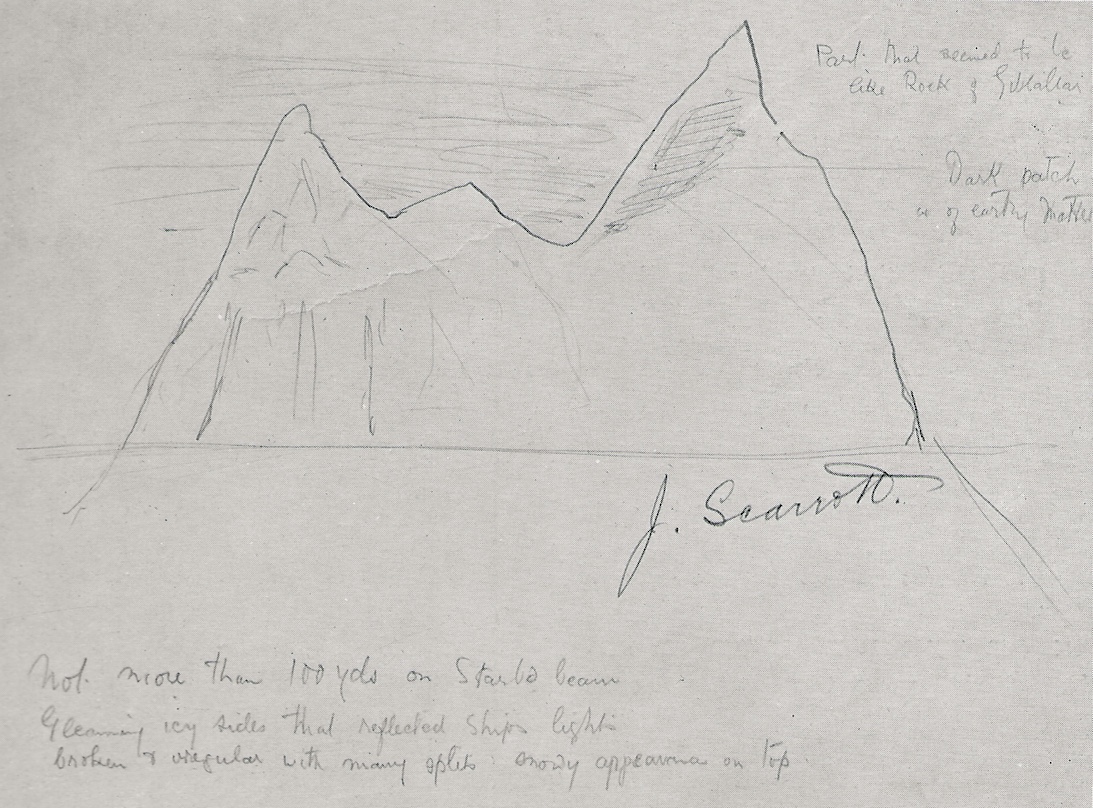
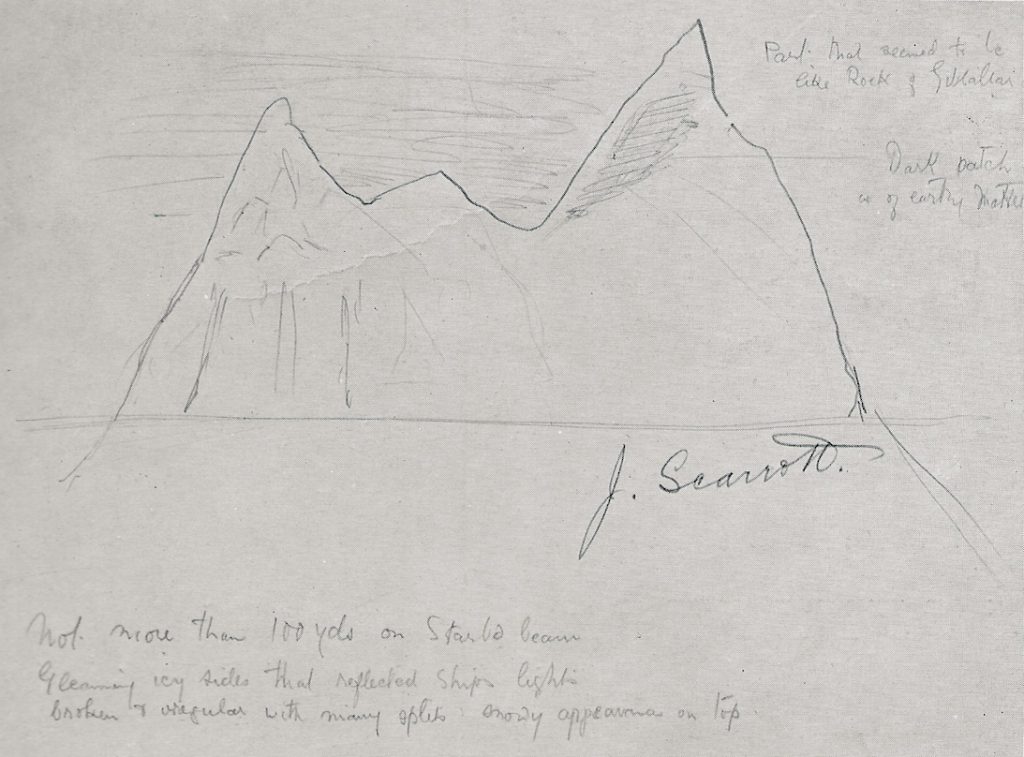
Above: Able Bodied Seaman Joseph Scarrott’s sketch of the iceberg which fatally wounded Titanic. (The Sphere, May 1912/Author’s collection)
Several years ago, a friend of mine who is a native German speaker noticed the term ‘niet schuldig’ on an item of clothing I was wearing. They asked me about it, because the German translation could have been taken as a reference to guilty rivets. (It would have been very badly written, lacking a capital ‘N’, using a singular rather than a plural, and using the male version: a better construct would use the female form and be ‘Nieten sind schuld.’) In fact, the language was Dutch and the term translated as ‘not guilty’. A key part of the confusion was that the word ‘schuldig’ is common to both languages and had the same meaning, whereas ‘niet’ was also common to both languages and had a different meaning!
Understanding the language something is written in is simply a starting point. Even in modern American English and British English, misunderstandings can arise through different use of words. An American’s definition of ‘fanny’ is very different to a British person’s! It is also true that the meaning of some words or expressions may change over time or stay the same.
An example of this comes in relation to Titanic comes from the late American writer, David G. Brown, in the early 2000s. He rightly argued about the importance of understanding changes in language over the years and highlighted that the meaning of words can change over time. The problem was that he laid a wholly inaccurate argument on top of that.
David argued that the use of the word ‘struck’ or ‘strike’ in 1912 was used solely by mariners to describe a vessel striking something on its bottom. His argument came from a definition in a dictionary published many decades afterwords. He used it to support his contention that Titanic‘s interaction with the iceberg was primarily a grounding event, arguing that if a survivor had used either word then they were deliberately indicating that they thought the ship had grounded on a portion of the iceberg .
It is important to be clear that this post is not an analysis or discussion of the grounding theory, which deserves serious discussion. Instead, it is an analysis of a very specific claim. David’s argument that these terms were used exclusively to describe a ship touching bottom (i.e. grounding on an underwater portion of an iceberg) is demonstrably false.
There are numerous contemporaneous examples of sailors in both the merchant and royal navies using ‘struck’ or ‘strike’ to describe a contact with the ship’s side, either from two moving ships colliding, a ship being torpedoed, or a ship making contact with a mine.
These include the Olympic-Hawke collision in September 1911. Hawke struck the White Star liner aft on the starboard side:
HMS Hawke log extract:
‘12.45. Helm jammed[,] full speed astern[.]
Struck SS Olympic on starboard quarter. Collision stations.’
And the accompanying entry in Olympic’s log:
‘12.46: Struck on starboard quarter by His Majesty’s Ship.’
Immediately before the collision, Pilot Bowyer had asked Captain Smith if Hawke was going to ‘strike’ Olympic.
Captain Smith later noted that the naval vessel: ‘turned very quickly, and struck us on the quarter – apparently to me, a right-angle blow almost.’
Chief Officer Wilde, First Officer Murdoch, Fourth Officer Alexander and Sixth Officer Holehouse all used the word ‘struck’ with reference to the collision and Fifth Officer Tulloch used ‘strike’.
A number of Hawke‘s crew also described the collision and used the same terminology.
Three years after the collision, Hawke was torpedoed. A gunner reported ‘We were struck a little abaft the starboard beam by a torpedo’.
As another of many examples, in 1917 the White Star liner Laurentic’s acting captain concluded ‘that the ship struck two mines’.
Whether any individual Titanic survivor was correct or not in what they interpreted from their observations of the collision, it is factually incorrect to claim that the survivor’s use of either ‘struck’ or ‘strike’ meant that they were deliberately describing a grounding unless they specifically made this clear in their account. (There was, for example, an account quoted in A Night to Remember where somebody in one of the boiler rooms thought the ship had gone aground off Newfoundland.)
David’s argument has undoubtedly seemed compelling to a number of people over the years and he certainly argued it passionately. However, the claims in that argument are demonstrably untrue.