Counterfactual: Sinking the Mauretania

Counterfactual: Sinking the Mauretania


Cunard’s Mauretania left Queenstown for New York on 14 April 1912, three days behind Titanic.  For the sake of a counterfactual, this post imagines a scenario where the Cunarder struck an iceberg and sank instead.

Edward Wilding and Leonard Peskett produced a joint memo for the British Wreck Commissioner’s court to try and answer the hypothetical question about whether Mauretania would have remained afloat if she had sustained similar damage to Titanic:

We have considered by approximate methods the flooding of the Mauretania in the event of an accident similar to that met with by the Titanic. We have assumed the watertight doors and hatches to be closed and similar deductions to those made in the calculations for the Titanic. From the calculations made, taking the vessel as damaged from the stem to the afterend of the forward boiler room (corresponding nearly – but not quite – to the length from the stem to the afterend of the No. 5 boiler room in the Titanic) the vessel would remain afloat with a considerable list, say 15 deg. to 20 deg., which, no doubt, could be slowly reduced by carefully flooding some after spaces on the opposite side. With the data available we do not think we can satisfactorily discuss flooding corresponding to the damage extending into No. 4 boiler room in the Titanic.

Their memo considered a specific scenario and it is not clear Mauretania could have remained afloat.  Wilding explained: ‘in order that the water should not rise above the top of the bulkhead, we had to assume the bunkers flooded on the other side. [author’s emphasis]  It would be quite a practicable operation by raising the watertight doors, but they would have to be opened so that the water could get through to the port bunkers’.  The longitudinal watertight bulkhead in the foremost boiler room would contain flooding, but at the cost of causing a considerable list to the starboard side.  Peskett  testified that he had no knowledge of any successful counter-flooding being carried out.  Wilding thought it ‘a dangerous thing to do, to try and remedy such a defect by letting water into a much larger compartment than you already have it in’.  He also thought that, with such a serious list, ‘water might find some other way in’ apart from the initial damage (such as through open portholes).  Their analysis also excluded potential damage equivalent to what Titanic may have incurred in the way of her boiler room 4.

There does seem a narrow possibility that Mauretania could potentially have survived, but this counterfactual will assume that efforts to correct the serious list to starboard would have been unsuccessful.  That would mean water would have risen above the watertight bulkhead.  The Cunarder would therefore have foundered, sinking by the bow and with a serious starboard list.

Turbine driven ships such as the Cunarders needed to have both separate ahead and astern turbines.  The reason for this was that the ahead turbines could not be reversed. One concern, expressed in a memo to Cunard management dated 7 February 1911, was that they only had astern turbines on two of the four propeller shafts. This caused a delay in stopping the ship:

When going full speed ahead and the order is given to go astern, the rotors on the centre shafts are going astern quite a time before the ahead rotors on the wing shafts have stopped going ahead.  This will retard the progress astern and of course there will be a little drag from the wing propellers after they have stopped going ahead.

Cunard opted prior to April 1912 to include astern turbines on all of their new Aquitania‘s propeller shafts, recognising that this was a better configuration.  Might they have faced criticism for Mauretania‘s manoeuvring abilities?  The combination propelling machinery arrangement on Olympic and Titanic meant that the port and starboard (reciprocating) engines could be stopped and reversed, even though the turbine driven centre propeller only operated ahead.  Titanic‘s stopping distance on sea trials was also far less than Lusitania‘s. 

Mauretania was equipped with a total of sixteen lifeboats under the older style radial davits, also providing a capacity far short of the maximum number of passengers and crew she could carry.  Their absolute and relative capacity was somewhat less than Titanic‘s.  As Leonard Peskett recalled in May 1912:

When the question of boat capacity of such ships as the Mauretania and Lusitania was brought forward, the special subdivision of those particular vessels was taken into account, and it was considered that owing to the extraordinary precautions which had been taken, the total capacity of boats necessary to be carried would be fully met by the existing Rules’

Might Cunard have faced criticism that Mauretania‘s lifeboat capacity was slightly less than Titanic‘s? Or that her davits were not as advanced as the new Welin design used on Olympic and Titanic?

If Mauretania was listing significantly, it might have meant that the lifeboats on one side of the ship would have been unavailable for use.  Peskett acknowledged this problem in relation to Aquitania, in September 1911:

it would…be more easy to control the passengers and get them away into boats from the gangway doors on E deck, than it have a rush of 4,000 people on to the boat deck, struggling to get into the boats, which would probably be available on one side only…

Titanic was remarkable for only taking a relatively small list to either side during the sinking process, but any significant list Mauretania took which led to many of the lifeboats being put out of use might have led to criticism of the longitudinal watertight bulkheads used in her design.  Peskett noted that the Lusitania and Mauretania model of transverse watertight bulkheads (running across the ship from one side to another) and longitudinal watertight bulkheads (running parallel to the ship’s side) was the only one of its kind in the British merchant service.
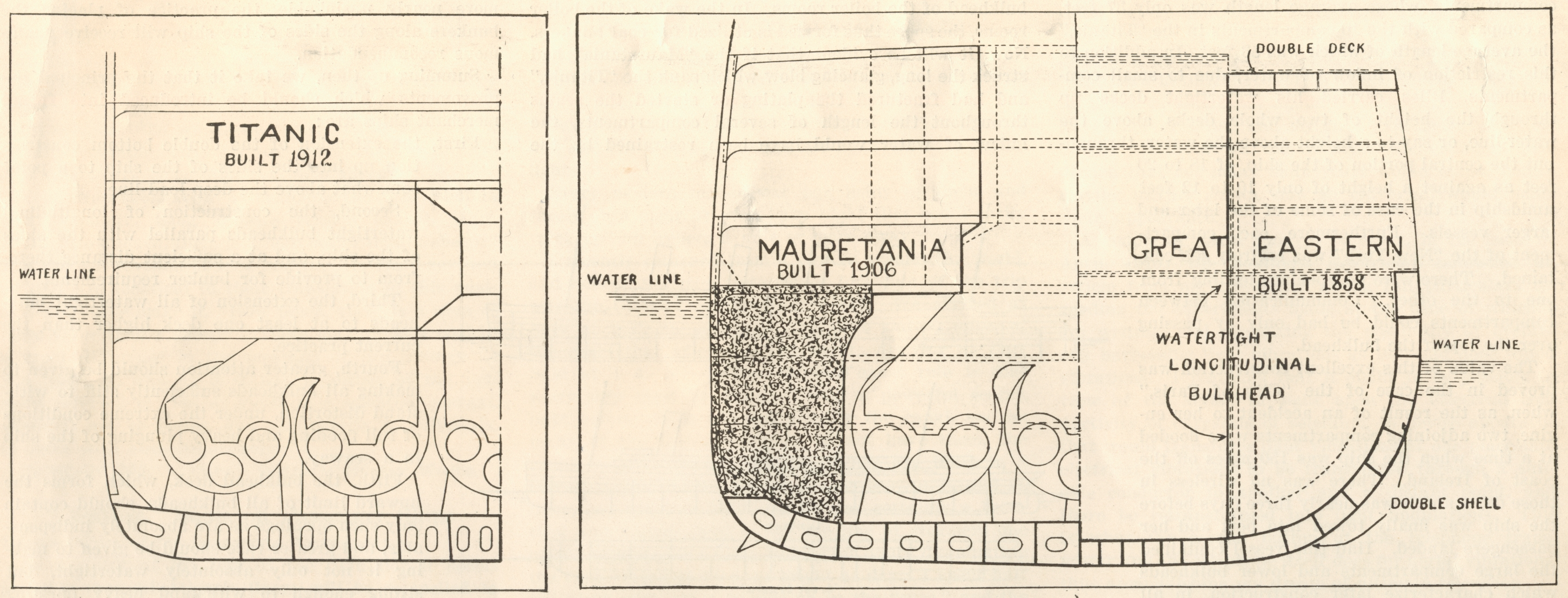
Above: Mauretania‘s configuration included coal bunkers along the ship’s side, separated from the boiler rooms by a longitudinal watertight bulkhead.  (Scientific American, 1912/Author’s collection)


In the summer of 1911, Cunard were working on designs for their new Aquitania.  The Board of Trade’s new rules concerning stairway escape from the lower passenger decks (primarily third class accommodation) concerned Peskett because they might ‘necessitate a rearrangement of the whole of the ship above E-deck’.  Cunard therefore pushed back on the grounds it would put their new ship at a competitive disadvantage:

It was pointed out…that to do so would prevent the ship becoming a commercial possibility, and that such an arrangement could not be considered by the Cunard company, as it would prevent them from competing with rivals, who with similar ships will not have to comply with such stringent regulations.  The Olympic and Titanic and the new German ships will not be called upon to carry out these rules.

…It was pointed out that the Cunard Co. did more in the way of making the ship practically unsinkable, than any other company in the world, and that in the matter of [watertight] subdivision, was far in excess of our Board of Trade rules, or [Lloyds] Registration Society’s requirements, and as an extraordinary precaution, the Cunard Company are anxious to fit W.T. bulkheads between E and D decks.  

Their viewpoint prior to April 1912 might have been taken as a complacency as to the safety of their express passenger ships.  Might Cunard have faced criticism for pushing back against a safety regulation on competitive grounds?  Might the company have been criticised for thinking their express ships were ‘practically unsinkable’?

Mauretania was expressly designed for speed and so her specifications had noted:

As the weight of all materials to be worked into the hull, fittings, and machinery is of vital importance, it is essential in getting out the designs of the various parts that the greatest care should be taken to avoid unnecessary weight, every part to be as light as possible, consistent with the necessary strength.

To keep overall weight down and help improve the ship’s stability, high-tensile steel was used in the upper hull structure rather than the usual mild steel.  This was an innovative feature enabling them to use less steel to obtain the same strength.

During Aquitania‘s design process, Cunard made clear that an essential criteria of any design proposal had to be a GM (metacentric height) which was not less than Lusitania and Mauretania.  This would ensure that she was not too tender.  (A positive GM was essential for a ship to return to upright: if the GM was too low then she would be too tender, with less stability; a GM which was higher would produce a more stable ship.)  Thomas Andrews noted in the summer of 1910 that Olympic and Titanic‘s stability:

would be so much greater than that of the Lusitania and Mauretania that lightness in the upper works was not a vital necessity with them as it had been in the case of these two ships’

Might Cunard have faced criticism that competitors such as Olympic and Titanic were superior in that regard, as Thomas Andrews had indicated?  Their own criteria for Aquitania indicated that they recognised Mauretania‘s stability as an issue. 

Another factor was that Mauretania‘s design used ordinary steel rivets to rivet high-tensile steel plating.  Part of the reason for using high-tensile steel was to help improve stability and reduce the weight of the upper hull structure. The shipbuilders believed that the use of hydraulic riveting and the use of rivets ‘at least equal to the requirements of Lloyd’s rules for mild steel plates of equivalent strength to the high tensile steel used’ mitigated this concern’.  It was a reasonable approach to take but there had been some comment about it back in 1907.  Might Cunard have faced criticism for ‘inferior’ rivets?

This discussion is a mere counterfactual. All of the potential criticisms that Cunard might have faced are speculative, but they are based on known facts.  They help to get us thinking about Titanic in the broader context.  It is easy to see how Mauretania might have been the subject of a disaster. She actually had a long and successful career, as did Olympic:  Titanic’s problem was striking the iceberg!

Much of this post is drawn from primary source documentation included in Olympic & Titanic: Triumph and Disaster, released this month.


Article from the Archives: Britannic: A Glimpse from John Riddell’s Album


This post is from an article which was published originally on the Titanic Research & Modelling Association (TRMA) website in February 2008 by Mark Chirnside and Michail Michailakis.  This was the first time that John Riddell’s many Britannic photos were made publicly available. Readers interested in Britannic can learn more about her history in Olympic Titanic Britannic: An Illustrated History of the ‘Olympic’ Class Ships , which includes Riddell’s images. Michail’s website is the leading online Britannic resource.


Britannic’s life was all too short. Consequently, researchers have access to far fewer photographs than they would like. As an added difficulty, during wartime the issue of security was very much at the forefront of the British authorities’ concerns. Nurses and Royal Army Medical Corps (RAMC) personnel were warned that the use of cameras was forbidden at the docks and it was technically illegal to photograph His Majesty’s vessels after 1914. Nevertheless, private photographs have survived and occasionally another photograph is discovered which adds to our knowledge of the ship.


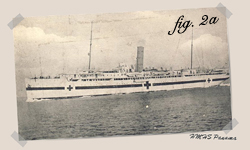
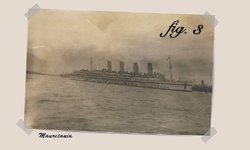
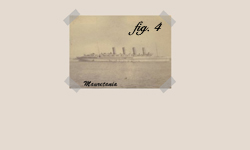
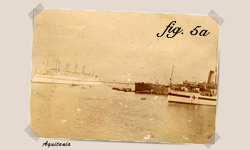
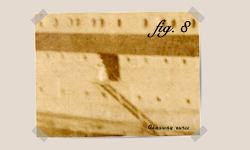
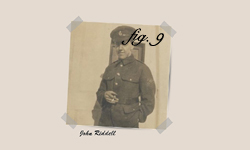
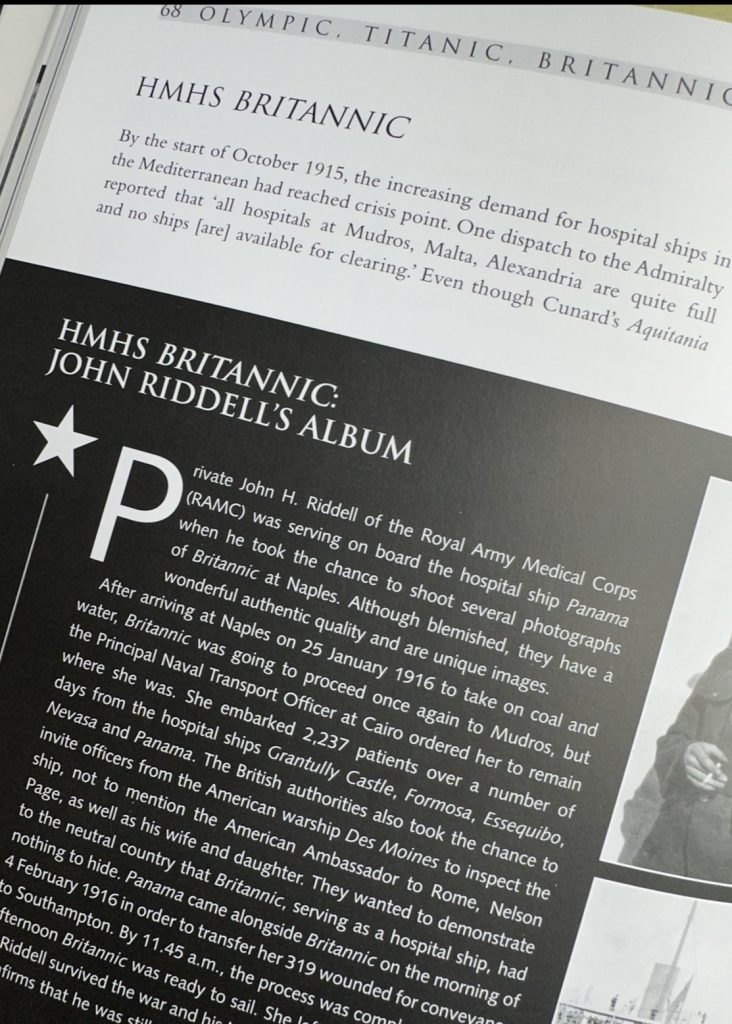
Private John Riddell, of the RAMC, served onboard HMHS Panama during the war.  He kept a photograph album which has survived to this day. The album has been identified by his own RAMC card, and a National Identity card issued during World War II which survived with the album. In early January 2008, the album was purchased by the present authors: Michail Michailakis and Mark Chirnside. It is a true gem, as it contains several rare Britannic photographs. We feel that these remarkable photographs – including four unique and apparently hitherto-unpublished images of Britannic – deserve a wider audience. Intriguingly, additional photographs of Mauretania and Aquitania have survived in the album, although – rather disappointingly for the Britannic researcher – two photographs that are captioned as ‘HMHS Britannic’ actually depict the smaller Mauretania!


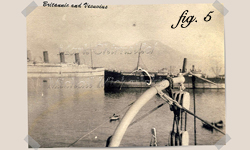
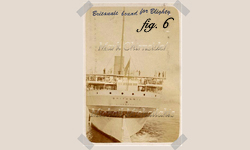
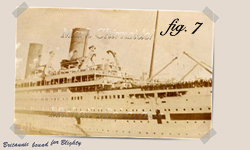
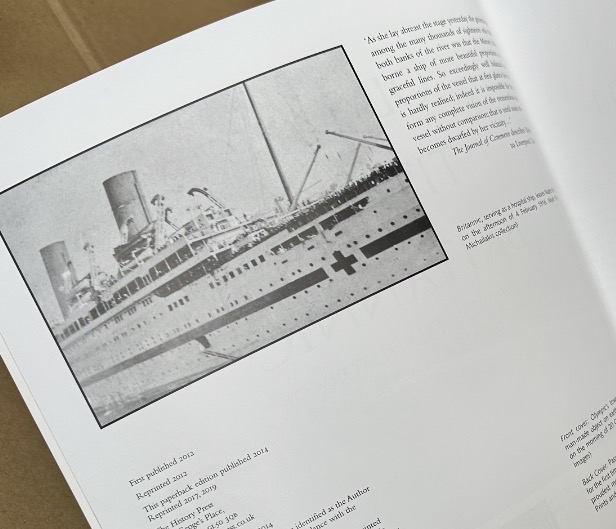
We know that four of them were taken when Britannic was preparing to leave, and then leaving, Naples (see Figures 1, 5, 6 and 7). Riddell captioned them specifically and there is nothing in the photographs to suggest that Riddell’s captions were mistaken. It is possible to identify when they were taken, right down to the hour, by examining several aspects of the historical record:


1: Draft


Although part of the stern is missing from the photograph (Figure 6), it is possible to estimate the ship’s draft using this photograph in combination with other images. We can then compare this estimate to the known draft each time Britannic left Naples, and this helps to narrow down the possibilities:


Draft of water aft at the time of proceeding to sea, on each Naples departure:

29 December 1915: 36 feet 1 inch.
4 February 1916: 34 feet 8 inches.
27 March 1916: 36 feet 6 inches.
1 October 1916: 36 feet 3 inches.
26 October 1916: 36 feet 8 inches.
19 November 1916: 36 feet 5 inches.


If the differences were merely a matter of inches, then this data would not be very helpful, but fortunately it is more than a foot. Britannic does not appear to be drawing any more than 35 feet, and so this narrows the date down to her 4 February 1916 departure.


2: Britannic at Naples


Britannic arrived at Naples for the second time in her career on 25 January 1916. She took on coal and water, before embarking patients from several smaller hospital ships between 27 January 1916 and 4 February 1916. She left at 3.15 p.m. on 4 February 1916, to return to Southampton.


3. Panama at Naples


His Majesty’s Hospital Ship Panama transferred 319 wounded to Britannic, between 9.45 a.m. and 11.45 a.m. on 4 February 1916. Riddell appears to have photographed Britannic when he was serving onboard Panama and, given that Panama had only arrived that morning, then it is likely the Britannic photographs were taken as she was leaving Naples at 3.15 p.m.


4. Aquitania at Naples


Two similar single-funnel vessels appear – one in a photograph of Aquitania (Figure 5a), and then another one in another photograph (Figure 5). However, the historical record shows that the Cunarder was at Naples around the same time as Britannic. It is known that Aquitania arrived at Naples on 7 February 1916. (She departed at 7.20 a.m. on 11 February 1916 and arrived at Southampton five days later.)


This information demonstrates that the photographs of Britannic were taken as she was departing on the afternoon of 4 February 1916, nine and a half months before she sank on 21 November 1916.


Above: Readers interested in Britannic can learn more about her history in Olympic Titanic Britannic: An Illustrated History of the ‘Olympic’ Class Ships .


FAQ: Aquitania’s First Class Grill Room

FAQ: Aquitania‘s First Class Grill Room


Was Aquitania’s First Class Grill Room An a la carte Restaurant?

No.

Contrary to popular belief, Aquitania did not have an a la carte restaurant. Cunard’s attitude towards an extra-tariff facility of this sort was different to HAPAG’s or the White Star Line.

When Olympic entered service in 1911, she proved very popular with first class passengers. Her a la carte restaurant was so popular that additional tables were soon ordered, and it was enlarged during the ship’s 1912-13 refit. It was also a revenue earner for the White Star Line because passengers who used the restaurant paid extra to enjoy its facilities. The benefit of the restaurant was that a first class passenger could choose to eat when they wanted, rather than being limited by the sitting times in the main first class dining saloon. They also had a wider choice of dishes, which was equal to the finest restaurants and hotels ashore. One observer thought that the restaurant’s décor made it one of the nicest public rooms on the ship.

However, Cunard’s naval architect, Leonard Peskett, felt that the restaurant created ‘a new class of passenger’ within first class – people who stood aloof from other first class diners. This attitude continued into the post-war years. When the German liner Imperator joined Cunard’s fleet and was renamed Berengaria, her a la carte restaurant was removed and instead the room served as a ballroom; after the Cunard White Star merger in 1934, the a la carte restaurants onboard both Olympic and Majestic were closed down before the year’s end. (The galley equipment from Majestic’s restaurant was removed early in 1935.)

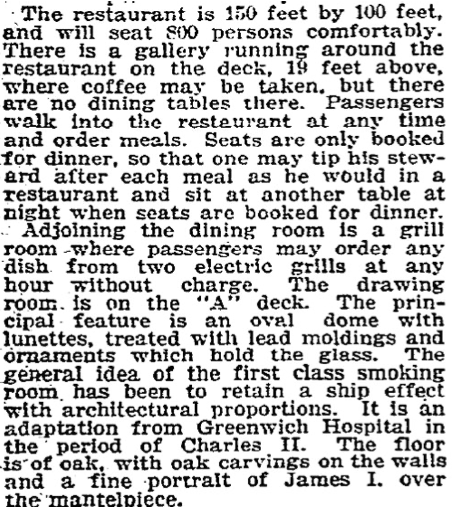
Aquitania’s arrangement was unique. The main first class dining saloon was designated as a ‘restaurant.’ However, an additional first class grill room was also provided aft of the dining saloon – on the port side.  This room is often mistaken for an a la carte restaurant. The New York Times reviewed Aquitania’s first class accommodation when she arrived in New York on her maiden voyage in 1914, writing:


When Aquitania made her maiden eastbound crossing in June 1914, some difficulties arose due to the large number of first class passengers.  One Cunard memo. noted:

Owing to the dining room now being called [a] restaurant, and it being advertised in New York that a la carte meals would be served, without charge, full advantage has been taken by the passengers. It has been one continuous meal, and I am afraid large numbers of crew will not sign on again.
…I would suggest that a notice be printed on the breakfast menu that no a la carte orders for luncheon can be taken after 10 o’clock, and on the luncheon menu that no a la carte dinner orders can be taken after 2 p.m. The menus are all of good variety, and to relieve the great pressure at luncheon, I put each day two dishes extra, marked as ‘special dishes’ and it met with a great success.

John Maxtone-Graham’s fine book, Crossing & Cruising, examines the grill room in detail.

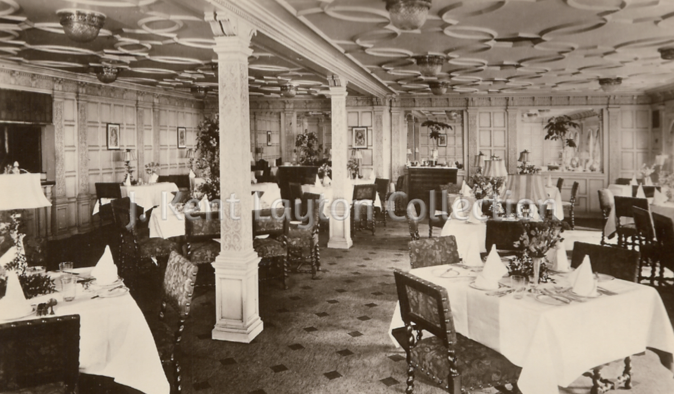
Above: Aquitania‘s first class grill room, pictured in the 1920s.  The decor had much in common with Olympic‘s first class dining saloon – so much so, that Cunard altered the original design slightly in July 1913, because they thought it looked too similar. (J. Kent Layton collection)


Why was Aquitania‘s First Class Grill Room removed?


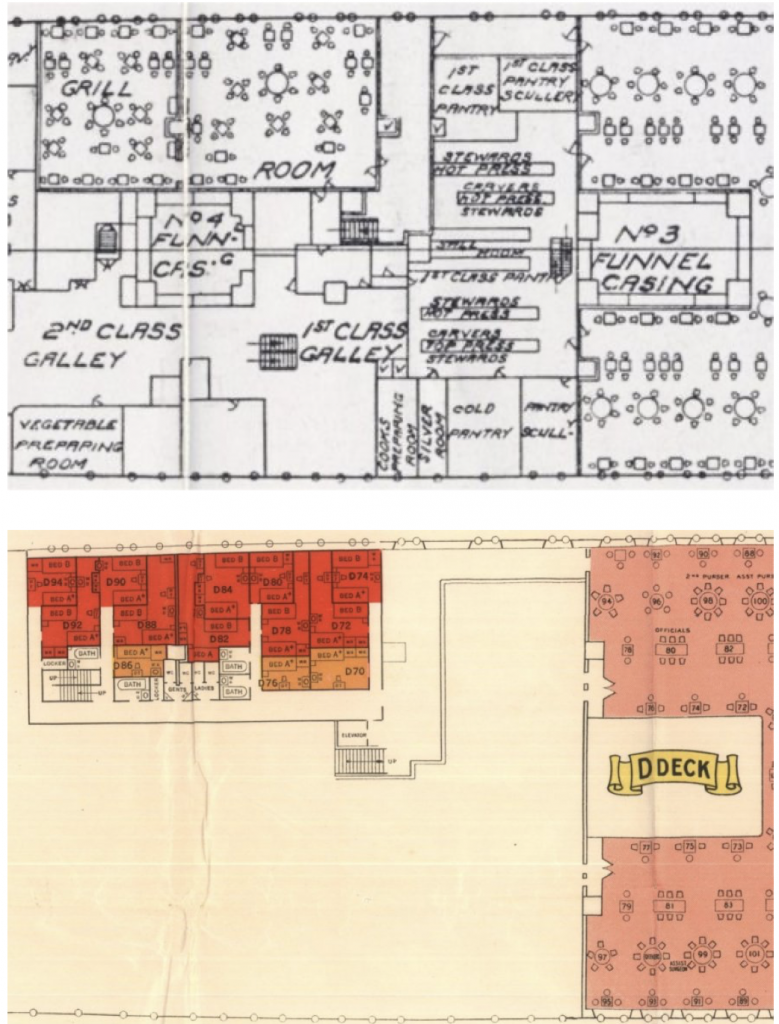
Below: Aquitania‘s first class grill room when she entered service and the same area after it was removed and converted to passenger staterooms in 1936. (The Shipbuilder, 1914/Author’s collection; and Aquitania Cruise Plan, 1938/Author’s collection.)

By 1935, the first class grill room was not as popular as it had been. First class passenger lists were not as high as they had been during Aquitania’s heyday. At a Cunard White Star  executive committee meeting in early September 1935, some defects were noted:

…very shabby appearance of the Ruboleum tiling in the grill room of the Aquitania, also in the corridor leading to that room. Renewal of this tiling was included in the schedule submitted for the vessel’s overhaul last winter but was deferred.
Removal and re-laying the tiling would cost approximately £335, but in view of the fact that the grill room is not very extensively used, it has been submitted that the deck be covered with carpet ex Olympic restaurant which is in quite good condition.

During a meeting in September 1936, Cunard’s Board decided that they needed to increase Aquitania’s tourist class passenger capacity to meet an anticipated increase in tourist class passengers in 1937 and beyond. Since the grill room was ‘not very extensively used,’ they chose to remove it:

It has been found possible, by converting the existing grill room on D-deck into passenger space, to provide for 44 passengers [sic]. The cost of the work is estimated at £7,000, and the passenger department is satisfied that this increase in the vessel’s earning capacity would produce £18,000 in the first year.

Although Aquitania’s first class (renamed ‘cabin’) passenger lists recovered in the late 1930s, they did not regain their pre-1931 level. In 1937, her highest cabin passenger lists were 436 westbound and 413 eastbound – less than her averages in the 1920s. They were easily accommodated in the main first class restaurant. In tourist class, Aquitania had a slightly better year in 1937, with her best performance for five years.  Third class numbers rose very sharply, to their best since 1924.


Lusitania & Mauretania ‘Full Astern’

Lusitania & Mauretania: ‘Full Astern’

During my lecture at the British Titanic Society’s convention in Belfast in April 2024, one of the themes I highlighted was how various criticisms of Titanic’s design are often made without reference to the broader context.

The ‘Olympic‘ class ships were triple screw steamers with reciprocating engines driving the port and starboard propellers and a low pressure turbine driving the centre propeller.  One such criticism of the ‘combination’ propelling machinery is that the centre propeller only operated ahead and could not be reversed.  The criticism was that this meant only the port and starboard propellers could be reversed in a scenario where a ‘full astern’ order was given.

However, those voicing this criticism have evidently paid little attention to competitors such as Lusitania and Mauretania.  The two Cunarders were quadruple screw steamers driven solely by turbine engines.  They entered service in 1907 and, by 1911, Cunard’s staff had plenty of experience from their day to day operation.  A memo entitled ‘New Fast Steamer’, dated 7 February 1911 and stamped with an Executive Committee stamp on 21 August 1912, noted a problem based on their experience to date.  Only the two inboard propellers [‘centre shafts’] were reversible:


When going full speed ahead and the order is given to go astern, the rotors on the centre shafts are going astern quite a time before the ahead rotors on the wing shafts have stopped going ahead.  This will retard the progress astern and of course there will be a little drag from the wing propellers after they have stopped going ahead.

As a result, it was suggested that the ‘new fast steamer’ (Aquitania) should be designed so that all four propellers could be reversed: ‘Astern rotors on the wing [propeller] shafts [as well] would overcome this difficulty and enable all four shafts to be revolved in the required direction, which of course would be a great advantage when manoeuvring’.

There are advantages and disadvantages between different propulsion systems.  One system might be superior in one aspect, whereas another might be better on another comparison.  Looking at twin screw ships such as Oceanic (1899), both propellers could be reversed.  Modern day analysis of Titanic‘s or any other vessel’s design simply needs to consider the broader context.  Not only did Lusitania and Mauretania have a similar issue in that only two of their four propellers could run in reverse, but Cunard’s own engineering staff noted that the two wing propellers were still going ahead for a period that the two inner propellers were running astern. 

‘Olympic & Aquitania: Eyeing up the Competition – Cunard’s “White Star Liner”‘

‘Olympic & Aquitania: Eyeing Up the Competition – Cunard’s White Star Liner” ’


While Olympic was under construction, White Star’s rival Cunard was not idle. They were planning their answer to the competition in the form of their new Aquitania. Unlike Lusitania and Mauretania, which were financed with state support, Cunard had to finance Aquitania on a commercial basis and opted for comfort and luxury rather than speed. That led them to design a ship whose key particulars were very close to Olympic in size and speed. Maritime historian John Maxtone-Graham called her Cunard’s ‘White Star Liner’. 

Cunard’s directors and engineering staff found out what they could about Olympic while she was being built and then their naval architect Leonard Peskett sailed on her in August 1911. He noted some features worth considering as Aquitania’s design was finalised, including bringing elements of her design more into line with Olympic.  My September 2022 presentation at PRONI covers the key details and provides ‘a brilliant insight’.


Above: Aquitania‘s first class grill room, with its Jacobean decor, had significant visual similarities with Olympic‘s first class dining saloon.  During the design phase in July 1913, Cunard actually opted for some slight changes to try and differentiate it.  (Author’s collection)