Counterfactual: Sinking the Mauretania

Counterfactual: Sinking the Mauretania


Cunard’s Mauretania left Queenstown for New York on 14 April 1912, three days behind Titanic.  For the sake of a counterfactual, this post imagines a scenario where the Cunarder struck an iceberg and sank instead.

Edward Wilding and Leonard Peskett produced a joint memo for the British Wreck Commissioner’s court to try and answer the hypothetical question about whether Mauretania would have remained afloat if she had sustained similar damage to Titanic:

We have considered by approximate methods the flooding of the Mauretania in the event of an accident similar to that met with by the Titanic. We have assumed the watertight doors and hatches to be closed and similar deductions to those made in the calculations for the Titanic. From the calculations made, taking the vessel as damaged from the stem to the afterend of the forward boiler room (corresponding nearly – but not quite – to the length from the stem to the afterend of the No. 5 boiler room in the Titanic) the vessel would remain afloat with a considerable list, say 15 deg. to 20 deg., which, no doubt, could be slowly reduced by carefully flooding some after spaces on the opposite side. With the data available we do not think we can satisfactorily discuss flooding corresponding to the damage extending into No. 4 boiler room in the Titanic.

Their memo considered a specific scenario and it is not clear Mauretania could have remained afloat.  Wilding explained: ‘in order that the water should not rise above the top of the bulkhead, we had to assume the bunkers flooded on the other side. [author’s emphasis]  It would be quite a practicable operation by raising the watertight doors, but they would have to be opened so that the water could get through to the port bunkers’.  The longitudinal watertight bulkhead in the foremost boiler room would contain flooding, but at the cost of causing a considerable list to the starboard side.  Peskett  testified that he had no knowledge of any successful counter-flooding being carried out.  Wilding thought it ‘a dangerous thing to do, to try and remedy such a defect by letting water into a much larger compartment than you already have it in’.  He also thought that, with such a serious list, ‘water might find some other way in’ apart from the initial damage (such as through open portholes).  Their analysis also excluded potential damage equivalent to what Titanic may have incurred in the way of her boiler room 4.

There does seem a narrow possibility that Mauretania could potentially have survived, but this counterfactual will assume that efforts to correct the serious list to starboard would have been unsuccessful.  That would mean water would have risen above the watertight bulkhead.  The Cunarder would therefore have foundered, sinking by the bow and with a serious starboard list.

Turbine driven ships such as the Cunarders needed to have both separate ahead and astern turbines.  The reason for this was that the ahead turbines could not be reversed. One concern, expressed in a memo to Cunard management dated 7 February 1911, was that they only had astern turbines on two of the four propeller shafts. This caused a delay in stopping the ship:

When going full speed ahead and the order is given to go astern, the rotors on the centre shafts are going astern quite a time before the ahead rotors on the wing shafts have stopped going ahead.  This will retard the progress astern and of course there will be a little drag from the wing propellers after they have stopped going ahead.

Cunard opted prior to April 1912 to include astern turbines on all of their new Aquitania‘s propeller shafts, recognising that this was a better configuration.  Might they have faced criticism for Mauretania‘s manoeuvring abilities?  The combination propelling machinery arrangement on Olympic and Titanic meant that the port and starboard (reciprocating) engines could be stopped and reversed, even though the turbine driven centre propeller only operated ahead.  Titanic‘s stopping distance on sea trials was also far less than Lusitania‘s. 

Mauretania was equipped with a total of sixteen lifeboats under the older style radial davits, also providing a capacity far short of the maximum number of passengers and crew she could carry.  Their absolute and relative capacity was somewhat less than Titanic‘s.  As Leonard Peskett recalled in May 1912:

When the question of boat capacity of such ships as the Mauretania and Lusitania was brought forward, the special subdivision of those particular vessels was taken into account, and it was considered that owing to the extraordinary precautions which had been taken, the total capacity of boats necessary to be carried would be fully met by the existing Rules’

Might Cunard have faced criticism that Mauretania‘s lifeboat capacity was slightly less than Titanic‘s? Or that her davits were not as advanced as the new Welin design used on Olympic and Titanic?

If Mauretania was listing significantly, it might have meant that the lifeboats on one side of the ship would have been unavailable for use.  Peskett acknowledged this problem in relation to Aquitania, in September 1911:

it would…be more easy to control the passengers and get them away into boats from the gangway doors on E deck, than it have a rush of 4,000 people on to the boat deck, struggling to get into the boats, which would probably be available on one side only…

Titanic was remarkable for only taking a relatively small list to either side during the sinking process, but any significant list Mauretania took which led to many of the lifeboats being put out of use might have led to criticism of the longitudinal watertight bulkheads used in her design.  Peskett noted that the Lusitania and Mauretania model of transverse watertight bulkheads (running across the ship from one side to another) and longitudinal watertight bulkheads (running parallel to the ship’s side) was the only one of its kind in the British merchant service.
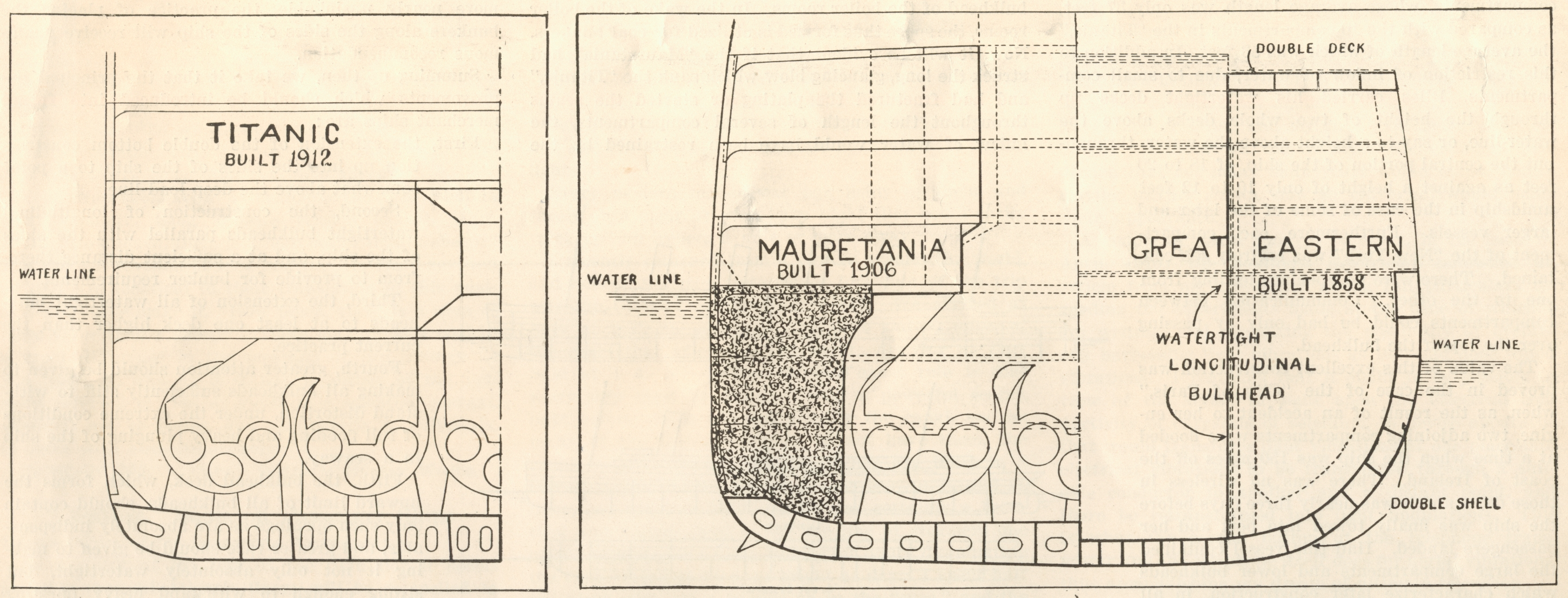
Above: Mauretania‘s configuration included coal bunkers along the ship’s side, separated from the boiler rooms by a longitudinal watertight bulkhead.  (Scientific American, 1912/Author’s collection)


In the summer of 1911, Cunard were working on designs for their new Aquitania.  The Board of Trade’s new rules concerning stairway escape from the lower passenger decks (primarily third class accommodation) concerned Peskett because they might ‘necessitate a rearrangement of the whole of the ship above E-deck’.  Cunard therefore pushed back on the grounds it would put their new ship at a competitive disadvantage:

It was pointed out…that to do so would prevent the ship becoming a commercial possibility, and that such an arrangement could not be considered by the Cunard company, as it would prevent them from competing with rivals, who with similar ships will not have to comply with such stringent regulations.  The Olympic and Titanic and the new German ships will not be called upon to carry out these rules.

…It was pointed out that the Cunard Co. did more in the way of making the ship practically unsinkable, than any other company in the world, and that in the matter of [watertight] subdivision, was far in excess of our Board of Trade rules, or [Lloyds] Registration Society’s requirements, and as an extraordinary precaution, the Cunard Company are anxious to fit W.T. bulkheads between E and D decks.  

Their viewpoint prior to April 1912 might have been taken as a complacency as to the safety of their express passenger ships.  Might Cunard have faced criticism for pushing back against a safety regulation on competitive grounds?  Might the company have been criticised for thinking their express ships were ‘practically unsinkable’?

Mauretania was expressly designed for speed and so her specifications had noted:

As the weight of all materials to be worked into the hull, fittings, and machinery is of vital importance, it is essential in getting out the designs of the various parts that the greatest care should be taken to avoid unnecessary weight, every part to be as light as possible, consistent with the necessary strength.

To keep overall weight down and help improve the ship’s stability, high-tensile steel was used in the upper hull structure rather than the usual mild steel.  This was an innovative feature enabling them to use less steel to obtain the same strength.

During Aquitania‘s design process, Cunard made clear that an essential criteria of any design proposal had to be a GM (metacentric height) which was not less than Lusitania and Mauretania.  This would ensure that she was not too tender.  (A positive GM was essential for a ship to return to upright: if the GM was too low then she would be too tender, with less stability; a GM which was higher would produce a more stable ship.)  Thomas Andrews noted in the summer of 1910 that Olympic and Titanic‘s stability:

would be so much greater than that of the Lusitania and Mauretania that lightness in the upper works was not a vital necessity with them as it had been in the case of these two ships’

Might Cunard have faced criticism that competitors such as Olympic and Titanic were superior in that regard, as Thomas Andrews had indicated?  Their own criteria for Aquitania indicated that they recognised Mauretania‘s stability as an issue. 

Another factor was that Mauretania‘s design used ordinary steel rivets to rivet high-tensile steel plating.  Part of the reason for using high-tensile steel was to help improve stability and reduce the weight of the upper hull structure. The shipbuilders believed that the use of hydraulic riveting and the use of rivets ‘at least equal to the requirements of Lloyd’s rules for mild steel plates of equivalent strength to the high tensile steel used’ mitigated this concern’.  It was a reasonable approach to take but there had been some comment about it back in 1907.  Might Cunard have faced criticism for ‘inferior’ rivets?

This discussion is a mere counterfactual. All of the potential criticisms that Cunard might have faced are speculative, but they are based on known facts.  They help to get us thinking about Titanic in the broader context.  It is easy to see how Mauretania might have been the subject of a disaster. She actually had a long and successful career, as did Olympic:  Titanic’s problem was striking the iceberg!

Much of this post is drawn from primary source documentation included in Olympic & Titanic: Triumph and Disaster, released this month.


Harland & Wolff Canteen Menus and Idle Workers

Harland & Wolff Canteen Menus and Idle Workers


This post is two short, edited extracts from my article ‘Thomas Andrews: In Court, In Rotterdam, In Belfast and Standing in: November 1911 to March 1912’ which was published in the Titanic Historical Society’s Titanic Commutator December 2024: Pages 18 to 28.  


CANTEEN MENUS AND IDLE WORKERS
On 6 February 1912, the Harland & Wolff managing directors meeting considered ‘the question of improving the Staff Dining Room menu’ which was ‘left to the Chairman and Mr. Andrews to deal with’. It is not clear specifically what needed to be improved with the existing menu options, but it was certainly something else adding to Andrews’ workload.

They also discussed the problem of workers ‘idling’ on Titanic:

Incidentally to the completion of No. 401 it was arranged that the managing directors should consider what was the best course to adopt to prevent the idling of the men on board this steamer, which has become very marked, and meet again on Friday, the 9th instant, at 12 o’clock to further discuss the matter…

STANDING IN FOR LORD PIRRIE
Lord Pirrie was not in the best of health in the early months of 1912. It fell to Thomas Andrews to stand in for him on at least one occasion. Late in March 1912, the Belfast Steamship Company’s Patriotic left on her sea trials. She proved herself ‘a handsome, commodious and seaworthy’ vessel, reaching eighteen knots on the ‘measured mile’. Lunch was served onboard afterwards.

Andrews rose to speak for Harland & Wolff. He said he was ‘very sorry that Lord Pirrie could not be present, as otherwise the duty with which he was entrusted would have been in much abler hands’. Harland & Wolff’s prosperity ‘was never greater’ and they were expanding elsewhere, but he was sure their headquarters would always be in Belfast. The workforce had reached over fifteen thousand men and he said that the total wages bill had just set another record:

A good deal of that had been involved in the completion of the two first class passenger ships – the Patriotic and the Titanic [laugher]. It was a heavy task for the firm to complete the two ships in one week.

He looked forward to the successful completion of Titanic’s own sea trials, scheduled for 1 April 1912…


Article from the Archives: ‘Thomas Andrews’ Olympic Maiden Voyage Notes’

This article represents an expanded version of material published by Mark Chirnside’s Reception Room in July 2005. It is published with revisions (up to July 2025).


There were reportedly three sets of copies of Andrews’ notes taken on Olympic’s maiden voyage – a copy for the White Star Line, a copy for Harland & Wolff, and his personal copy. Some of the notes he took have been summarised before (see: Lepien, Ray. ‘Olympic The Maiden Voyage’. Titanic Commutator 2003; Volume 27 Number 162; and: Marre, Jean-Philippe. Thomas Andrews: Architecte du Titanic. Lulu; 2015.) I was fortunate to purchase some of Andrews’ notes in summer 2004. I then published extracts online in July 2005 and again as an appendix in the revised and expanded edition of The ‘Olympic’ Class Ships: Olympic, Titanic & Britannic (History Press; May 2011), however many of Andrews’ recommendations were missing. At that time, I did not realise quite how many were unavailable but, over the years, a number of researchers have kindly shared material and helped to fill in the gaps.


We know that the set is still not complete because Andrews numbered his notes consecutively, from 1 to 56. Work is ongoing to try and reassemble the entirety of what he wrote, however notes 28 to 39 and 47 to 55 inclusive are still missing (as of July 2025). This revised article adds to the notes published previously.


I am grateful to researchers including Scott Andrews, Bruce Beveridge, Robin Beuting, Gunter Babler, Mark Evans, Joao Goncalves, Ray Lepien and Bill Sauder, for sharing information and supporting with my interpretation of either the handwriting or a particular detail. Any errors are mine alone.


Thomas Andrews’ Rules of Duty

Thomas Andrews’ Rules of Duty

A review of Shan Bullock’s biography of Thomas Andrews, which was published in the Belfast Evening Telegraph later in 1912, included ‘The rules of duty which Mr. Andrews applied to everyday life’. They were taken from advice he gave to a man who was starting work as an engineer in 1905.  Andrews’ advice was sound and applies to other occupations as well.  He wrote:

As an old hand, who has come through the mill myself, I would just like to say how important it is for you to give your employers full confidence from you at the start. This can best be gained:


1. By punctuality and close attention to your work at all times, but don’t allow your health to suffer through overwork.
2. Always carry out instructions given by those above you, whether you agree with them or not, and try to get instructions in writing if you are not sure of your man.
3. Always treat those above you with respect, no matter whether they are fools or know less than yourself.
4. Never give information unless you are perfectly sure; better to say you are not sure but will look the matter up.
5. Never be anxious to show how quick you are by being the first out of the shop when the horn blows. It is better on these occasions to be a bit slow.


Titanic & Social Media Misinformation

Titanic & Social Media Misinformation

Titanic & Social Media Misinformation

There is a huge volume of Titanic information online but the quality of that information can be very poor.

Titanic is one of the subjects that drives ‘hits’ and engagement on social media.  The speed at which information can be shared to thousands of people is remarkable.  In many ways, that is a positive.  However, in others there is a very negative impact.  One problem is where inaccurate information is shared using graphics or memes, which are so often seen by people who take them as a true representation of the facts.  An example of this is a series of claims about Thomas Andrews which have been circulating:


Above: A photo of Thomas Andrews, accompanied by various inaccurate claims, circulated on Facebook in February 2023. (Author’s collection)

There are a lot of problems with the factual accuracy of these various claims.

Starting with the positive, he was one of the wider design team at Harland & Wolff who were responsible for Olympic and Titanic. He was also onboard for the fateful maiden voyage.  We also know from witness accounts that Andrews put a lot of effort into helping to save lives during the evacuation.

However, there are numerous claims which are not supported by evidence:

  1. The text speaks about ‘his original design’. The earliest designs for these ships, including details of the structural elements, were prepared while Alexander Carlisle was in charge of the design department and were, ultimately, the result of a team effort.  At that time, Thomas Andrews was in a more junior role at Harland & Wolff, taking on duties from Alexander Carlisle after he retired at the end of June 1910.  It is therefore incorrect to attribute the ‘original design’ to Andrews.
  2. The claim that ‘a double hull’ was included is incorrect. The earliest midsection plan we have – a ‘cutaway’ drawing which essentially looks through the ship and shows all the key structural elements of the hull and the general design – dates from June 1908.  It includes a double bottom only, which was of very strong cellular construction, and is exactly how the ship was built. The purpose was to provide protection in the event she grounded.  It was not Harland & Wolff’s practice to build ships with ‘double hulls’.
  3. The claim that ‘more watertight compartments’ were included is incorrect.  Comparing the ‘Design “D”‘ concept, which was approved by the White Star Line’s directors in July 1908, with the completed ship, the number of watertight compartments was increased in the finished product.
  4. The claim that ‘twice as many lifeboats’ were included is incorrect.  The ‘Design “D”‘ concept showed sixteen lifeboats (14 standard lifeboats and two emergency cutters), which was later increased to a total of twenty by the addition of four collapsible (or semi collapsible) boats. During the design process, Alexander Carlisle recommended the use of a new Welin davit design in an effort to make sure the ships could easily be adapted to any change in lifeboat regulations.  (At this time, there was anticipation that the Board of Trade would mandate a significant increase in the number of lifeboats carried by passenger liners.)  J. Bruce Ismay approved Carlisle’s recommendation in January 1910. The benefit of the new Welin davit design was that a second row of lifeboats could be carried inboard, which provided the option to increase easily the number of lifeboats onboard. As part of the approvals process for using a new davit design, which had to be approved by the regulator, detailed blueprints of the davits were prepared and submitted to the Board of Trade.  A blueprint was also prepared by the Welin company, showing how the boat deck would look with these davits installed and two rows of lifeboats carried on either side of the ship.  Carlisle retired at the end of June 1910 and he testified that a decision about the number of lifeboats to be carried had not been taken at that time.  By May 1911, no change in regulations had materialised and Harland & Wolff and White Star added the four collapsible boats so that they exceeded the statutory requirements. According to his own testimony, Alexander Carlisle never explicitly advocated for more lifeboats to be carried and there is no evidence that Thomas Andrews did either. Edward Wilding testified that Harland & Wolff’s collective view was that the number of lifeboats these ships carried was sufficient and in excess of the regulations. The full story is included in detail in my September 2021 presentation at PRONI

Unfortunately, many people see claims made on social media and treat them as credible, without being aware of the inaccuracies.  In an age when we have access to such a huge volume of data and digital information, it is imperative to take a sceptical approach and to try and fact-check as far as possible.  There is a huge volume of Titanic information online but the quality of that information can be very poor.


Thomas Andrews’ Bonus

Thomas Andrews’ Bonus

Almost two months after his thirtieth birthday, Thomas Andrews received a letter from Messrs. Ismay, Imrie & Co. – the management company of the Oceanic Steam Navigation Co. Ltd (White Star Line).  They felt that all the work he had been doing at Harland & Wolff, which directly or indirectly supported the White Star Line, warranted a tangible acknowledgement.  The letter was sent 122 years ago today and, sadly, a mere nine years before Andrews lost his life in the Titanic disaster.   (Public Record Office Northern Ireland/PRONI)

Steamship Department
Liverpool
April 1st 1903

T. Andrews Esq.
Messrs. Harland & Wolff
Belfast


Dear Sir,

At the last annual meeting of the Oceanic Steam Navigation Co. Ltd. the shareholders voted a sum of money to be distributed at our discretion in recognition of services rendered to the company, and having in mind the valuable work which you have performed in a variety of ways on behalf of the White Star Line, we feel that it would be pleasing to all concerned that the opportunity should be availed of to mark our appreciation of same. We therefore enclose a cheque value £200, which we will be glad if you will accept with our best wishes for your future success.


Yours faithfully,

Ismay, Imrie & Co.


The Show About Titanic Podcast

The Show About Titanic Podcast: Thomas Andrews and the Sister Ships with Mark Chirnside

The Show About Titanic

The Show About Titanic podcast (‘Thomas Andrews and the Sister Ships with Mark Chirnside’) is available online: ‘In this episode of The Show About Titanic, Edward welcomes maritime historian Mark Chirnside to delve into the history of the Titanic and her sister ships, Olympic and Britannic. Mark shares his journey into maritime research, his extensive knowledge on these renowned liners, and the vital alterations and events surrounding them. The conversation also highlights key insights into Thomas Andrews, the naval architect behind these legendary ships.’  Thanks to Edward for inviting me.


‘Olympic: Thomas Andrews’ Notes from a Successful Maiden Voyage’

It was great to be able to present my lecture about Thomas Andrews and the observations he made during Olympic‘s maiden voyage in June 1911.  I spoke at PRONI, in a lecture jointly supported by PRONI and the Belfast Titanic Society:

‘Olympic: Thomas Andrews’ Notes from a Successful Maiden Voyage”’
(September 2023)

In June 1911, Thomas Andrews was onboard Olympic during her maiden voyage to observe how she performed under normal operating conditions at sea; to monitor her progress; and make all sorts of notes. His comments were wide ranging and went beyond matters of shipbuilding in a number of cases.  These included recommendations for changing particular operating procedures or improving the working practices of the ship’s crew; improving aspects of the ship’s passenger accommodation and increasing her earning power, such as by adding additional staterooms; or in making economies (he saw no need to provide both linoleum tiles and carpeting in the captain’s sitting room).  He made a particular recommendation to try and help keep third class female passengers safe from unwanted attention. Andrews’ notes included many aspects where Titanic‘s design was improved compared to Olympic‘s.  They show a remarkable attention to detail, demonstrating the concerns of a knowledgeable professional who was intent on improving her design in even the slightest way. 


‘Olympic & Titanic: “A Very Remote Contingency” – Lifeboats for All’

‘‘Olympic & Titanic: “A Very Remote Contingency” – Lifeboats for All’ 


My presentation in September 2021 at PRONI discussed the topic of lifeboats.  I set the scene by covering the key points about lifeboat provision during the decades preceding the Titanic disaster; the regulations in 1912 and how they had evolved; and how Harland & Wolff and the White Star Line exceeded the legal requirements for lifeboat capacity.


Contrary to popular belief, there is no evidence that Harland & Wolff recommended to the White Star Line that more lifeboats should be fitted.  What they did do is provide a new Welin davit design which would enable them to carry more lifeboats in the future, if the regulations changed.  They also provided four additional semi collapsible boats for each ship.  Comparing the number of lifeboats shown on the ‘Design “D”‘ concept which the White Star Line approved in July 1908 with Titanic as completed in April 1912, the number of lifeboats increased from 16 to 20.     

I closed the presentation by covering some examples of inaccurate claims about Titanic‘s lifeboats in the mass media.  One was a completely inaccurate characterisation of a Harland & Wolff drawing office notebook, which a television programme claimed was evidence that Harland & Wolff had intended originally for Titanic to be fitted with enough lifeboats for everyone (in fact, it was a document recording changes to Olympic‘s lifeboat configuration in the 1912-13 refit).  Another was a newspaper article mischaracterising notes which were authored by Board of Trade surveyor Captain Maurice Harvey Clarke.  They were written after the disaster, not before.   

Mark explores the issue of lifeboat regulation over the decades preceding the Titanic disaster and discusses the context immediately prior to 1912. He discusses the question of lifeboat provision for these new White Star giants and dispels a few longstanding myths and false claims made about Titanic’s lifeboats.