Naturally enough, there was a surge in interest around the one hundredth anniversary of Titanic‘s loss, just as there had been when her wreck was discovered in 1985 and after the release of the Cameron film in the late 1990s. Unfortunately, many of the articles and books published in 2012 contained a number of errors. Given the significant interest in the subject at the time, it’s particularly unfortunate that many of these errors probably found a large audience.
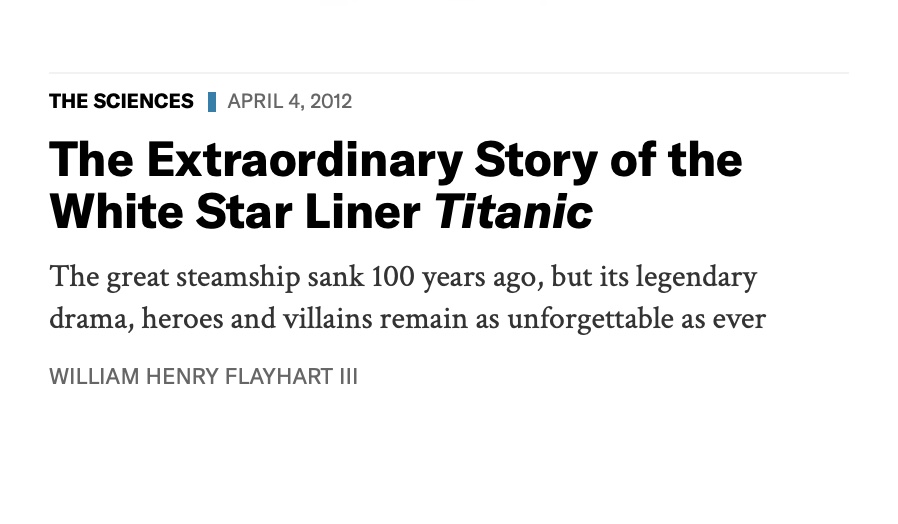
An example of this is an article, ‘The Extraordinary Story of the White Star liner Titanic‘, which was published by the Scientific American on 4 April 2012. Here is a short extract:
The master of the Titanic was the commodore of the White Star Line, Captain Edward John Smith. He had also been the first master of the Olympic and, therefore, had had a year’s familiarity with the flaws and qualities of the new White Star floating palaces. He learned that they responded slowly to their rudders, partially because one of the three propellers was positioned immediately behind the rudder. Thomas Andrews, designer of the ships, brought up this issue with Ismay, but the White Star president expressed his reluctance to delay the construction in order to refine the design. He reportedly commented that the only place these liners would have to maneuver quickly would be in port and that was what you had tugboats for.
Andrews wanted another change as well: a second row of lifeboats that could be launched as soon as the first set was in the water. The result would have been enough lifeboats for all the passengers and crew. Ismay protested that they already had more than the legally required number of lifeboats (16) and the extra boats simply would clutter up the beautiful open expanse of the upper deck, where first-class passengers would want to stroll. Hence, the Titanic sailed with 16 lifeboats
Although Smith was White Star’s senior captain in 1912, the title commodore was not formally in use at the time. Therefore using it is somewhat misleading, but perhaps this is a relatively minor quibble.
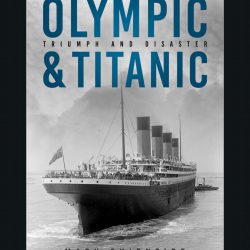
More concerning is the claim that Smith had ‘learned that they responded slowly to their rudders, partially because one of the three propellers was positioned immediately behind the rudder’. There is no evidence whatsoever to support this claim. In 1911, Smith said actually said that Olympic steered ‘very well’. Moreover, the fact that the rudder was behind the turbine-driven centre propeller was potentially a benefit when the propeller was in operation. Experience with Olympic during her early years of service was that she was more manoeuvrable when the turbine was running! (These subjects are covered in Olympic & Titanic: Triumph and Disaster. )
It follows from this that the claim ‘Thomas Andrews, designer of the ships, brought up this issue with Ismay’ is also incorrect. How, too, could construction be delayed ‘in order to refine the design’? Olympic was in service from June 1911 and Titanic was already launched and outfitting at Belfast. The question of refining the design in this sense is clearly not possible, because one ship was already in service and the hull and rudder arrangement of the second already complete. It is not as if they were both on the drawing board with the opportunity to change the design of their stern. It also speaks volumes that their younger sister, not yet laid down, had exactly the same stern and rudder configuration.
There is no evidence Andrews ‘wanted another change as well: a second row of lifeboats’ or that ‘Ismay protested’. Quite the contrary. Nor would a second row of lifeboats have provided ‘enough lifeboats for all the passengers and crew’. Even if we make the generous assumption of a further 16 boats with a 65-person capacity, that would have provided 1,040 extra lifeboat seats. Perhaps that might have been enough for the number of people onboard at the time of the disaster, but it was not enough for all the passengers and crew Titaniccould carry.
The article also noted that ‘Titanic sailed with 16 boats’. In fact, she had 20 – comprising 14 standard lifeboats, two cutters and four semi-collapsible boats.
It is not the purpose of this blog post to single out this particular article or its author for criticism, but it does serve as a good case study of the danger of inaccurate information disseminated in secondary sources. It appeared in a well-regarded publication and was part of a series of articles published for the centennial. Many people will, in all likelihood, have seen it and taken its claims at face value, but the study of history requires an interpretation and understanding of the past which is evidence-based.
Above: One of many articles published for the centennial of the disaster, by William H. Flayhart (1944-2019). (Scientific American, 2012)