FAQ: Would Higher Watertight Bulkheads Have Saved Titanic?
Published on
FAQ: Would Higher Watertight Bulkheads Have Saved Titanic?
No, probably not.
In the immediate aftermath of Titanic‘s allision with the iceberg, it became clear she had sustained significant damage. Flooding was reported in the forepeak tank, holds 1, 2 and 3, boiler room 6 and boiler room 5. This extent of damage was beyond the ship’s capacity to survive and her watertight subdivision was overwhelmed, leading to her foundering about 2 hours and 40 minutes later.
Initially, water ingress in boiler room 5 was kept under control by the pumps. However, as Walter Lord noted in his 1986 book The Night Lives On, boiler room 4 was subsequently found to be taking on water also. This evidence is often overlooked. (Sam Halpern’s excellent article ‘Where Did That Water Come From?‘ is highly recommended.)
Above: Olympic‘s watertight subdivision as-built. The majority of the watertight bulkheads extended to the saloon deck, D, and the remainder to the upper deck, E. (Bruce Beveridge collection).
Edward Wilding, who was responsible for key design elements including the ship’s strength and watertight subdivision, was asked about this before the British Wreck Commissioner’s Court:
20953. (Mr. Laing.) Now I want to sum up, to see if I understand properly the flooding plan. If No. 6 boiler room and the compartments forward of it are flooded, am I right that the vessel, as she is designed, is lost – she must sink? – If No. 6 boiler room and the three holds forward of it, and the forepeak are flooded, the ship is undoubtedly lost as built.
20954. If No. 5 boiler room is flooded in addition, supposing the bulkheads had been carried up to D, would that have saved her? – It would not. There is a plan which I have put in which is marked E.
The Commissioner:Will you repeat that question?
20955. (Mr. Laing.) If No. 5 boiler section is flooded carrying the bulkheads up to D would not save the vessel? – No. There is another plan which shows it better than the one your Lordship has. Yes, that is the one. (Indicating.)
20956. And the last question is: With No. 4 [boiler room] section added on, no possible arrangement could save the ship? – No possible vertical extension of the existing bulkheads.
Boiler room 4 represented the seventh watertight compartment back from the bow. Unless the ship’s engineers had managed to bring the water ingress under control permanently using the available pumps, then Titanic would have been doomed regardless of how high her watertight bulkheads had extended.
Wilding reiterated the point three years later, before the Limitation of Liability hearings:
Q. Suppose there was damage in No. 4 boiler room… What height of bulkhead would have been necessary to prevent the ship from sinking? – No height of bulkhead; it might have been extended to the funnel top and she would have gone down.
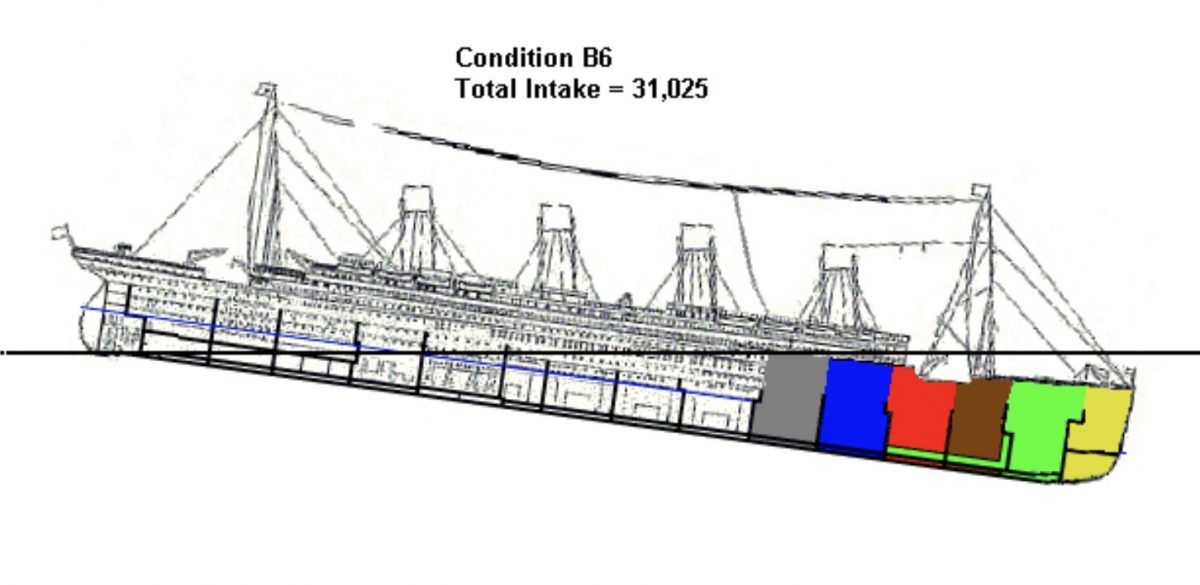
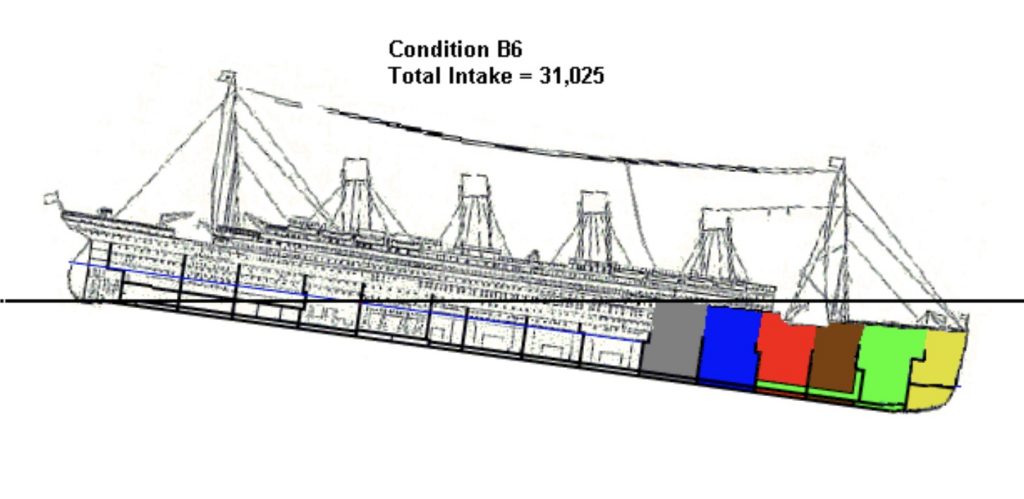
After the Titanic disaster, modifications to Olympic and Britannic included the stepped-up extension of the watertight bulkhead between boiler rooms 4 and 5 to the underside of B-deck. The purpose of that particular change was to enable the ship to float theoretically with the first six watertight compartments up to and including boiler room 5 flooded but, even in that situation, the bow would have been submerged with the water up over the fore end of the superstructure.
Above: Diagram depicting Edward Wilding’s ‘Condition B6’ with the first six watertight compartments – the forepeak, holds 1, 2 and 3, boiler room 6 and boiler room 5 – completely flooded. (Sam Halpern collection)