Did You Know? Olympic & Titanic’s Rudders

Did You Know?   Olympic & Titanic‘s Rudders


Late in November 1908, Harland & Wolff placed their order for both rudders with the Darlington Forge Company Ltd. The rudders were intended to be identical with each ship’s rudder weighing about 101 tons. Each was to be made from Siemen’s Martin mild cast steel, however the shipbuilder specified stringent material and workmanship standards that had to be met. These standards are not always fully understood or appreciated.

The rudder castings needed to have a tensile strength (the ultimate strength that the material could take before breaking) of ’28 to 35 tons per square inch’ with an elastic limit (the greatest stress the material could take without permanent deformation) 45 per cent of the tensile strength. The material also needed to be bent ‘through an angle of 60 to 80 degrees without fracture’ when ‘cold’. Test pieces needed to be tested in the presence of a Lloyd’s representative as well as one from Harland & Wolff ‘if we so require’. They also required the Lloyd’s representative to certify the test results.

Olympic’s rudder was due for delivery by January 1910 and Titanic’s by July 1910. They also required a guarantee against the ‘material and workmanship’ which would be valid for twelve months from the date of each ship starting on her maiden voyage.

When Harland & Wolff ordered the rudders for the Royal Mail Steam Packet company’s new cargo ships Berbice and Balantia the following month, the order specified merely that their rudders had to be made about of the same material and certified by Lloyd’s classification society.

Further details can be found in Olympic & Titanic: Triumph And Disaster.
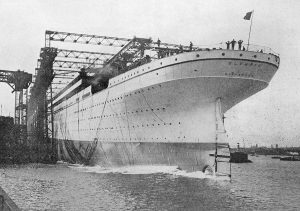
 

Above: Olympic enters the water for the first time.  The rudder was installed prior to launch and was supported in place as a special precaution.  (The American Marine Engineer, 1910)


The Yacht-Like Olympic

The Yacht-Like Olympic


As [Olympic] lay abreast the stage yesterday the general opinion among the many thousands of sightseers who thronged both banks of the river was that the Mersey had never borne a ship of more beautiful proportions or more graceful lines. So exceedingly well balanced are the proportions of the vessel that at first glance her vast bulk is hardly realised; indeed it is impossible for the eye to form any complete vision of the tremendous size of the vessel without comparison; that is until some other vessel becomes dwarfed by her vicinity.

The Journal of Commerce describes Olympic‘s visit to Liverpool, June 1911


There were many compliments about Olympic‘s profile when she entered service in 1911, but she also won favourable reviews for the way she handled.  On more than one occasion, mariners commented positively on how she steered, likening her to a ‘catboat’ and a ‘yacht’.   

‘She steers like a catboat. I went onboard from […] the pilot boat, at half past two this morning off the lightship, and we were anchored in Quarantine an hour later. She handled beautifully’.

Pilot J. J. Adler, New York Harbour Pilot, June 1911.

‘Does the Olympic steer well?’

‘Very well.’

Captain Edward J. Smith, Olympic’s commander, November 1911.

‘We all observed the marvellous rapidity with which this prodigious ship turned from side to side, answering to its steering gear like a yacht answering to the tiller’.

Account of manoeuvres in May 1912, published in The American Marine Engineer, June 1912. 

‘…she came out along the Turbot Bank like a small yacht would, and answered her helm just like a yacht’.

Captain James Tobin, who commanded mail tenders at Queenstown over four decades, describing one of Olympic’s visits to the port

These quotes are among many nuggets of information in Olympic & Titanic: Triumph and Disaster.  (Thanks to Mike Poirier.)