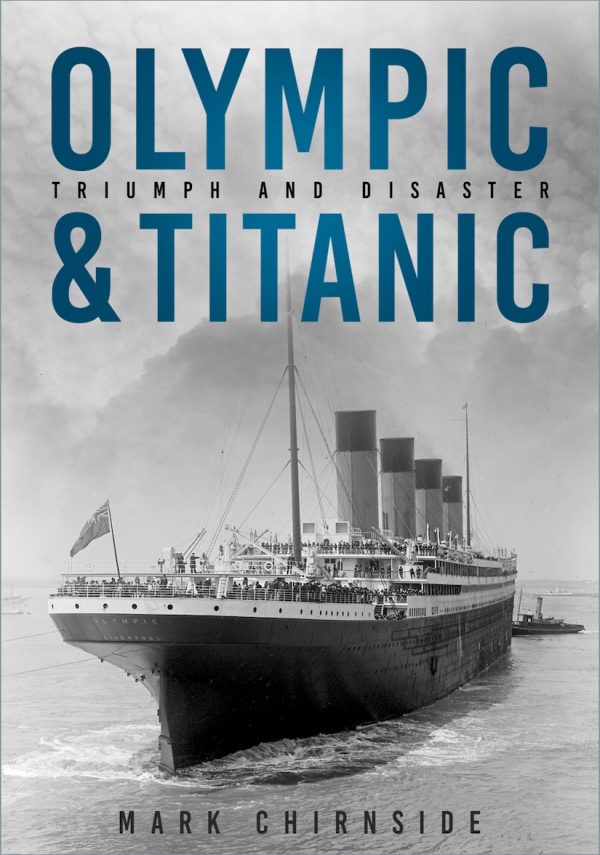
Olympic & Titanic: Triumph and Disaster – Chapter 3

Olympic & Titanic: Triumph and Disaster – Chapter 3


Chapter 3, ‘Unsinkable’, explores topics related to safety and sea and ship design.

We start by looking at the context in the decades prior to 1912.  Many modern liners were claimed to be ‘practically unsinkable’ or similar, due to their watertight bulkheads.  There are several examples of ships being late to port and their owners reassuring the public in the meantime that their passengers and crew would be safe.

There are several examples of earlier liners built without watertight doors.  Practical reality forced shipowners and shipbuilders to cut open the watertight bulkheads and fit watertight doors retrospectively.  We also see the views of naval architects such as Leonard Peskett and Edward Wilding and how they thought  watertight doors were essential in the machinery compartments of large North Atlantic passenger steamers.

The design specifications of White Star’s new ships are covered at length, including exploring the standard of watertight subdivision on other contemporary ships.  Harland & Wolff went above and beyond the design requirements and exceeded contemporary standards by a significant margin.  We see that the watertight subdivision was improved during the design process (with an increase in the number of compartments).  An assessment of the strength of the watertight bulkheads showed them very favourably.

We examine the pros and cons of Olympic‘s watertight subdivision compared to Mauretania‘s.  Safety statistics for the preceding two decades show that, statistically, the North Atlantic route had been very safe historically.  We read about Thomas Henry Ismay’s efforts to improve safety and the use of the North and Southern routes to avoid ice.

The history of safety legislation is explored, including discussions in the 1880s about lifeboat requirements.  Sir Digby Murray, professional member of the Marine Department of the Board of Trade, had even argued that:

I do not think you are going to save life by increasing the boats; I think it must be done by the subdivision of the ships. If you really want to save life that is the only way of doing it, and in that case a smaller number of boats would suffice.

We track the history of lifeboat requirements and how shipping lines were preparing, by 1911-12, for a future where more lifeboats would be obligatory.  This included the use of a new type of davit on Olympic and her sister to accommodate more boats, if needed, and an increase in the number of lifeboats by adding four semi-collapsibles.  The approach is to place the new White Star ships in context with competitors, including previously unpublished and little known information.  (We also see an example of Harland & Wolff pushing back against another shipping line’s query about the need to improve the lifeboat provision on a new passenger liner.)

Contrary to popular misconception, even smaller liners did not carry ‘boats for all’.  The chapter closes by putting forward the wider context.  We see how quickly things were moving by 1911-12, including Cunard’s decision to provide ‘boats for all’ on their new Aquitania.  Even so, professionals agreed that the best way to preserve life was either to avoid danger entirely or to ensure that watertight subdivision could keep a damaged ship afloat…


Titanic Myths Busted – Club Paranormal (Truth Be Told)

Titanic Myths Busted: The Mistakes,The Myths & TheTruth    Mark Chirnside – Club Paranormal (Truth Be Told)


What really happened the night the Titanic struck the iceberg—and how much of what we think we know is actually wrong? In this gripping episode of Truth Be Told, Tony welcomes renowned maritime historian Mark Chirnside from the UK to break down the myths, misconceptions, and overlooked truths surrounding one of history’s most infamous disasters. From the critical minutes after impact to the mistakes and decisions that sealed Titanic’s fate, Mark dives deep into the real timeline of events—and why the story is far more complex than Hollywood ever showed us. They explore the role of Captain Smith, First Officer Murdoch, and the controversial legacy of J. Bruce Ismay, while also uncovering the truth behind conspiracy theories, communication failures, and the ship’s so-called “unsinkable” design. Plus—did Titanic really have a chance to survive? And what about that age-old debate… could Jack have fit on the door? This episode separates fact from fiction and reveals why, over a century later, Titanic still captivates the world—and what we’re still learning today.


Captain Smith’s Titanic Quote

Captain Smith’s Titanic Quote

Captain Smith’s Titanic Quote

Titanic was headline news for weeks following the disaster.  On 16 April 1912, the New York Times included an article about Captain Smith and his career in their coverage.  Within that article were extracts from comments Smith had reportedly made on the conclusion of Adriatic‘s successful maiden voyage almost five years earlier, to the press in New York.  It is easy to see why a newspaper reporter would want to quote Smith’s comments.  He had spoken about his ‘uneventful’ career and the love of the ocean that he had had since childhood. Then, he went on to talk about the safety of modern passenger liners. Those comments had a sad irony given the recent disaster.  One common quotation, used by historians in the decades to come, was:

I will say that I cannot imagine any condition which could cause a ship to founder.  I cannot conceive of any vital disaster happening to this vessel.  Modern shipbuilding has gone beyond that.

Back in 2008, I began to worry that I had not been able to find Smith’s comments in newspaper coverage from that summer of 1907.  I found it somewhat uncomfortable that our source seemed to be only a post-disaster publication.  However, thanks to the effort of a number of researchers including the late Mark Baber, Smith biographer Gary Cooper, and Dr. Paul Lee, sources for the quotation were found from pre-disaster publications.  These included press reports dating from later in 1907 through to a report in The World’s Work in April 1909 (shown in an extract from a slide in my presentation to the British Titanic Society in April 2024, below).


By comparison, the New York Times’  report published on 16 April 1912 had some interesting differences in emphasis.  For example, rather than saying ‘modern shipbuilding has gone beyond that’, the pre-disaster quote was ‘modern shipbuilding has reduced that danger to a minimum’. The New York Times also summarised Smith’s preceding comments, paraphrasing him: ‘Captain Smith maintained that shipbuilding was such a perfect art nowadays that absolute disaster, involving the passengers on a great modern liner, was quite unthinkable. Whatever happened, he contended, there would be time before the vessel sank to save the lives of every person on board’.  The paraphrased summary was broadly accurate, but it omitted the comment ‘I will not assert that she is unsinkable’ [emphasized above].

All of Smith’s reported comments are important and they need to be understood in their full context.   It’s also important to recognise that even the pre-disaster quotations are from a secondary source and rely on a degree of assumption that what Smith said was reported with reasonable accuracy!