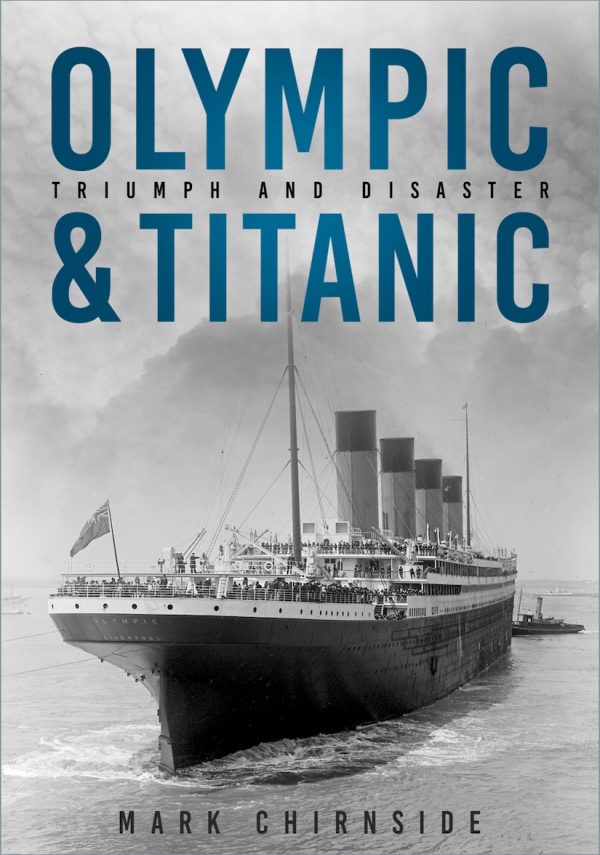
Olympic & Titanic: Triumph and Disaster – Chapter 2
If you have reached the end of Chapter 1, you’ll have seen the background leading up to the decision to proceed with the new ships and the record of their order on 30 April 1907.
Chapter 2, ‘Yard Numbers 400 and 401’, explores the nature of the relationship between White Star and Harland & Wolff. They effectively outsourced their ship design to the shipbuilder, whereas other companies – such as Cunard – designed their ships ‘in house’ and went out to competitive tender from different shipyards. We come to understand more about Lord Pirrie, Alexander Carlisle, Thomas Andrews and Edward Wilding, both through biography and their roles at Harland & Wolff as they related to the new ships. They were keeping an eye on the competition, including the observation that the lavatory pans on Lusitania were too shallow (a rather unfortunate problem when the ship was rolling!). Thomas Andrews also drew a comparison, pointing out that the stability of the new White Star liners would be much greater than the Cunarders.
Press reports soon begin to appear about the new ships, with a wide variation in levels of accuracy. Cunard tried to work out the key details before they had been publicly announced (a highlight of the chapter is a previously unpublished drawing which apparently represented their ‘best guess’ of the new White Star ships’ design). Meanwhile, their size grew significantly as Harland & Wolff worked through the detail and the various design concepts. The earliest known estimate of size put them at about 38,000 gross tons, which eventually grew to over 45,000 – more than doubling the margin of size over Mauretania! By July 1908, design work had progressed far enough for the White Star Line to approve the proposed ‘Design “D”‘ concept which finalised all the fundamental details including the ships’ dimensions. (Many smaller details changed or remained to be worked out.)
We track all the preparations that Harland & Wolff had to make throughout the late summer and autumn of 1908, as the shipyard and engine works were ordered to proceed with all the practical details of construction. This included placing numerous orders for materials and component parts with subcontractors, such as the stern frame castings and propeller boss arms. Unusually, the orders for the enormous rudders contained particular specifications for quality of material and manufacture, including ultimate tensile strength of the material and its elastic limit.
One of the subjects that is not often covered is the close degree of cooperation between the various shipping lines’ technical staff, such as the marine superintendents. We follow a conference between major shipping lines which the White Star Line hosted in Liverpool during August 1910.
The White Star Line and Harland & Wolff had to cope with exacting demands from the postal authorities. Their new ships would be Royal Mail Steamers and, as such, the post office facilities and accommodation needed to be satisfactory. They spent more than a year going back and forth with the postal authorities to make sure the plans met requirements. One extraordinary request was that the post office accommodation be placed on the lower promenade (B-deck). White Star argued that this was simply not possible:
it is really impossible in a passenger steamer to put accommodation of this nature upon the upper decks, as it would interfere seriously with the earning power of such costly vessels
They reassured them that post office accommodation could be provided on a lower deck as well as being very well ventilated and comfortable. The original proposal for the post office accommodation to be placed towards the stern was also changed so that the facilities were at the bow.
We see some of the health and safety challenges common to all shipyards of the period. There were unfortunately a number of incidents and fatalities at Harland & Wolff. Incidents of theft were also recorded. One worker was caught stealing paintbrushes from the shipyard and pawning them. Another man, who was not even employed by Harland & Wolff, was caught stealing workers’ food. Their morning supplies had been vanishing daily for a number of consecutive days, naturally causing a lot of concern: the men were ‘getting wild’ and angry about it. All these details, great and small, shed light on what it was like at the Belfast shipyard as construction progressed…