Did You Know About the Electric Lighting in the Toilets?

Did You Know About the Electric Lighting in the Toilets?


In August 1911, Cunard’s naval architect Leonard Peskett was onboard Olympic to check out the competition.  One of the details he noticed was the sanitary ware, supplied by Messrs. Doulton and ‘equal in quality and similar in design to…the Franconia, the only difference being that the wash basins are fitted in marble slabs and the WCs are flushed by lifting a lever handle instead of pushing a button’.

He also noted the automatic electric lighting in the ship’s public bathroom facilities:

The electric lights in the WCs are put on automatically by closing the door.  When the door is closing it presses on a button fitted in the architrave near the top hinge of the door, and puts on the light, the light going out immediately the door is opened.  For WCs this is considered to be better than a switch, as so many lights are left on when not required.

This innovative feature reduced unnecessary use of electricity, because the toilet cubicles were only illuminated when they were in use and the door was closed.  (The Holland America Line’s Willem Piek Jr., by contrast, criticised this as ‘not pleasant and, in my opinion, not conducive to cleanliness’ in December 1911.)

Peskett thought that the third class sanitary accommodation was ‘a little better than usual [sic] provided by White Star. The WCs are of the pedestal type with levers at [the] side for flushing’.  There seems to be a modern-day misconception, seen in some online forums and memes, that the third class toilets all flushed automatically because the White Star Line did not think passengers would know how to operate them.  As Peskett’s comments confirm, this was not the case.   

Further details in Olympic & Titanic: Triumph And Disaster


Above: Olympic & Titanic: Triumph and Disaster is filled with little known anecdotes and details which flesh out our knowledge of these ships.


Did You Know? Olympic & Titanic’s Rudders

Did You Know?   Olympic & Titanic‘s Rudders


Late in November 1908, Harland & Wolff placed their order for both rudders with the Darlington Forge Company Ltd. The rudders were intended to be identical with each ship’s rudder weighing about 101 tons. Each was to be made from Siemen’s Martin mild cast steel, however the shipbuilder specified stringent material and workmanship standards that had to be met. These standards are not always fully understood or appreciated.

The rudder castings needed to have a tensile strength (the ultimate strength that the material could take before breaking) of ’28 to 35 tons per square inch’ with an elastic limit (the greatest stress the material could take without permanent deformation) 45 per cent of the tensile strength. The material also needed to be bent ‘through an angle of 60 to 80 degrees without fracture’ when ‘cold’. Test pieces needed to be tested in the presence of a Lloyd’s representative as well as one from Harland & Wolff ‘if we so require’. They also required the Lloyd’s representative to certify the test results.

Olympic’s rudder was due for delivery by January 1910 and Titanic’s by July 1910. They also required a guarantee against the ‘material and workmanship’ which would be valid for twelve months from the date of each ship starting on her maiden voyage.

When Harland & Wolff ordered the rudders for the Royal Mail Steam Packet company’s new cargo ships Berbice and Balantia the following month, the order specified merely that their rudders had to be made about of the same material and certified by Lloyd’s classification society.

Further details can be found in Olympic & Titanic: Triumph And Disaster.


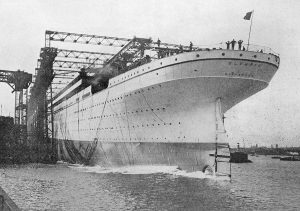
Above: Olympic enters the water for the first time.  The rudder was installed prior to launch and was supported in place as a special precaution.  (The American Marine Engineer, 1910)


Did You Know About John Andrews?

Did You Know About John Andrews?


Northern Ireland’s first Prime Minister, Sir James Craig, served in the post from 1921-40.  He died in office. The United Kingdom of Great Britain and Northern Ireland was at war and it was felt that the next Prime Minister needed to be an ‘exceptional man’.  Historian Alvin Jackson told a BBC documentary that the new Prime Minister faced an ‘almost impossible job’.  Belfast was an important industrial city and an inevitable key target for the German Air Force.

Thomas Andrews’ brother John M. Andrews (1871-1956) was almost 70 years old.  As Labour Minister in the Government of Northern Ireland, he had ensured Northern Ireland had the same social benefits as in Great Britain.  He often deputised for Sir James.  Andrews’ grandson, Johnny Andrews, reflected that John M. Andrews was ‘the natural successor’ with a strong work ethic and attention to detail, who saw politics as a ‘duty’.

In this British Pathe film, John M. Andrews comments about the war against Hitler’s Germany and argues that ‘Ulster is key to the defence of Ireland…to make it neutral would mean handing over that key to Hitler.  A neutral Ulster is impossible…’:


Did You Know Who Used Olympic’s Turkish Baths?

Did You Know Who Used Olympic‘s Turkish Baths?


The first class leisure facilities including the swimming pool, Turkish and electric baths on Olympic were heavily promoted by the White Star Line.  Adriatic (1907) had introduced a Turkish and electric bath complex with a plunge bath.  Their success and popularity encouraged the White Star Line to provide similar facilities on Olympic, including what was the first true swimming pool on an ocean liner.  Both ships had a gymnasium and Olympic also introduced a squash court.  Passengers travelling first class on Olympic had far more options to keep them occupied compared to ships a mere few years earlier.

However, data available from Olympic‘s first three round trip voyages to New York in the summer of 1911 shows a distinct gender divide in the number of female and male passengers who used these facilities:


Number of Passengers Gender Split
Swimming Pool (paid) Ladies (56) 7%
Gentlemen (785) 93%
Swimming Pool (free) Ladies (528) 24%
Gentlemen (1636) 76%
Turkish Baths Ladies (90) 20%
Gentlemen (358) 80%
Electric Baths Ladies (38) 51%
Gentlemen (37) 49%


The passengers using the swimming pool were 81% male (on a combined basis including both the paid and free uses of the pool) and those using the Turkish Baths were 80% male.  Only in the case of the Electric Baths, which were much less popular, were the numbers fairly evenly balanced with female passengers accounting for 51%.

A full gender breakdown of the total number of first class passengers carried during these three round trips is unavailable.  It may well be that there were more male passengers in first class, in general.  However it seems unlikely that this would be to the same extent of the 80/20 split in male/female passengers using the swimming pool and Turkish Baths.  All the indications are that these facilities were significantly more popular with male passengers.


Did You Know About Cunard’s Experience with Lusitania & Mauretania? Ordering ‘Full Astern’

Did You Know About Cunard’s Experience with Lusitania & Mauretania?  Ordering ‘Full Astern’


During my lecture at the British Titanic Society’s convention in Belfast in April 2024, one of the themes I highlighted was how various criticisms of Titanic’s design are often made without reference to the broader context.

The ‘Olympic‘ class ships were triple screw steamers with reciprocating engines driving the port and starboard propellers and a low pressure turbine driving the centre propeller.  One such criticism of the ‘combination’ propelling machinery is that the centre propeller only operated ahead and could not be reversed.  The criticism was that this meant only the port and starboard propellers could be reversed in a scenario where a ‘full astern’ order was given.

However, those voicing this criticism have evidently paid little attention to competitors such as Lusitania and Mauretania.  The two Cunarders were quadruple screw steamers driven solely by turbine engines.  They entered service in 1907 and, by 1911, Cunard’s staff had plenty of experience from their day to day operation.  A memo entitled ‘New Fast Steamer’, dated 7 February 1911 and stamped with an Executive Committee stamp on 21 August 1912, noted a problem based on their experience to date.  Only the two inboard propellers [‘centre shafts’] were reversible:


When going full speed ahead and the order is given to go astern, the rotors on the centre shafts are going astern quite a time before the ahead rotors on the wing shafts have stopped going ahead.  This will retard the progress astern and of course there will be a little drag from the wing propellers after they have stopped going ahead.

As a result, it was suggested that the ‘new fast steamer’ (Aquitania) should be designed so that all four propellers could be reversed: ‘Astern rotors on the wing [propeller] shafts [as well] would overcome this difficulty and enable all four shafts to be revolved in the required direction, which of course would be a great advantage when manoeuvring’.

There are advantages and disadvantages between different propulsion systems.  One system might be superior in one aspect, whereas another might be better on another comparison.  Looking at twin screw ships such as Oceanic (1899), both propellers could be reversed.  Modern day analysis of Titanic‘s or any other vessel’s design simply needs to consider the broader context.  Not only did Lusitania and Mauretania have a similar issue in that only two of their four propellers could run in reverse, but Cunard’s own engineering staff noted that the two wing propellers were still going ahead for a period that the two inner propellers were running astern.