
Titanic: Solving the Mysteries
In January 2017, British television aired a programme entitled Titanic: The New Evidence, which later aired in America under the same title. It sparked a media frenzy around the world. During the programme, it was postulated that new photographic evidence had recently come to light proving that Titanic suffered severe hull damage from a coal bunker fire, and that the damage could be seen from outside the ship on the day she left for her trials, 2 April…
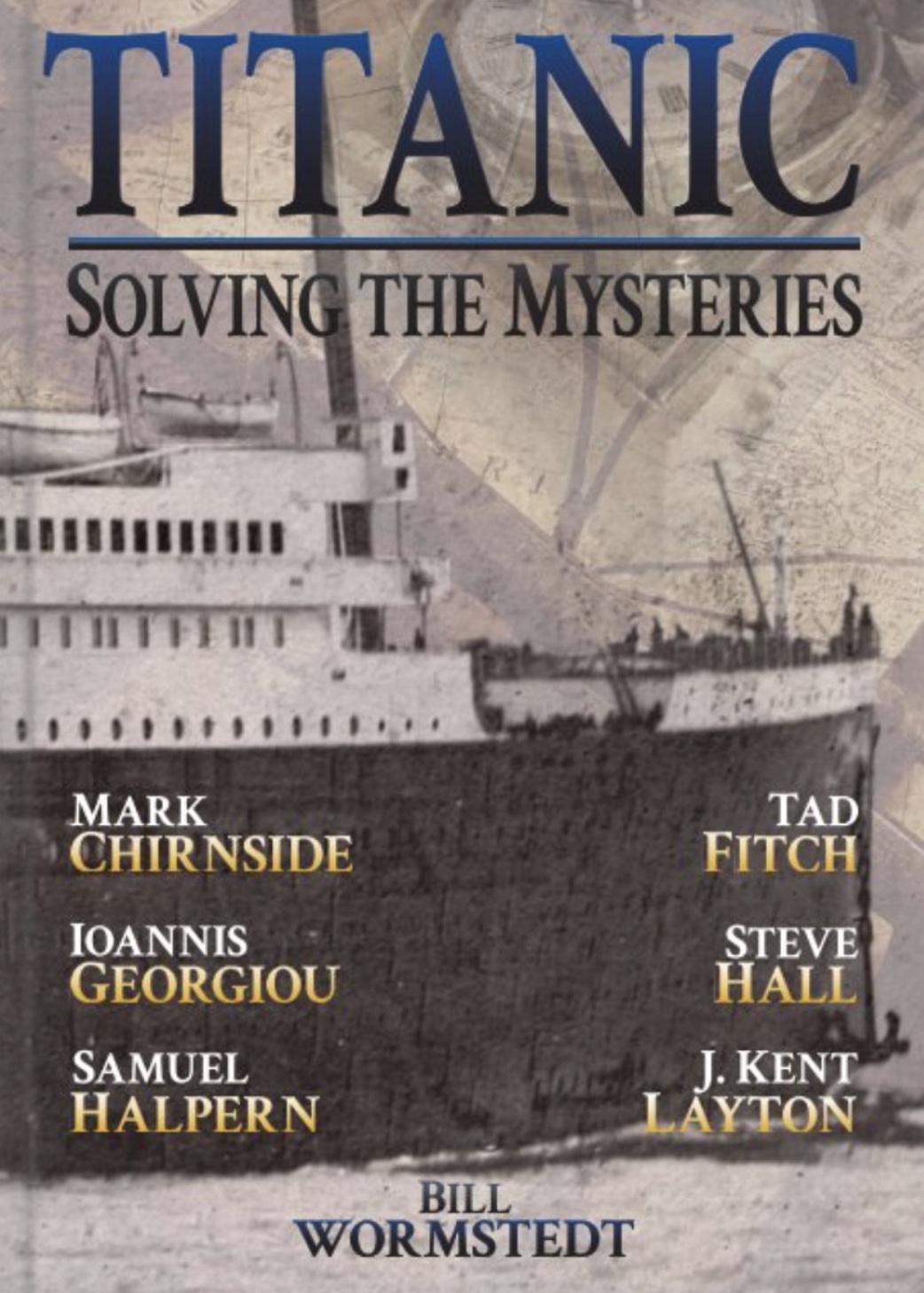
Following the subsequent media storm, when many demonstrably untrue statements were reported as if they were fact, I joined a team of researchers and historians in contributing to a collaborative research paper, which we published online as: ‘Titanic: Fire and Ice (Or What You Will)’ (see press release). Later, in November 2019, the research paper formed part of a monograph published in the book Titanic: Solving the Mysteries.
Our research paper is very detailed and with citations to the sources used. However, the below headline summary highlights our conclusions against each of the key claims (given in bold below)
The smudge [alleged mark of fire damage on Titanic’s bow] and its location. The inaccurate supposition that the smudge is evidence of damage to the Titanic’s hull led to the start of an investigation based on bad data. Other photographs do not show any kind of damage. While it is stated in the show that the coal bunker fire was ‘directly behind’ the smudge, its actual location was over fifty feet away from it. There is no damage visible near the actual location of the coal bunker fire.
The fire. One press account that has known errors is used in the programme to indicate that the fire was never extinguished. This disagrees with testimony given at the inquiries, which state the fire was out by Saturday, April 13 – the day before the iceberg was hit.
Financial pressures and substandard ships. This claim does not match the historical record. Examina-tion of letters to and from Harland & Wolff officials and the Board of Trade representatives referred to in the programme show they are not evidence of substitution of lower-quality steel and cutting corners.
Withholding information, and the decision to hold to the schedule. The situation was not unusual, considering that coal bunker fires were not entirely unheard of on coal-powered ships. Eyewitness testimony indicates that while a bunker fire was the exception rather than the rule, it was handled in line with typical procedures of the day. Since the fire was not regarded as extremely serious, telling passengers would only have made them nervous. If the fire was serious, there would have been clear evidence available to all aboard.
Covering up the fire at the British Inquiry. There is no evidence of a coverup at the British Inquiry. Some of the ‘facts’ stated in this portion are inaccurate. Testimony read during the programme were taken out of context, and do not represent the full extent of the inquiry’s questioning of various eye-witnesses on the matter over the course of multiple days.
The fire began to spread – a deteriorating situation. This is inaccurate. Multiple first-hand accounts by survivors said that it was extinguished on Saturday, and had cooled enough so that the bunker could be entered, and black oil rubbed on the ‘dinged’ bulkhead.
Titanic was short of coal. Inaccurate. Titanic had a reserve steaming time of up to 1.8 days at 21 knots, and even more at slower speeds.
Thomas Andrews believed the ship would survive. Inaccurate. Thomas Andrews told Captain Smith that Titanic was doomed 45 minutes before the rush of water Barrett saw, which the programme said was due to the collapse of the fire-damaged bulkhead.
The fire played one final, deadly role in the disaster: the fire-damaged bulkhead gave way, causing the ship to sink, and the enormous loss of life. Since the ship was doomed from the moment of the collision, whether or not the bulkhead collapsed was more or less immaterial to the timing of the disaster. Lives were not lost because it allegedly collapsed early.
There was a culture of coverup at the White Star Line, and the whole matter was buried. The claims made in the show on this point have nothing to do with reality. ‘YAMSI’ and other code words were routinely used to route traffic to the correct individuals or departments at White Star Line offices.When hard evidence is factored in, there is only one viable conclusion: the coal bunker fire aboard Titanic was not a primary factor in her contact with the iceberg, or in causing her to sink after the she struck the ice. It played no part in the significant loss of life.

Above: On 3 January 2017, I participated in a discussion of the ‘coal fire’ and various other claims on an episode of Talkback, hosted by William Crawley on BBC Radio Ulster. The episode is not currently online but may be available through the BBC archives.