It was an honour to participate as a special guest in an episode of Joanna Strassburg‘s RMS Titanic Reflections: Deep Conversations.
We had a wide-ranging three hour discussion concerning all manner of Titanic and White Star Line related subjects. I spoke a lot about my various research projects and the many different books I’ve authored or co-authored over the years.
Click here or on the image below to watch a replay of the livestream on the RMS Titanic Reflections Facebook page!
Please join us for this very special LIVE event on Monday, September 2, 2024. Mark Chirnside will be the special guest for Deep Conversations Episode 18. Mark is a talented and very knowledgable author and historian. He has appeared in many documentaries to provide his expertise regarding many topics….
FAQ: Titanic‘s Weight: How Much Did Titanic Weigh?
Gross tonnage is NOT a measure of weight
There is a lot of confusion about the subject of Titanic‘s weight, which is not helped by some of the terminology used. We often see references to the ship’s ‘gross tonnage’. However, despite what the term implies with the use of the word ‘tonnage’, it is not a measure of weight. It actually measures the total enclosed space within the ship’s hull and superstructure. Therefore references in the media which refer to a comparison of ‘gross tonnage’ and to Titanic being approximately 1,000 tons ‘heavier’ than her sister Olympic are completely inaccurate (and all too common).
The total weight of the ship (displacement) was calculated as 52,310 tons when she was loaded to her designed draught of 34 feet 7 inches – precisely the same as her sister Olympic. (Their larger, younger sister ship Britannic had a displacement of 53,170 tons and the same designed draught.) This was made up of the lightweight (the weight of the ship herself, including her hull, engines, machinery and permanent fittings before she was loaded for sea) plus the deadweight (the weight of the cargo loaded onboard, including everything from her human cargo – passengers and crew – to the coal, other supplies for the voyage and commercial cargo carried in the ship’s holds). These figures are all given in the British, Imperial measure.
This data is taken from shipbuilder Harland & Wolff’s records and summarised below. We see that Titanic in an unloaded condition weighed 480 tons more than her older sister Olympic and that her deadweight was correspondingly smaller. However, both ships’ total weight (displacement) was the same assuming that they were loaded to their designed draught.
It is important to understand that, despite all the confusion in secondary sources (such as articles, books, television programmes and so forth), the primary source evidence (original, contemporary documentation) is all very clear in regard to how much the ship weighed. The ship’s displacement is confirmed in multiple original documents, including Harland & Wolff’s records; Olympic‘s displacement scale (which shows how much water she displaced at a given draught); and the Board of Trade. It is benchmarked against figures Thomas Andrews provided for Olympic in 1911.
FAQ: Was Titanic’s Starboard Propeller Used to Repair Olympic after the Hawke collision?
No.
The available evidence indicates that Harland & Wolff used three spare blades as replacements for the three damaged blades on Olympic’s starboard propeller.
George Cuming, one of Harland & Wolff’s managing directors, was one of a number of professionals to see Olympic in drydock. On 14 October 1911, he summarised the necessary repair work to an Engineer Commander, whose report went to the Director of Dockyards (on behalf of the Admiralty) some days later.
Olympic’s Starboard Propeller Blades
There was some good news: ‘There are no marks on the propeller blades of the centre and port shafts to show that these have been touched by anything at the time of collision’. Unfortunately, the starboard propeller blades were all damaged:
The three blades have been removed; they are damaged towards the tips. They are probably bent as well although this is not obvious. Mr. Cummings’ [sic] proposal is to scrap these three blades, appropriate three spare and replace the spare blades used. The blades are…manganese bronze.
Olympic’s Starboard Propeller Boss
The starboard propeller boss itself (the cylinder at the centre of the propeller to which the blades were attached) was ‘apparently undamaged’ but either of Titanic’s port or starboard propeller bosses were available to use as a replacement in the event that any damage to Olympic’s starboard propeller boss became apparent later. (There is no evidence that it did.) Harland & Wolff proposed to ‘anneal the studs for securing the blades, and if necessary, to renew them’. (To ‘anneal’ meant to heat the material and then allow it to cool slowly, which made it easier to work. In the event, it was necessary to renew at least some of them.)
Olympic’s Starboard Propeller Shafting
There was damage to Olympic’s propeller shafting, but Harland & Wolff did not think any bent shafting could be straightened out or repaired. Instead, it would need to be replaced:
The tail shaft can be withdrawn into the dock and so removed to the shop, the three pieces forward of this necessitate that certain plates should be removed from the ship’s side so as to pass them out into the dock and so send into the shop.
Where the shafting passes through [watertight] bulkheads, the plating has had to be cut in order to uncouple and pass the shafting to be removed through the orifice being cut in the ship’s side.
It is not expected that these four lengths will be in the shop for another seven or eight days, and so the renewal necessary as regards them is unknown. As a precautionary measure a forging has been ordered for one length of shafting. The shafting is hollow and Messrs. Harland & Wolff do not consider that if any length is bent it can be made serviceable by straightening.
The Titanic’s shafting is available if necessary but if used would entail considerable delay in that ship’s completion, as the engines are now being put into her.
While Olympic was in dry dock, Harland & Wolff took the opportunity to increase the pitch of her port propeller blades from 33 feet to 34 feet 6 inches. The cost was accounted for separately to the repairs of the collision damage. The new starboard propeller blades were undoubtedly set at the same pitch.
Olympic in drydock for her annual overhaul, January 1929. (‘Rivet counters’ might notice that there are five rows of rivets around the top of the centre propeller aperture. This is one of several easy ways to identify photos of Olympic which date from after her stern frame was replaced over the winter of 1925-26. As built, there were only four rows of rivets in this location.) (White Star Magazine, 1929/Author’s collection)
‘Titanic at 110: Learning, Unlearning & Relearning History’
My presentation in April 2022 at PRONI discussed some key Titanic topics.
PRONI in partnership with the Belfast Titanic Society welcome Mark Chirnside to give a talk to mark the 110th anniversary of the sinking of RMS Titanic.
Titanic is one of the most famous ships in history and people might justifiably ask whether there is anything new to learn. However, 110 years after her loss many commonly-cited facts about the ship are either based on questionable evidence or are demonstrably untrue. Statements are often repeated from one modern-day source to another without reference to contemporary documentation from 1912.
Mark Chirnside takes a look at some of the testimonies of survivors from the bridge, engine and boiler rooms in a discussion about what happened before the collision; explores an example of documentation being mischaracterised in modern-day media; and discusses recently unearthed evidence about Titanic’s propeller configuration.
‘‘Olympic & Titanic: “A Very Remote Contingency” – Lifeboats for All’
My presentation in September 2021 at PRONI discussed the topic of lifeboats. I set the scene by covering the key points about lifeboat provision during the decades preceding the Titanic disaster; the regulations in 1912 and how they had evolved; and how Harland & Wolff and the White Star Line exceeded the legal requirements for lifeboat capacity.
Contrary to popular belief, there is no evidence that Harland & Wolff recommended to the White Star Line that more lifeboats should be fitted. What they did do is provide a new Welin davit design which would enable them to carry more lifeboats in the future, if the regulations changed. They also provided four additional semi collapsible boats for each ship. Comparing the number of lifeboats shown on the ‘Design “D”‘ concept which the White Star Line approved in July 1908 with Titanic as completed in April 1912, the number of lifeboats increased from 16 to 20.
I closed the presentation by covering some examples of inaccurate claims about Titanic‘s lifeboats in the mass media. One was a completely inaccurate characterisation of a Harland & Wolff drawing office notebook, which a television programme claimed was evidence that Harland & Wolff had intended originally for Titanic to be fitted with enough lifeboats for everyone (in fact, it was a document recording changes to Olympic‘s lifeboat configuration in the 1912-13 refit). Another was a newspaper article mischaracterising notes which were authored by Board of Trade surveyor Captain Maurice Harvey Clarke. They were written after the disaster, not before.
Mark explores the issue of lifeboat regulation over the decades preceding the Titanic disaster and discusses the context immediately prior to 1912. He discusses the question of lifeboat provision for these new White Star giants and dispels a few longstanding myths and false claims made about Titanic’s lifeboats.
In January 2017, British television aired a programme entitled Titanic: The New Evidence, which later aired in America under the same title. It sparked a media frenzy around the world. During the programme, it was postulated that new photographic evidence had recently come to light proving that Titanic suffered severe hull damage from a coal bunker fire, and that the damage could be seen from outside the ship on the day she left for her trials, 2 April…
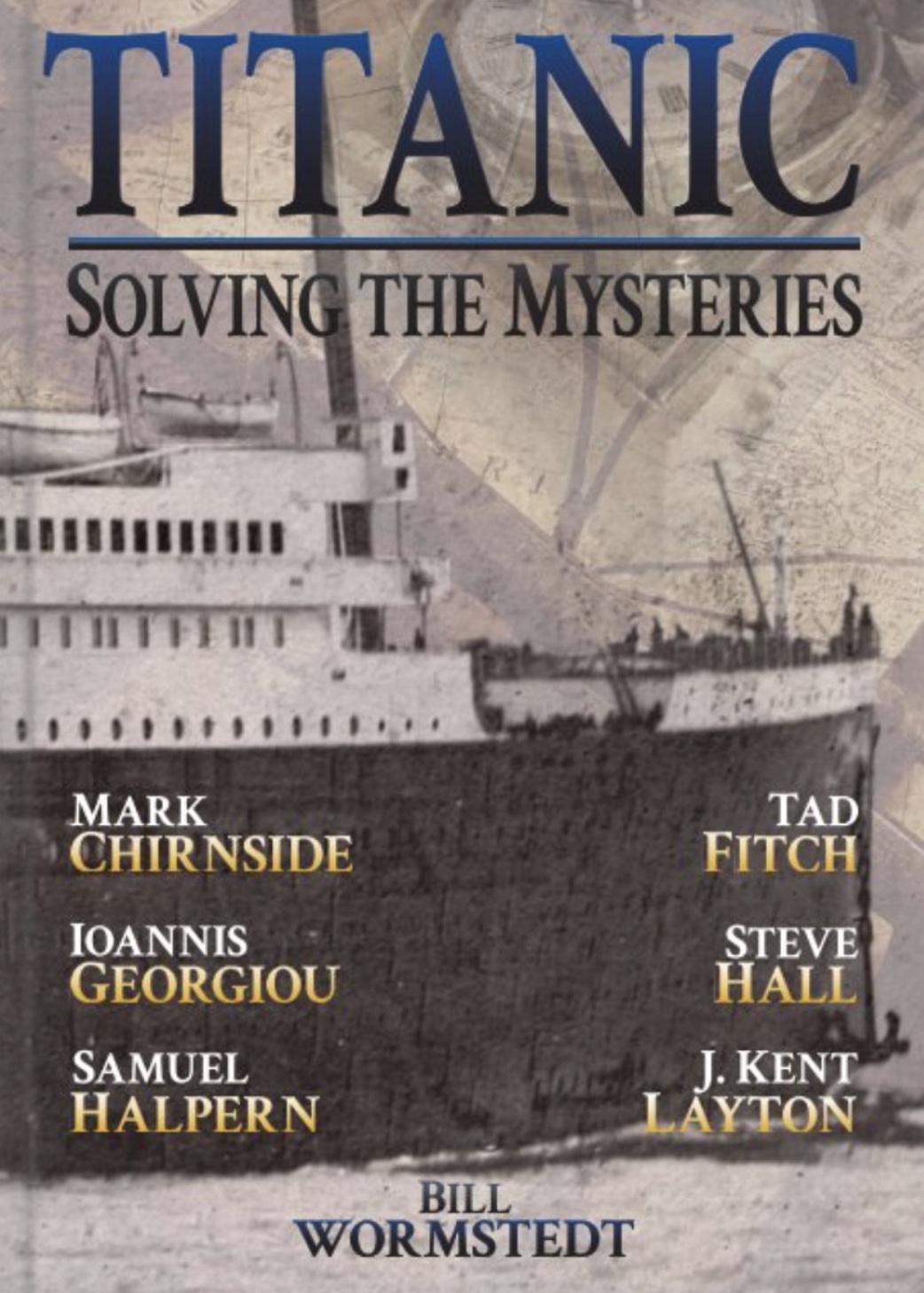
Following the subsequent media storm, when many demonstrably untrue statements were reported as if they were fact, I joined a team of researchers and historians in contributing to a collaborative research paper, which we published online as: ‘Titanic: Fire and Ice (Or What You Will)’ (see press release). Later, in November 2019, the research paper formed part of a monograph published in the book Titanic: Solving the Mysteries.
Our research paper is very detailed and with citations to the sources used. However, the below headline summary highlights our conclusions against each of the key claims (given in bold below)
The smudge [alleged mark of fire damage on Titanic’s bow] and its location. The inaccurate supposition that the smudge is evidence of damage to the Titanic’s hull led to the start of an investigation based on bad data. Other photographs do not show any kind of damage. While it is stated in the show that the coal bunker fire was ‘directly behind’ the smudge, its actual location was over fifty feet away from it. There is no damage visible near the actual location of the coal bunker fire. The fire. One press account that has known errors is used in the programme to indicate that the fire was never extinguished. This disagrees with testimony given at the inquiries, which state the fire was out by Saturday, April 13 – the day before the iceberg was hit. Financial pressures and substandard ships. This claim does not match the historical record. Examina-tion of letters to and from Harland & Wolff officials and the Board of Trade representatives referred to in the programme show they are not evidence of substitution of lower-quality steel and cutting corners. Withholding information, and the decision to hold to the schedule. The situation was not unusual, considering that coal bunker fires were not entirely unheard of on coal-powered ships. Eyewitness testimony indicates that while a bunker fire was the exception rather than the rule, it was handled in line with typical procedures of the day. Since the fire was not regarded as extremely serious, telling passengers would only have made them nervous. If the fire was serious, there would have been clear evidence available to all aboard. Covering up the fire at the British Inquiry. There is no evidence of a coverup at the British Inquiry. Some of the ‘facts’ stated in this portion are inaccurate. Testimony read during the programme were taken out of context, and do not represent the full extent of the inquiry’s questioning of various eye-witnesses on the matter over the course of multiple days. The fire began to spread – a deteriorating situation. This is inaccurate. Multiple first-hand accounts by survivors said that it was extinguished on Saturday, and had cooled enough so that the bunker could be entered, and black oil rubbed on the ‘dinged’ bulkhead. Titanic was short of coal. Inaccurate. Titanic had a reserve steaming time of up to 1.8 days at 21 knots, and even more at slower speeds. Thomas Andrews believed the ship would survive. Inaccurate. Thomas Andrews told Captain Smith that Titanic was doomed 45 minutes before the rush of water Barrett saw, which the programme said was due to the collapse of the fire-damaged bulkhead. The fire played one final, deadly role in the disaster: the fire-damaged bulkhead gave way, causing the ship to sink, and the enormous loss of life. Since the ship was doomed from the moment of the collision, whether or not the bulkhead collapsed was more or less immaterial to the timing of the disaster. Lives were not lost because it allegedly collapsed early. There was a culture of coverup at the White Star Line, and the whole matter was buried. The claims made in the show on this point have nothing to do with reality. ‘YAMSI’ and other code words were routinely used to route traffic to the correct individuals or departments at White Star Line offices.
When hard evidence is factored in, there is only one viable conclusion: the coal bunker fire aboard Titanic was not a primary factor in her contact with the iceberg, or in causing her to sink after the she struck the ice. It played no part in the significant loss of life.
Above: On 3 January 2017, I participated in a discussion of the ‘coal fire’ and various other claims on an episode of Talkback, hosted by William Crawley on BBC Radio Ulster. The episode is not currently online but may be available through the BBC archives.