Olympic & Titanic: Triumph and Disaster – Chapter 3
Published on
Olympic & Titanic: Triumph and Disaster – Chapter 3
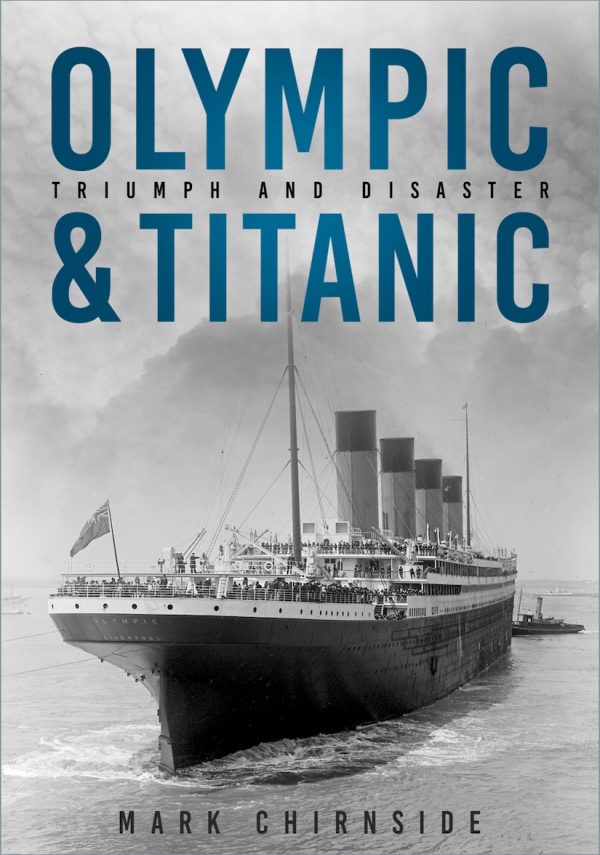
Chapter 3, ‘Unsinkable’, explores topics related to safety and sea and ship design.
We start by looking at the context in the decades prior to 1912. Many modern liners were claimed to be ‘practically unsinkable’ or similar, due to their watertight bulkheads. There are several examples of ships being late to port and their owners reassuring the public in the meantime that their passengers and crew would be safe.
There are several examples of earlier liners built without watertight doors. Practical reality forced shipowners and shipbuilders to cut open the watertight bulkheads and fit watertight doors retrospectively. We also see the views of naval architects such as Leonard Peskett and Edward Wilding and how they thought watertight doors were essential in the machinery compartments of large North Atlantic passenger steamers.
The design specifications of White Star’s new ships are covered at length, including exploring the standard of watertight subdivision on other contemporary ships. Harland & Wolff went above and beyond the design requirements and exceeded contemporary standards by a significant margin. We see that the watertight subdivision was improved during the design process (with an increase in the number of compartments). An assessment of the strength of the watertight bulkheads showed them very favourably.
We examine the pros and cons of Olympic‘s watertight subdivision compared to Mauretania‘s. Safety statistics for the preceding two decades show that, statistically, the North Atlantic route had been very safe historically. We read about Thomas Henry Ismay’s efforts to improve safety and the use of the North and Southern routes to avoid ice.
The history of safety legislation is explored, including discussions in the 1880s about lifeboat requirements. Sir Digby Murray, professional member of the Marine Department of the Board of Trade, had even argued that:
I do not think you are going to save life by increasing the boats; I think it must be done by the subdivision of the ships. If you really want to save life that is the only way of doing it, and in that case a smaller number of boats would suffice.
We track the history of lifeboat requirements and how shipping lines were preparing, by 1911-12, for a future where more lifeboats would be obligatory. This included the use of a new type of davit on Olympic and her sister to accommodate more boats, if needed, and an increase in the number of lifeboats by adding four semi-collapsibles. The approach is to place the new White Star ships in context with competitors, including previously unpublished and little known information. (We also see an example of Harland & Wolff pushing back against another shipping line’s query about the need to improve the lifeboat provision on a new passenger liner.)
Contrary to popular misconception, even smaller liners did not carry ‘boats for all’. The chapter closes by putting forward the wider context. We see how quickly things were moving by 1911-12, including Cunard’s decision to provide ‘boats for all’ on their new Aquitania. Even so, professionals agreed that the best way to preserve life was either to avoid danger entirely or to ensure that watertight subdivision could keep a damaged ship afloat…