Late in November 1908, Harland & Wolff placed their order for both rudders with the Darlington Forge Company Ltd. The rudders were intended to be identical with each ship’s rudder weighing about 101 tons. Each was to be made from Siemen’s Martin mild cast steel, however the shipbuilder specified stringent material and workmanship standards that had to be met. These standards are not always fully understood or appreciated.
The rudder castings needed to have a tensile strength (the ultimate strength that the material could take before breaking) of ’28 to 35 tons per square inch’ with an elastic limit (the greatest stress the material could take without permanent deformation) 45 per cent of the tensile strength. The material also needed to be bent ‘through an angle of 60 to 80 degrees without fracture’ when ‘cold’. Test pieces needed to be tested in the presence of a Lloyd’s representative as well as one from Harland & Wolff ‘if we so require’. They also required the Lloyd’s representative to certify the test results.
Olympic’s rudder was due for delivery by January 1910 and Titanic’s by July 1910. They also required a guarantee against the ‘material and workmanship’ which would be valid for twelve months from the date of each ship starting on her maiden voyage.
When Harland & Wolff ordered the rudders for the Royal Mail Steam Packet company’s new cargo ships Berbice and Balantia the following month, the order specified merely that their rudders had to be made about of the same material and certified by Lloyd’s classification society.
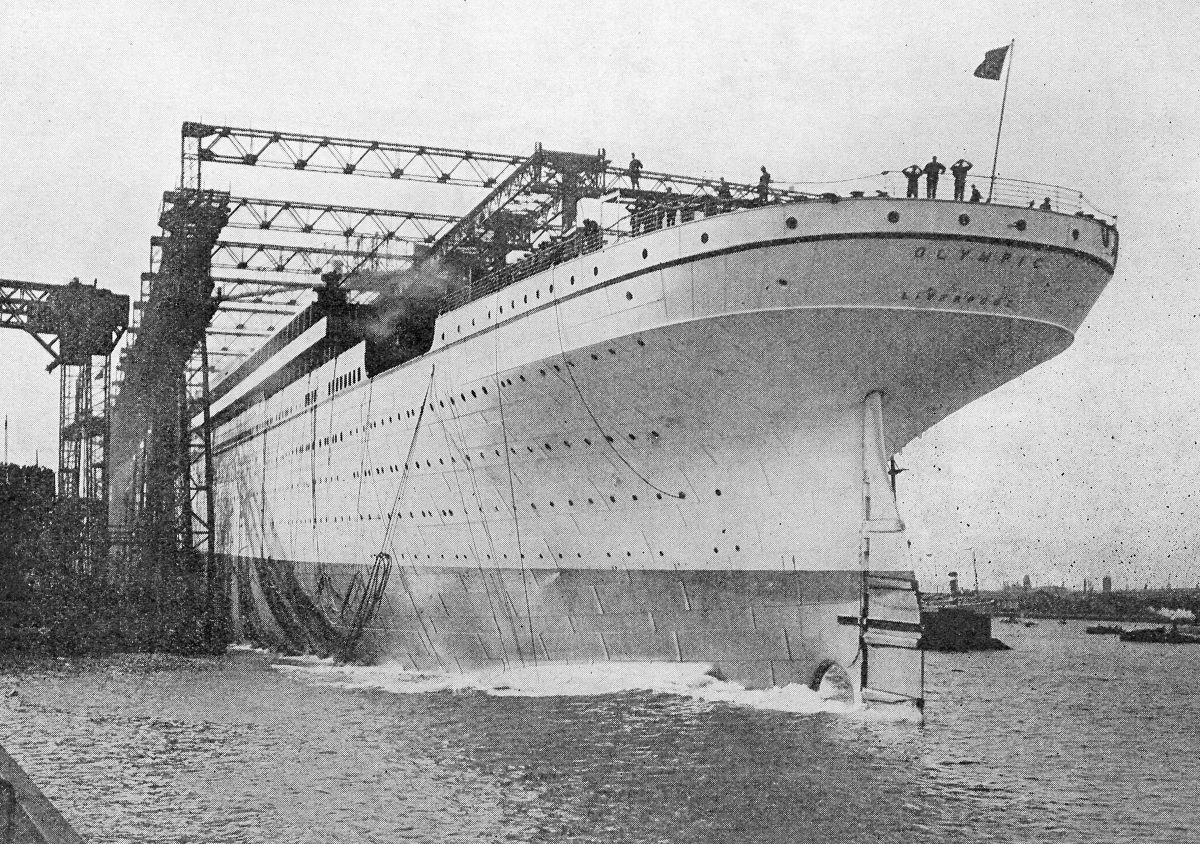
Above: Olympic enters the water for the first time. The rudder was installed prior to launch and was supported in place as a special precaution. (The American Marine Engineer, 1910)