Captain Smith’s Titanic Quote

Captain Smith’s Titanic Quote

Captain Smith’s Titanic Quote

Titanic was headline news for weeks following the disaster.  On 16 April 1912, the New York Times included an article about Captain Smith and his career in their coverage.  Within that article were extracts from comments Smith had reportedly made on the conclusion of Adriatic‘s successful maiden voyage almost five years earlier, to the press in New York.  It is easy to see why a newspaper reporter would want to quote Smith’s comments.  He had spoken about his ‘uneventful’ career and the love of the ocean that he had had since childhood. Then, he went on to talk about the safety of modern passenger liners. Those comments had a sad irony given the recent disaster.  One common quotation, used by historians in the decades to come, was:

I will say that I cannot imagine any condition which could cause a ship to founder.  I cannot conceive of any vital disaster happening to this vessel.  Modern shipbuilding has gone beyond that.

Back in 2008, I began to worry that I had not been able to find Smith’s comments in newspaper coverage from that summer of 1907.  I found it somewhat uncomfortable that our source seemed to be only a post-disaster publication.  However, thanks to the effort of a number of researchers including the late Mark Baber, Smith biographer Gary Cooper, and Dr. Paul Lee, sources for the quotation were found from pre-disaster publications.  These included press reports dating from later in 1907 through to a report in The World’s Work in April 1909 (shown in an extract from a slide in my presentation to the British Titanic Society in April 2024, below).


By comparison, the New York Times’  report published on 16 April 1912 had some interesting differences in emphasis.  For example, rather than saying ‘modern shipbuilding has gone beyond that’, the pre-disaster quote was ‘modern shipbuilding has reduced that danger to a minimum’. The New York Times also summarised Smith’s preceding comments, paraphrasing him: ‘Captain Smith maintained that shipbuilding was such a perfect art nowadays that absolute disaster, involving the passengers on a great modern liner, was quite unthinkable. Whatever happened, he contended, there would be time before the vessel sank to save the lives of every person on board’.  The paraphrased summary was broadly accurate, but it omitted the comment ‘I will not assert that she is unsinkable’ [emphasized above].

All of Smith’s reported comments are important and they need to be understood in their full context.   It’s also important to recognise that even the pre-disaster quotations are from a secondary source and rely on a degree of assumption that what Smith said was reported with reasonable accuracy!


On A Sea of Glass & Part Time Explorer 113th Anniversary Titanic Livestream 2025

On A Sea of Glass & Part-Time Explorer 113th Anniversary Titanic Livestream 2025

I am honoured to have been invited to participate in the On A Sea of Glass and Part-Time Explorer 113th Anniversary Titanic Livestream, which will be broadcast on Thomas Lynskey’s Part-Time Explorer channel on YouTube.  It starts at 9.30 p.m. Eastern Time (United States) on Monday 14 April 2025 / 2.30 a.m. (United Kingdom) on Monday 15 April 2025.  The livestream will also be recorded and available to replay afterwards.

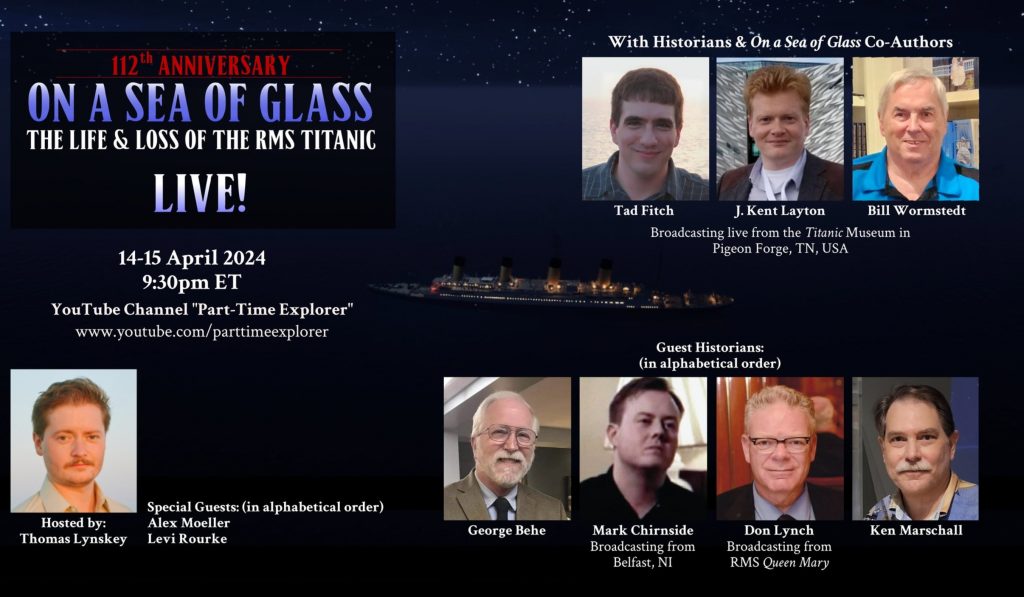
Hosted by Thomas Lynskey, it includes special guests Alex Moeller and Levi Rourke; historians and On A Sea of Glass co-authors Tad Fitch, J. Kent Layton and Bill Wormstedt; and guest historians Don Lynch, Ken Marschall and I. 


Article from the Archives: ‘Olympic & Titanic: Refining a Design’


Mark Chirnside’s Reception Room first came online back on 1 April 2005!  Since then, it has expanded substantially and been redesigned twice (2007 and 2022) to keep it fit for purpose.  The nature of the internet and online content means that so many websites which were available then are no longer with us.  One of those websites was the Titanic Research & Modelling Association (TRMA) which was pioneering in its day. (Fortunately, much of it is archived and preserved as a static site.)


My article ‘Olympic & Titanic: Refining a Design‘, is a revised and expanded version of a short article of mine published by TRMA in 2005.  It was published in the British Titanic Society’s Atlantic Daily Bulletin 2019: Pages 18-22.     

Author’s Note: Back in 2005, I published information about some previously unknown refinements to Titanic based on experience Harland & Wolff gained from observing Olympic during a particularly severe North Atlantic storm in January 1912. The article was published on the Titanic Research & Modelling Association (TRMA) website. It discussed some modifications to some of her rivetted joints fore and aft: Olympic’s great length meant that the stresses at these points – from about a quarter of her length ahead of the stern and a quarter of her length abaft the bow – required some additional reinforcement, beyond what previous experience had suggested was necessary, to prevent rivets in these areas becoming gradually slack in severe weather conditions.

It goes to show how much we are still learning about the ‘Olympic’ class ships all these years later, but the demise of the TRMA website offered an opportunity to publish this new article. It contains the original article’s information about the changes to Titanic, supplemented by additional material, including new diagrams of both Titanic and Britannic, and contextual information about other large liners of the period.

When I published this information for the first time all those years ago, my view was that these refinements demonstrated the fundamental strength of Olympic. Harland & Wolff were following their usual practice, as Edward Harland had explained back in 1873, of using their experience from operating new ships over their early voyages to proactively make improvements to them and their sister ships.  She experienced a storm in January 1912 which was one of the worst of her entire career and which Captain Smith reportedly said was the worst he had ever seen in all his decades of North Atlantic service.  The North Atlantic in winter storm conditions is an extremely hostile environment but she came through it: the modifications were not intended to remedy any serious defect which had occurred but to prevent future maintenance requirements.  Ships such as Olympic were built as fast passenger and mail steamers, designed to run through these hostile conditions even at relatively high speed.   


Nonetheless, I was contacted shortly after the original article’s publication by an American conspiracy theorist who was trying to argue that Titanic was a weak ship that sank because she broke up, rather than the reality that she was a strong ship which broke up in the final stages of sinking. (The cause of the breakup is that she was exposed to stresses over a prolonged period that were far greater than what she would have experienced in the worst possible storm conditions that she was designed for. No comparable passenger liner was designed to have her stern raised clear of the water for an extended period, unsupported.)  He sought to use the information I had published (which he mischaracterised and deliberately took out of context) to support his claims and, unfortunately, all too many others followed suit:  It is a very common problem with Titanic that many people look at her in isolation without looking at the broader context or doing an objective analysis.  That context includes her sister ships as well as other large liners of the period.


Sensationalism is often what draws attention in the mass media and one example of this was a headline in a United Kingdom newspaper, which echoed his claims:

‘Titanic faced disaster from the moment it set sail, experts now believe…Even if the ocean liner had not struck an iceberg during its maiden voyage, structural weaknesses made it vulnerable to any stormy sea’. (Copping, Jasper. ‘Revealed: Titanic Was Doomed Before it Set Sail’, Daily Telegraph 10 June 2007)

This headline stands in stark contrast to the assessments of experienced professionals at the time, summarised by two short quotes from a number of examples.  Edward Wilding, Harland & Wolff naval architect, 1915:

We have had less repairs to the Olympic than to any large ship we have ever built, due to external causes, of course’

Principal Ship Surveyor to the Board of Trade, 1925:

Olympic…has, I think, proved to be a successful ship in the matter of strength’.

On the positive side, the design changes outlined in my article have also been analysed and cited by serious researchers.  (For an analysis of these changes and their potential impact on Titanic, see Parks Stephenson’s article ‘What Caused Titanic to Sink?’ in the Titanic Historical Society’s Titanic Commutator 2014: Volume 39 Number 206. Pages 92- 100. See, also: Rudi Newman’s ‘A “Riveting” Article – an Historical Rejoinder to Metallurgical Studies of the Titanic Disaster’ in the British Titanic Society’s Atlantic Daily Bulletin 2012: Pages 18-30.)  Following on from my 2005 article, when The ‘Olympic’ Class Ships: Olympic, Titanic & Britannic was published (History Press; revised and expanded edition, 2011) I included this information on page 226.


Titanic’s ‘Achilles Heel’? Steam & Splendor Podcast – Season 1 Episodes 3-4

Titanic‘s ‘Achilles Heel’? Steam & Splendor Podcast – Season 1 Episodes 3-4 Mark Chirnside


I have to say that it’s the best Titanic related media I’ve ever heard or seen…your contribution to dispelling the myths is just outstanding.  Compelling and fascinating. 

All too often, sensationalist claims are made in the media about Titanic and the disaster which befell her. A typical theme is claims of an ‘Achilles Heel’, design ‘flaws’, poor materials or even that Titanic was doomed from the start.  The mundane reality that Titanic was a well built and designed ship, which sank because she sustained extraordinary damage as a result of an awesome encounter with an iceberg, does not make headlines.

I was pleased to participate in two podcast episodes where we discussed a large number of these issues over the course of nearly two hours.  We covered a great deal of material.  Grab a coffee and listen in!

Part 1: Hosts Tad Fitch and J. Kent Layton are joined by author and researcher Mark Chirnside for an eye-opening discussion that challenges everything you thought you knew about the Titanic and her sister ships. Over the years, myths have surfaced claiming these iconic liners were poorly designed, made with subpar materials, and doomed from the start. But how much of that is actually true? Join us as we discuss the allegations, break down what the actual historical documentation and context indicates, and dispel some long-held myths.

Part 2: Join hosts Tad Fitch and J. Kent Layton as they continue their discussion with researcher Mark Chirnside, diving into the historical record to uncover the truth about the safety, reliability, and durability of the Titanic and ‘Olympic’ Class ships. How well-designed and safe was RMS Olympic—both before and after its post-Titanic disaster refit? Tune in as they examine the evidence, compare the design of these ships to their contemporaries and debunk long-held myths.


A Voyage on Olympic: Willem Frederik Piek

A Voyage on Olympic: Willem Frederik Piek Jr.’s Notes for the Holland America Line, December 1911

A new article of mine, ‘A Voyage on Olympic: Willem Frederik Piek Jr.’s Notes for the Holland America Line, December 1911′ (external link) has been published on Encyclopedia Titanica.

Born in Amsterdam on 16 March 1874, Willem Frederik Piek Jr. became the head agent of the Holland America Line in New York, in 1912; four years later, he became a director of the company, serving in that position until 1935. In December 1911, he boarded Olympic at New York for an eastbound crossing (the passenger list also included ‘Mrs Piek’). Travelling first class, his objective was to check out what life was like onboard. How comfortable was her passenger accommodation? How was the White Star service? How might they lure away her passengers?

His meticulous notes, handwritten in Dutch, provide fascinating details of what it was like to sail on Olympic. They contain the sort of observations that cannot be found in period journals such as The Shipbuilder, or in chatty, casual letters home from passengers. It all adds to the social history of Olympic and provides a glimpse of what life might have been like onboard Titanic, such as first class passengers stealing spoons from adjacent tables, or maids and valets hanging around the companionways because they only had a dining saloon on C-deck.

One common factor when observers acting for one shipping line wrote about competitors’ vessels is that they often seemed very critical about particular aspects of a ship. This can also be seen in reports Cunard’s naval architect, Leonard Peskett, wrote about Olympic in August 1911 and Imperator in June 1913. If advertisements of the period extolled a ship’s virtues, then competitors’ criticisms provide a counterweight. The reality lies in between. Indeed, we also see positives such as the lack of items which rattled in first class staterooms.

This is believed to be the first time that his notes have been published. They illustrate the importance of diversifying beyond English language sources. His observations and a vast array of other hitherto unpublished material will be included in Mark Chirnside’s next book, from which much of this article is drawn from.

This article was first published in the Titanic International Society’s Voyage 128 July 2024: Pages 158-62. (A German language version was published in the Swiss Titanic Society’s Titanic Post 129 September 2024: Pages 125-30.)

A number of the locations that Piek referred to in his notes, such as the maids’ and valets’ dining saloon, can be seen recreated as they were on Titanic through Titanic: Honor & Glory’s DEMO 401 Update 2.0 Release Day Tour

Above: The Holland America liner Rotterdam (1908) was built by Harland & Wolff.  She introduced many innovations and set a number of new standards in passenger accommodation.  (Author’s collection)


Titanic Witness Podcast – Episode 17

Titanic Witness Podcast – Episode 17 Mark Chirnside: Maritime Author


My recent podcast with James Penca for his Titanic Witnesses series is available.  We discussed my personal research journey, from when I first started visiting archives and undertaking research using the primary source materials, to common problems with Titanic information disseminated in the media and secondary sources.  There are a large number of aspects of Titanic‘s history where there is widespread inaccurate information in secondary sources (such as media reports or television programmes), which is often subject to fierce debate online as to what is correct or not.  The use of primary sources is essential to forming the most accurate understanding of history that we can.  In many cases, the primary sources provide a definitive answer.  Much of the confusion we see could easily be avoided by relying on the primary documentation, but instead we see demonstrably false statements repeated from one secondary source to another.   

Have you ever wondered how much work goes into the writing of your favorite history books? This week, we are joined by celebrated maritime author Mark Chirnside for a look at the many road blocks and pitfalls that come with Titanic research. Welcome to WITNESS TITANIC, a podcast where we interview witnesses of the infamous Titanic disaster including modern experts, enthusiasts, and even the survivors of the sinking. Like the century-old inquiries that came before us, we may never fully determine what really happened on that cold April night but you may be surprised to find how close our efforts will bring us to Titanic herself… 


Deep Conversations – Episode 18

Deep Conversations – Episode 18 Mark Chirnside


It was an honour to participate as a special guest in an episode of Joanna Strassburg‘s RMS Titanic Reflections: Deep Conversations.

We had a wide-ranging three hour discussion concerning all manner of Titanic and White Star Line related subjects.  I spoke a lot about my various research projects and the many different books I’ve authored or co-authored over the years.

Click here or on the image below to watch a replay of the livestream on the RMS Titanic Reflections Facebook page! 

Please join us for this very special LIVE event on Monday, September 2, 2024. Mark Chirnside will be the special guest for Deep Conversations Episode 18. Mark is a talented and very knowledgable author and historian. He has appeared in many documentaries to provide his expertise regarding many topics…. 


FAQ: How Much Did Titanic Weigh?

FAQ: Titanic‘s Weight: How Much Did Titanic Weigh?

Gross tonnage is NOT a measure of weight

There is a lot of confusion about the subject of Titanic‘s weight, which is not helped by some of the terminology used.  We often see references to the ship’s ‘gross tonnage’.  However, despite what the term implies with the use of the word ‘tonnage’, it is not a measure of weight.  It actually measures the total enclosed space within the ship’s hull and superstructure. Therefore references in the media which refer to a comparison of ‘gross tonnage’ and to Titanic being approximately 1,000 tons ‘heavier’ than her sister Olympic are completely inaccurate (and all too common).

The total weight of the ship (displacement) was calculated as 52,310 tons when she was loaded to her designed draught of 34 feet 7 inches – precisely the same as her sister Olympic.  (Their larger, younger sister ship Britannic had a displacement of 53,170 tons and the same designed draught.)  This was made up of the lightweight (the weight of the ship herself, including her hull, engines, machinery and permanent fittings before she was loaded for sea) plus the deadweight (the weight of the cargo loaded onboard, including everything from her human cargo – passengers and crew – to the coal, other supplies for the voyage and commercial cargo carried in the ship’s holds).  These figures are all given in the British, Imperial measure.

This data is taken from shipbuilder Harland & Wolff’s records and summarised below.  We see that Titanic in an unloaded condition weighed 480 tons more than her older sister Olympic and that her deadweight was correspondingly smaller. However, both ships’ total weight (displacement) was the same assuming that they were loaded to their designed draught.   


It is important to understand that, despite all the confusion in secondary sources (such as articles, books, television programmes and so forth), the primary source evidence (original, contemporary documentation) is all very clear in regard to how much the ship weighed.  The ship’s displacement is confirmed in multiple original documents, including Harland & Wolff’s records; Olympic‘s displacement scale (which shows how much water she displaced at a given draught); and the Board of Trade.  It is benchmarked against figures Thomas Andrews provided for Olympic in 1911.


FAQ: Was Titanic’s Starboard Propeller Used to Repair Olympic after the Hawke collision?

FAQ: Was Titanic’s Starboard Propeller Used to Repair Olympic after the Hawke collision?


No.

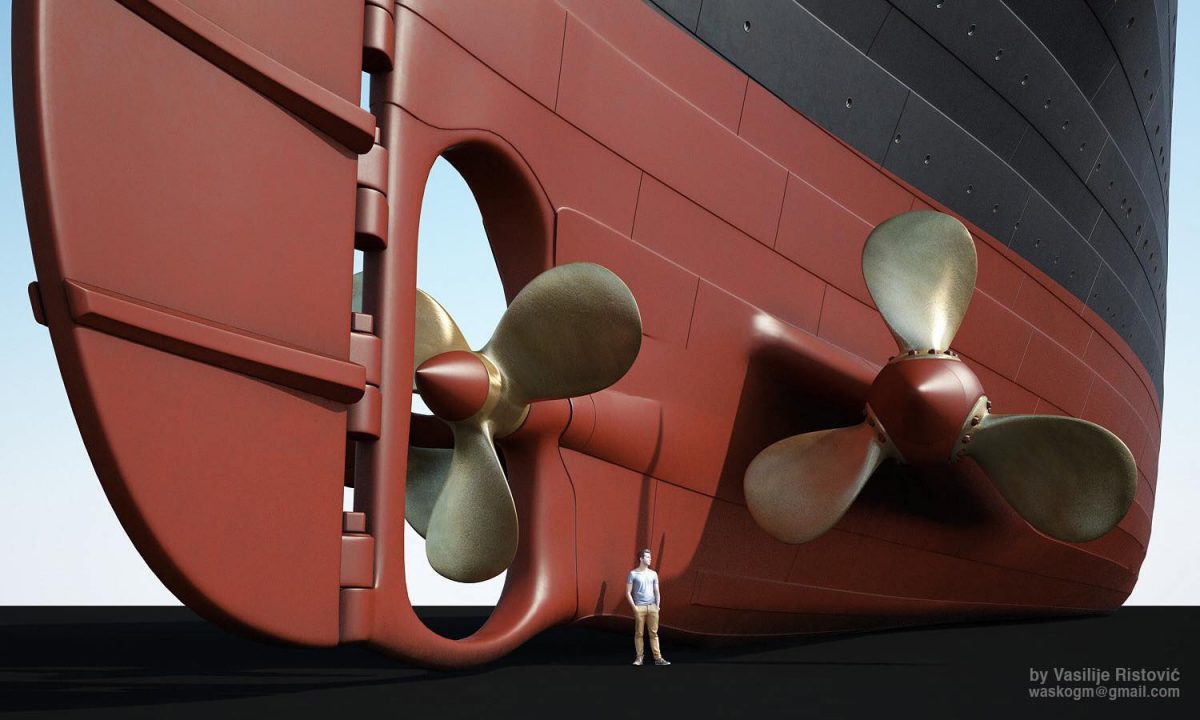
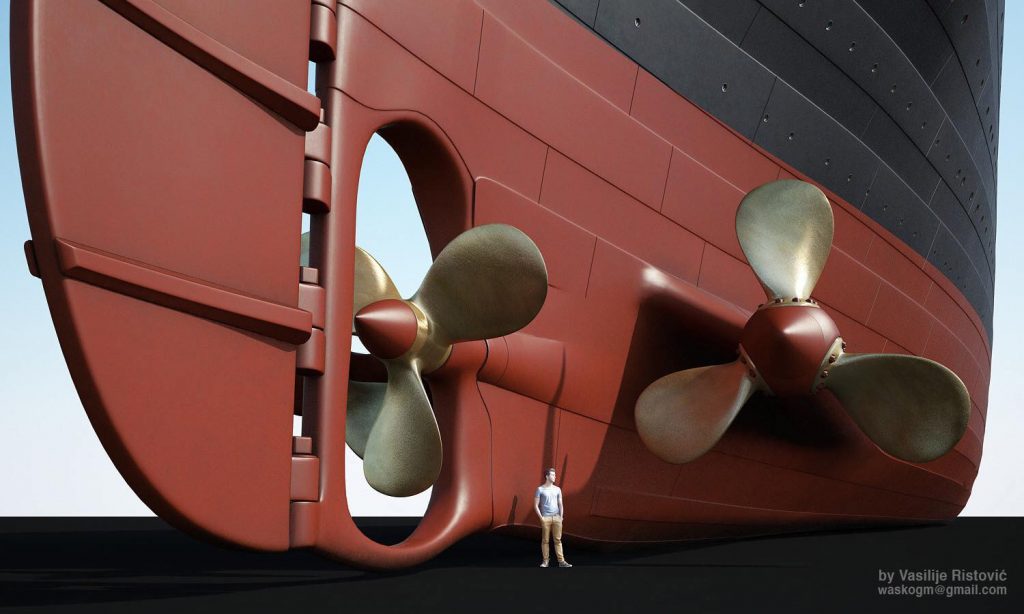
The available evidence indicates that Harland & Wolff used three spare blades as replacements for the three damaged blades on Olympic’s starboard propeller.

George Cuming, one of Harland & Wolff’s managing directors, was one of a number of professionals to see Olympic in drydock.  On 14 October 1911, he summarised the necessary repair work to an Engineer Commander, whose report went to the Director of Dockyards (on behalf of the Admiralty) some days later.

Olympic’s Starboard Propeller Blades

There was some good news: ‘There are no marks on the propeller blades of the centre and port shafts to show that these have been touched by anything at the time of collision’.  Unfortunately, the starboard propeller blades were all damaged:

The three blades have been removed; they are damaged towards the tips.  They are probably bent as well although this is not obvious.  Mr. Cummings’ [sic] proposal is to scrap these three blades, appropriate three spare and replace the spare blades used.  The blades are…manganese bronze.

Olympic’s Starboard Propeller Boss

The starboard propeller boss itself (the cylinder at the centre of the propeller to which the blades were attached) was ‘apparently undamaged’ but either of Titanic’s port or starboard propeller bosses were available to use as a replacement in the event that any damage to Olympic’s starboard propeller boss became apparent later.  (There is no evidence that it did.)  Harland & Wolff proposed to ‘anneal the studs for securing the blades, and if necessary, to renew them’.  (To ‘anneal’ meant to heat the material and then allow it to cool slowly, which made it easier to work.  In the event, it was necessary to renew at least some of them.)

Olympic’s Starboard Propeller Shafting

There was damage to Olympic’s propeller shafting, but Harland & Wolff did not think any bent shafting could be straightened out or repaired.  Instead, it would need to be replaced:

The tail shaft can be withdrawn into the dock and so removed to the shop, the three pieces forward of this necessitate that certain plates should be removed from the ship’s side so as to pass them out into the dock and so send into the shop.

Where the shafting passes through [watertight] bulkheads, the plating has had to be cut in order to uncouple and pass the shafting to be removed through the orifice being cut in the ship’s side.

It is not expected that these four lengths will be in the shop for another seven or eight days, and so the renewal necessary as regards them is unknown. As a precautionary measure a forging has been ordered for one length of shafting. The shafting is hollow and Messrs. Harland & Wolff do not consider that if any length is bent it can be made serviceable by straightening.

The Titanic’s shafting is available if necessary but if used would entail considerable delay in that ship’s completion, as the engines are now being put into her.

While Olympic was in dry dock, Harland & Wolff took the opportunity to increase the pitch of her port propeller blades from 33 feet to 34 feet 6 inches.  The cost was accounted for separately to the repairs of the collision damage.  The new starboard propeller blades were undoubtedly set at the same pitch. 


Olympic Starboard Propeller 1929
Olympic in drydock for her annual overhaul, January 1929. (‘Rivet counters’ might notice that there are five rows of rivets around the top of the centre propeller aperture.  This is one of several easy ways to identify photos of Olympic which date from after her stern frame was replaced over the winter of 1925-26.  As built, there were only four rows of rivets in this location.) (White Star Magazine, 1929/Author’s collection)


‘Secrets of the Lost Liners’ Series 2

Secrets of the Lost Liners Series 2

Sky HISTORY’s Series 2 of their successful Secrets of the Lost Liners is coming soon!  The first episode features Titanic and will be broadcast on 29 April 2024.  I contributed to some episodes in Series 1, which were broadcast in 2022, and I was pleased to contribute to Series 2 as well.

#SecretsOfTheLostLiners @HISTORYUK


On A Sea of Glass & Part-Time Explorer 112th Anniversary Titanic Livestream 2024 replay

On A Sea of Glass & Part-Time Explorer 112th Anniversary Titanic Livestream 2024 – replay available on YouTube

The On A Sea of Glass and Part-Time Explorer 112th Anniversary Titanic Livestream, which was broadcast on Thomas Lynskey’s Part-Time Explorer channel on YouTube, is available to replay.

As I reflected earlier this week:

It was incredible to be part of the On a Sea of Glass livestream for the 112th anniversary of Titanic’s loss, hosted by Thomas Lynskey with special guests Alex Moeller and Levi Rourke; On A Sea of Glass co-authors and historians Tad Fitch, J. Kent Layton, Bill Wormstedt; and guest historians George Behe, Ken Marschall and Don Lynch.
I’ve learned so much from these guys and, as I think I mentioned during the event, Ken Marschall’s paintings illustrated the children’s book Exploring the Titanic, which was my first book about the subject as a young child. If I had been told back then that I’d have the honour of being part of this event, all these years later, I wouldn’t have believed it!
…Not forgetting the many other excellent events happening this last week, including Bruce Beveridge and Steve Hall discussing the countdown to collision and Titanic: Honor & Glory’s own livestream with stunning animations.
As we talked through the real time animation of the sinking, it struck me how fast time was going and my perception of it. It was ‘midnight’ before we knew it and I think many of us felt the pressure of time, simply trying to get in points of historical commentary. The sinking was relatively long compared to Britannic (1916), Lusitania (1915) or Express of Ireland (1914), but that was not how it seemed – and we had the advantage of knowing how much time was left. Those aboard Titanic had no such advantage and their circumstances were not editorial concerns for a programme, but a matter of life or death.
I did not sleep that night. In the morning, I emerged from the hotel to daylight and looked over the slipways where Olympic, Titanic and Britannic were built. Later, we saw a rainbow.


On A Sea of Glass & Part-Time Explorer 112th Anniversary Titanic Livestream 2024

On A Sea of Glass & Part-Time Explorer 112th Anniversary Titanic Livestream 2024

I am honoured to have been invited to participate in the On A Sea of Glass and Part-Time Explorer 112th Anniversary Titanic Livestream, which will be broadcast on Thomas Lynskey’s Part-Time Explorer channel on YouTube.  It starts at 9.30 p.m. Eastern Time (United States) on Sunday 14 April 2024 / 2.30 a.m. (United Kingdom) on Monday 15 April 2024.  The livestream will also be recorded and available to replay afterwards.

Hosted by Thomas Lynskey, it includes special guests Alex Moeller and Levi Rourke; historians and On A Sea of Glass co-authors Tad Fitch, J. Kent Layton and Bill Wormstedt; and guest historians George Behe, Don Lynch, Ken Marschall and I. 


Big Ships and Small Boats

New Article: Big Ships and Small Boats

A new article, ‘Big Ships and Small Boats’ has been uploaded.

In the years leading up to the Titanic disaster, ships were getting significantly larger.  A lot of comment at the time and up to the present day has focused on the increasing size of ships in relation to the lifeboats they needed to carry under the law.  However, this overlooks the fact that the size of a ship was not necessarily a reliable indicator of how many passengers and crew she could carry.  This article provides a snapshot comparison between Olympic and Carpathia in April 1912 and some comparative British government data looking at the largest foreign-going passenger steamers, their passenger and crew capacity and lifeboat provision.

It was first published in the Titanic International Society’s Voyage September 2022: Pages 3-4.


‘Olympic: Thomas Andrews’ Notes from a Successful Maiden Voyage’

It was great to be able to present my lecture about Thomas Andrews and the observations he made during Olympic‘s maiden voyage in June 1911.  I spoke at PRONI, in a lecture jointly supported by PRONI and the Belfast Titanic Society:

‘Olympic: Thomas Andrews’ Notes from a Successful Maiden Voyage”’
(September 2023)

In June 1911, Thomas Andrews was onboard Olympic during her maiden voyage to observe how she performed under normal operating conditions at sea; to monitor her progress; and make all sorts of notes. His comments were wide ranging and went beyond matters of shipbuilding in a number of cases.  These included recommendations for changing particular operating procedures or improving the working practices of the ship’s crew; improving aspects of the ship’s passenger accommodation and increasing her earning power, such as by adding additional staterooms; or in making economies (he saw no need to provide both linoleum tiles and carpeting in the captain’s sitting room).  He made a particular recommendation to try and help keep third class female passengers safe from unwanted attention. Andrews’ notes included many aspects where Titanic‘s design was improved compared to Olympic‘s.  They show a remarkable attention to detail, demonstrating the concerns of a knowledgeable professional who was intent on improving her design in even the slightest way. 


Titanic Talkline

Titanic Talkline Podcast

My Titanic Talkline podcast (Season 1, Episode 17) is available online: ‘Mark Chirnside comes aboard this week for a great chat about the Titanic and her sister ships, Olympic and Britannic, as well as the Harland and Wolff shipyards!’ Thanks to Alexia Thirumalai for inviting me and hosting.


‘”The Old Rules…Are Entirely Obsolete”: British Lifeboat Regulation in the 1880s’

New Article: ‘”The Old Rules…Are Entirely Obsolete”: British Lifeboat Regulation in the 1880s’

A new article, ‘”The Old Rules…Are Entirely Obsolete”: British Lifeboat Regulation in the 1880s’, explores lifeboat regulations in the 1880s. They were comparatively worse than the rules in force when Titanic foundered in 1912, but a senior official argued  ‘you can make ships perfectly safe by [watertight] subdivision’.


‘Titanic at 110: Learning, Unlearning & Relearning History’

Titanic at 110: Learning, Unlearning & Relearning History’


My presentation in April 2022 at PRONI discussed some key Titanic topics. 

PRONI in partnership with the Belfast Titanic Society welcome Mark Chirnside to give a talk to mark the 110th anniversary of the sinking of RMS Titanic.

Titanic is one of the most famous ships in history and people might justifiably ask whether there is anything new to learn. However, 110 years after her loss many commonly-cited facts about the ship are either based on questionable evidence or are demonstrably untrue. Statements are often repeated from one modern-day source to another without reference to contemporary documentation from 1912.

Mark Chirnside takes a look at some of the testimonies of survivors from the bridge, engine and boiler rooms in a discussion about what happened before the collision; explores an example of documentation being mischaracterised in modern-day media; and discusses recently unearthed evidence about Titanic’s propeller configuration.


‘Olympic & Titanic: “A Very Remote Contingency” – Lifeboats for All’

‘‘Olympic & Titanic: “A Very Remote Contingency” – Lifeboats for All’ 


My presentation in September 2021 at PRONI discussed the topic of lifeboats.  I set the scene by covering the key points about lifeboat provision during the decades preceding the Titanic disaster; the regulations in 1912 and how they had evolved; and how Harland & Wolff and the White Star Line exceeded the legal requirements for lifeboat capacity.


Contrary to popular belief, there is no evidence that Harland & Wolff recommended to the White Star Line that more lifeboats should be fitted.  What they did do is provide a new Welin davit design which would enable them to carry more lifeboats in the future, if the regulations changed.  They also provided four additional semi collapsible boats for each ship.  Comparing the number of lifeboats shown on the ‘Design “D”‘ concept which the White Star Line approved in July 1908 with Titanic as completed in April 1912, the number of lifeboats increased from 16 to 20.     

I closed the presentation by covering some examples of inaccurate claims about Titanic‘s lifeboats in the mass media.  One was a completely inaccurate characterisation of a Harland & Wolff drawing office notebook, which a television programme claimed was evidence that Harland & Wolff had intended originally for Titanic to be fitted with enough lifeboats for everyone (in fact, it was a document recording changes to Olympic‘s lifeboat configuration in the 1912-13 refit).  Another was a newspaper article mischaracterising notes which were authored by Board of Trade surveyor Captain Maurice Harvey Clarke.  They were written after the disaster, not before.   

Mark explores the issue of lifeboat regulation over the decades preceding the Titanic disaster and discusses the context immediately prior to 1912. He discusses the question of lifeboat provision for these new White Star giants and dispels a few longstanding myths and false claims made about Titanic’s lifeboats.


Presentation from the Archives: ‘The Chairman & The Commander: J. Bruce Ismay and Captain “E. J.” Smith’


My ‘superb’ presentation in September 2020 at PRONI discussed both J. Bruce Ismay and Captain Smith.  Key topics include J. Bruce Ismay’s correspondence several weeks before the Titanic disaster, when he writes about his daughter’s wedding coming up in March 1912 and explains that he will sail on Titanic on 10 April 1912, expecting to return to Southampton on 27 April 1912; Captain Smith’s ‘uneventful’ career is discussed in some detail, including the Hawke collision on 20 September 1911.   

A talk focusing on two of the key personalities in the Titanic story: the White Star Line’s chairman, J. Bruce Ismay, and the Line’s senior captain, ‘E. J.’ Smith. Mark explores some of the history of these two men in the years leading up to 1912, including little known anecdotes and events – as well as some of the misconceptions surrounding them.


Presentation from the Archives: ‘An”Olympic” Challenge: “We Have Reached the Limit…’


Building the largest ships in the world wasn’t simply a question of the shipbuilding process itself.  There were all sorts of other practical challenges to consider, including financing them, insuring them, expanding the port and docking facilities to operate and maintain them, and powering them across the North Atlantic. My presentation in September 2019 at PRONI discussed a number of these key issues and highlighted just how many logistical challenges the White Star Line was faced with.