Olympic & Titanic: Triumph and Disaster Quotes

Olympic & Titanic: Triumph and Disaster – Three Parts


The book contains seventeen chapters as well as seven appendices.  There is an incredible amount of information and so we decided that the book would work well divided into three parts, each containing between five and six chapters.

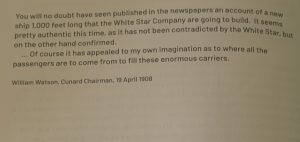
Each part is introduced by its own section, differentiated by a black strip running down the page.  They are populated by quotes from the various chapters which give a flavour of the material. They have been chosen to support the narrative and are from material which is either rare or previously unpublished.  One example is a quote included in the introduction to Part 1, which is from William Watson, Cunard’s chairman, writing in April 1908.  He discussed a number of issues at that time and commented on recent press reports claiming (inaccurately) that the White Star Line were going to built a new 1,000-foot liner.  The potential implication he saw in such a large ship was that she would carry a very great number of passengers, leading him to ponder ‘where all the passengers are going to come from’.


In reality, the White Star Line opted to use the greater size of their new ships to increase the number of first and second class passengers, rather than third class.  What that meant was that they carried fewer passengers compared to what they might have done if third class had been prioritised.  Indeed, Olympic carried fewer passengers than some ships far smaller than her.

By January 1909, Cunard had a much better idea of the true scale of White Star’s new ships, as well as vessels under construction for Norddeutscher Lloyd.  Throughout 1909 and 1910, they followed developments closely and tried to understand what HAPAG, Norddeutscher Lloyd and White Star were planning. All of this effort helped underpin the design of their new Aquitania…


FAQ: Would It Have Been Inconvenient for Titanic to Arrive in New York on Tuesday?

FAQ: Would It Have Been Inconvenient for Titanic to Arrive in New York on Tuesday?


Titanic never reached New York, but there has been a lot of discussion over the years about her projected arrival time.  All of the details of that debate are beyond the scope of this post.  Instead, it will focus on what we know about Olympic.

Information is available about the arrival times for six of Olympic‘s first eight westbound crossings in 1911-12.  These include:

Westbound Voyage 1: Arrival at Ambrose Channel Light Vessel 2.24 a.m. Wednesday 21 June 1911

Westbound Voyage 2: Arrival at Ambrose Channel Light Vessel 10.08 p.m. Tuesday 18 July 1911

Westbound Voyage 3: Arrival at Ambrose Channel Light Vessel 9.10 p.m. Tuesday 15 August 1911

Westbound Voyage 4: Arrival at Ambrose Channel Light Vessel 5.40 p.m. Tuesday 5 September 1911 

Westbound Voyage 7: Arrival at Ambrose Channel Light Vessel afternoon of Wednesday 17 January 1912

Westbound Voyage 8: Arrival at Ambrose Channel Light Vessel 9.37 p.m. Tuesday 13 February 1912.

What we can see from these six westbound crossings is that Olympic arrived at the Ambrose Channel Light Vessel on Tuesday evening on four out of six occasions.  In the case of her fourth westbound crossing, she docked in New York on the Tuesday evening as well as disembarked all her passengers.

On her maiden voyage, she arrived there less than two-and-a-half hours after midnight, but it is known she left Queenstown, Ireland, about three hours late and that she had been delayed about one-and-a-half hours during the crossing due to fog. In other words, it was those two delays which combined to prevent her arriving on Tuesday evening on that occasion.

The sixth westbound crossing was actually one of the slowest of Olympic‘s long career.  She averaged less than 19 knots, taking more than six days and six hours to complete the crossing due to horrendous weather conditions.

There is a question of how we define ‘arrival’.  When someone talks about arriving in New York, they might be referring to the arrival at the Ambrose Channel Light Vessel, which marked the end point of the transatlantic crossing, or, alternatively, the time the ship actually completed her docking. It is therefore important to be precise with our definitions.  The White Star Line reassured their passengers that, if the ship docked after 8 p.m., they had the option to remain onboard overnight and have breakfast in the morning, rather than disembark.  In other words, passengers were not inconvenienced in either case if they had based their plans on disembarking on Wednesday.  On the one occasion when she docked on Tuesday evening, the passengers were reported to be satisfied and without complaint, disembarking by about 11.30 p.m.

What is clear from the available data is that Olympic regularly arrived at the Ambrose Channel Light Vessel in New York on Tuesday evening and she also docked in New York on one occasion (when she was on the shorter northern track, which cut more than a hundred nautical miles off the voyage distance).  There is therefore no basis to state that any inconvenience would have been caused to her passengers if Titanic arrived in New York on Tuesday evening, because her older sister did so repeatedly in 1911-12. 


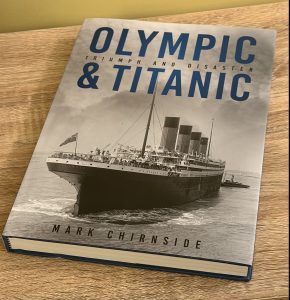
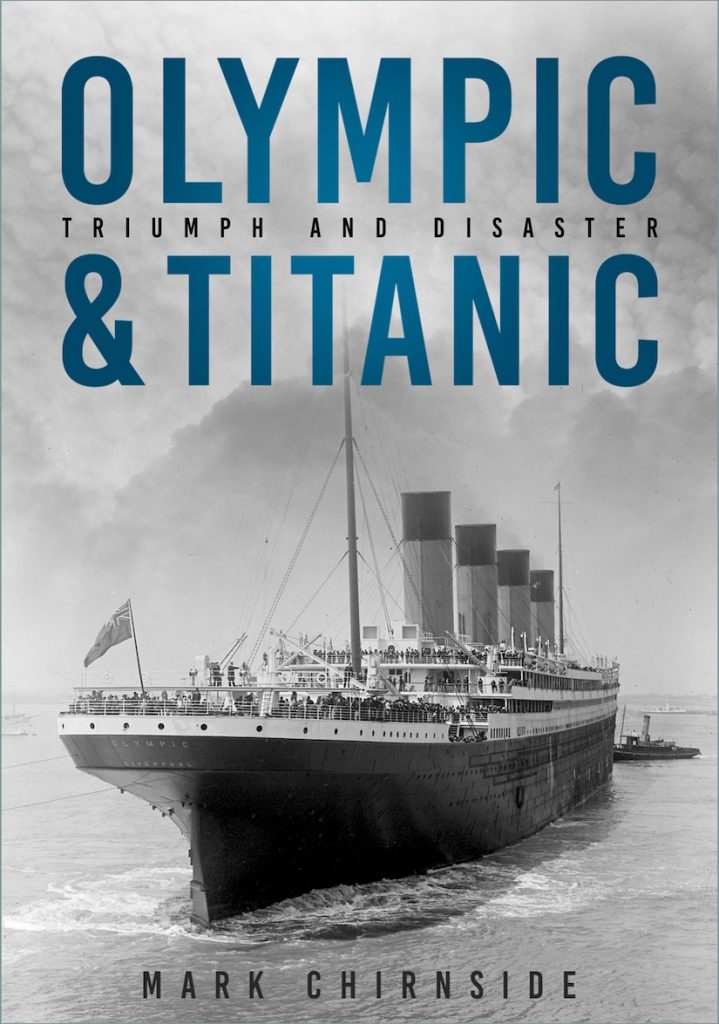
Olympic & Titanic: Triumph And Disaster Cover


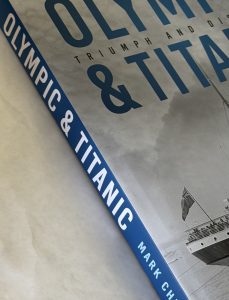
Olympic & Titanic: Triumph and Disaster – Judging a Book by its Cover

Olympic & Titanic: Triumph and Disaster – Judging a Book by its Cover


There is a cliche that you should not judge a book by its cover, but many people probably do exactly that!

Getting a book’s cover design correct is very important.  This includes not just the front, but the rear cover as well.  Imagery catches the eye.  The cover also needs to convey the content of the book.  The process is a collaborative effort between the author and the design team at the publisher.

The title of the book, Olympic & Titanic: Triumph and Disaster, is intended to draw the contrast between the first two of the three ‘Olympic‘ class ships.  A theme throughout is how similar these ships were from a design perspective and how their stories diverged so significantly.  It seemed appropriate that Olympic should be on the front cover, as the more successful of the two.  We see her depicted in a wonderful, sharp photograph as she sets out for New York.  Everything portends a long, successful career which is exactly what lay ahead of her.

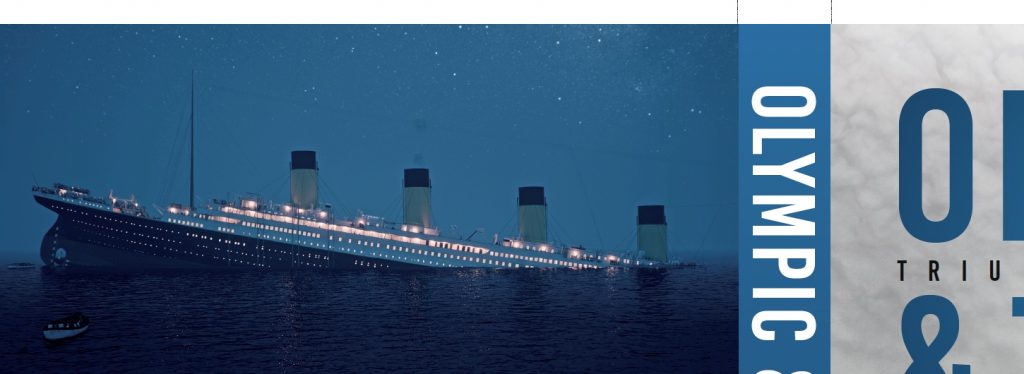
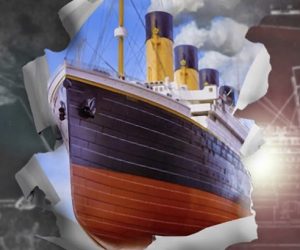
To complete the comparison, Titanic found her place on the rear cover.  She represents the opposite of her successful sister – the ‘disaster’ in the final word of the book’s title. There are illustrations from 1912 depicting the sinking but I thought that a colour image would be a better representation and form a contrast with the black and grey colouring of the front cover.  It was a pleasure to work with Tom Lynskey and Levi Rourke from HFX Studios, who kindly permitted us to use an illustration from their most recent Titanic sinking animation.  As an added bonus, they had worked with the publisher before in providing imagery for other book covers, so were well acquainted with the process.   


I think the cover designer, Martin Latham, and the History Press team did an excellent job.  I feel the whole combination works well, with the blue lettering on the front cover, blue spine and dust jackets, and then the darker, blue sea extended down the rear cover to provide space for reviewer’s quotes. 

To learn more about HFX Studios’ work or watch their stunning YouTube documentaries, click on the logos below!


The Oceanic Historical Society

The Oceanic Historical Society


The White Star Line was the trading name of the Oceanic Steam Navigation Company Limited.  During their many decades, they operated two ships called Oceanic and had plans for a third.  Those plans, which were taking shape from the mid 1920s, never became a reality.  Nonetheless, new material continues to be uncovered about their intentions for this great ship through the efforts of Eric Okanume.

You can find out more about his exciting research project here.

The Oceanic Historical Society is led by a team of contributing historians who collaborate to research and document the history of the Oceanic. Founded by Eric Okanume, the Society unites dedicated researchers working to uncover new information, verify existing sources, and piece together a clearer understanding of the project’s development. Together, we combine our findings to create a comprehensive record of Oceanic’s legacy and the broader history of Harland & Wolff, the White Star Line, and twentieth-century shipbuilding.


Counterfactual: Sinking the Mauretania

Counterfactual: Sinking the Mauretania


Cunard’s Mauretania left Queenstown for New York on 14 April 1912, three days behind Titanic.  For the sake of a counterfactual, this post imagines a scenario where the Cunarder struck an iceberg and sank instead.

Edward Wilding and Leonard Peskett produced a joint memo for the British Wreck Commissioner’s court to try and answer the hypothetical question about whether Mauretania would have remained afloat if she had sustained similar damage to Titanic:

We have considered by approximate methods the flooding of the Mauretania in the event of an accident similar to that met with by the Titanic. We have assumed the watertight doors and hatches to be closed and similar deductions to those made in the calculations for the Titanic. From the calculations made, taking the vessel as damaged from the stem to the afterend of the forward boiler room (corresponding nearly – but not quite – to the length from the stem to the afterend of the No. 5 boiler room in the Titanic) the vessel would remain afloat with a considerable list, say 15 deg. to 20 deg., which, no doubt, could be slowly reduced by carefully flooding some after spaces on the opposite side. With the data available we do not think we can satisfactorily discuss flooding corresponding to the damage extending into No. 4 boiler room in the Titanic.

Their memo considered a specific scenario and it is not clear Mauretania could have remained afloat.  Wilding explained: ‘in order that the water should not rise above the top of the bulkhead, we had to assume the bunkers flooded on the other side. [author’s emphasis]  It would be quite a practicable operation by raising the watertight doors, but they would have to be opened so that the water could get through to the port bunkers’.  The longitudinal watertight bulkhead in the foremost boiler room would contain flooding, but at the cost of causing a considerable list to the starboard side.  Peskett  testified that he had no knowledge of any successful counter-flooding being carried out.  Wilding thought it ‘a dangerous thing to do, to try and remedy such a defect by letting water into a much larger compartment than you already have it in’.  He also thought that, with such a serious list, ‘water might find some other way in’ apart from the initial damage (such as through open portholes).  Their analysis also excluded potential damage equivalent to what Titanic may have incurred in the way of her boiler room 4.

There does seem a narrow possibility that Mauretania could potentially have survived, but this counterfactual will assume that efforts to correct the serious list to starboard would have been unsuccessful.  That would mean water would have risen above the watertight bulkhead.  The Cunarder would therefore have foundered, sinking by the bow and with a serious starboard list.

Turbine driven ships such as the Cunarders needed to have both separate ahead and astern turbines.  The reason for this was that the ahead turbines could not be reversed. One concern, expressed in a memo to Cunard management dated 7 February 1911, was that they only had astern turbines on two of the four propeller shafts. This caused a delay in stopping the ship:

When going full speed ahead and the order is given to go astern, the rotors on the centre shafts are going astern quite a time before the ahead rotors on the wing shafts have stopped going ahead.  This will retard the progress astern and of course there will be a little drag from the wing propellers after they have stopped going ahead.

Cunard opted prior to April 1912 to include astern turbines on all of their new Aquitania‘s propeller shafts, recognising that this was a better configuration.  Might they have faced criticism for Mauretania‘s manoeuvring abilities?  The combination propelling machinery arrangement on Olympic and Titanic meant that the port and starboard (reciprocating) engines could be stopped and reversed, even though the turbine driven centre propeller only operated ahead.  Titanic‘s stopping distance on sea trials was also far less than Lusitania‘s. 

Mauretania was equipped with a total of sixteen lifeboats under the older style radial davits, also providing a capacity far short of the maximum number of passengers and crew she could carry.  Their absolute and relative capacity was somewhat less than Titanic‘s.  As Leonard Peskett recalled in May 1912:

When the question of boat capacity of such ships as the Mauretania and Lusitania was brought forward, the special subdivision of those particular vessels was taken into account, and it was considered that owing to the extraordinary precautions which had been taken, the total capacity of boats necessary to be carried would be fully met by the existing Rules’

Might Cunard have faced criticism that Mauretania‘s lifeboat capacity was slightly less than Titanic‘s? Or that her davits were not as advanced as the new Welin design used on Olympic and Titanic?

If Mauretania was listing significantly, it might have meant that the lifeboats on one side of the ship would have been unavailable for use.  Peskett acknowledged this problem in relation to Aquitania, in September 1911:

it would…be more easy to control the passengers and get them away into boats from the gangway doors on E deck, than it have a rush of 4,000 people on to the boat deck, struggling to get into the boats, which would probably be available on one side only…

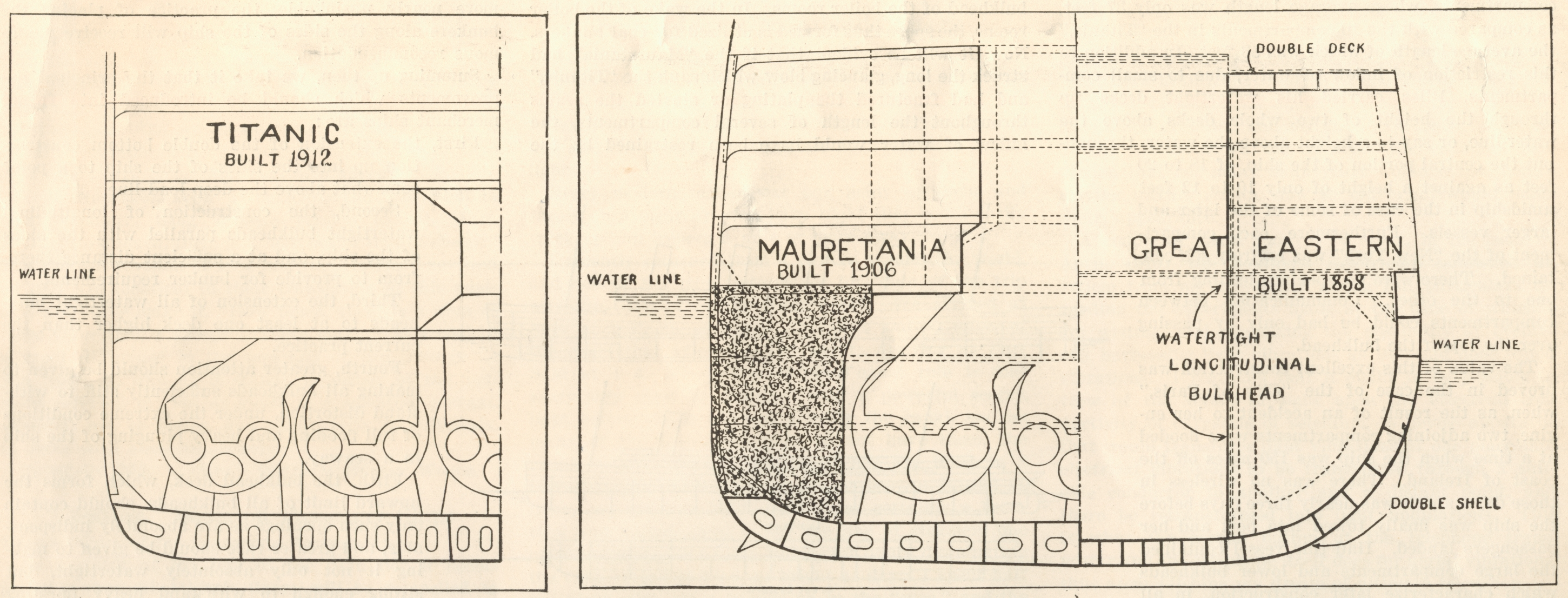
Titanic was remarkable for only taking a relatively small list to either side during the sinking process, but any significant list Mauretania took which led to many of the lifeboats being put out of use might have led to criticism of the longitudinal watertight bulkheads used in her design.  Peskett noted that the Lusitania and Mauretania model of transverse watertight bulkheads (running across the ship from one side to another) and longitudinal watertight bulkheads (running parallel to the ship’s side) was the only one of its kind in the British merchant service.

Above: Mauretania‘s configuration included coal bunkers along the ship’s side, separated from the boiler rooms by a longitudinal watertight bulkhead.  (Scientific American, 1912/Author’s collection)


In the summer of 1911, Cunard were working on designs for their new Aquitania.  The Board of Trade’s new rules concerning stairway escape from the lower passenger decks (primarily third class accommodation) concerned Peskett because they might ‘necessitate a rearrangement of the whole of the ship above E-deck’.  Cunard therefore pushed back on the grounds it would put their new ship at a competitive disadvantage:

It was pointed out…that to do so would prevent the ship becoming a commercial possibility, and that such an arrangement could not be considered by the Cunard company, as it would prevent them from competing with rivals, who with similar ships will not have to comply with such stringent regulations.  The Olympic and Titanic and the new German ships will not be called upon to carry out these rules.

…It was pointed out that the Cunard Co. did more in the way of making the ship practically unsinkable, than any other company in the world, and that in the matter of [watertight] subdivision, was far in excess of our Board of Trade rules, or [Lloyds] Registration Society’s requirements, and as an extraordinary precaution, the Cunard Company are anxious to fit W.T. bulkheads between E and D decks.  

Their viewpoint prior to April 1912 might have been taken as a complacency as to the safety of their express passenger ships.  Might Cunard have faced criticism for pushing back against a safety regulation on competitive grounds?  Might the company have been criticised for thinking their express ships were ‘practically unsinkable’?

Mauretania was expressly designed for speed and so her specifications had noted:

As the weight of all materials to be worked into the hull, fittings, and machinery is of vital importance, it is essential in getting out the designs of the various parts that the greatest care should be taken to avoid unnecessary weight, every part to be as light as possible, consistent with the necessary strength.

To keep overall weight down and help improve the ship’s stability, high-tensile steel was used in the upper hull structure rather than the usual mild steel.  This was an innovative feature enabling them to use less steel to obtain the same strength.

During Aquitania‘s design process, Cunard made clear that an essential criteria of any design proposal had to be a GM (metacentric height) which was not less than Lusitania and Mauretania.  This would ensure that she was not too tender.  (A positive GM was essential for a ship to return to upright: if the GM was too low then she would be too tender, with less stability; a GM which was higher would produce a more stable ship.)  Thomas Andrews noted in the summer of 1910 that Olympic and Titanic‘s stability:

would be so much greater than that of the Lusitania and Mauretania that lightness in the upper works was not a vital necessity with them as it had been in the case of these two ships’

Might Cunard have faced criticism that competitors such as Olympic and Titanic were superior in that regard, as Thomas Andrews had indicated?  Their own criteria for Aquitania indicated that they recognised Mauretania‘s stability as an issue. 

Another factor was that Mauretania‘s design used ordinary steel rivets to rivet high-tensile steel plating.  Part of the reason for using high-tensile steel was to help improve stability and reduce the weight of the upper hull structure. The shipbuilders believed that the use of hydraulic riveting and the use of rivets ‘at least equal to the requirements of Lloyd’s rules for mild steel plates of equivalent strength to the high tensile steel used’ mitigated this concern’.  It was a reasonable approach to take but there had been some comment about it back in 1907.  Might Cunard have faced criticism for ‘inferior’ rivets?

This discussion is a mere counterfactual. All of the potential criticisms that Cunard might have faced are speculative, but they are based on known facts.  They help to get us thinking about Titanic in the broader context.  It is easy to see how Mauretania might have been the subject of a disaster. She actually had a long and successful career, as did Olympic:  Titanic’s problem was striking the iceberg!

Much of this post is drawn from primary source documentation included in Olympic & Titanic: Triumph and Disaster, released this month.


FAQ: Would Higher Watertight Bulkheads Have Saved Titanic?

FAQ: Would Higher Watertight Bulkheads Have Saved Titanic?


No, probably not.

In the immediate aftermath of Titanic‘s allision with the iceberg, it became clear she had sustained significant damage. Flooding was reported in the forepeak tank, holds 1, 2 and 3, boiler room 6 and boiler room 5.  This extent of damage was beyond the ship’s capacity to survive and her watertight subdivision was overwhelmed, leading to her foundering about 2 hours and 40 minutes later.

Initially, water ingress in boiler room 5 was kept under control by the pumps.  However, as Walter Lord noted in his 1986 book The Night Lives On, boiler room 4 was subsequently found to be taking on water also.  This evidence is often overlooked.  (Sam Halpern’s excellent article ‘Where Did That Water Come From?‘ is highly recommended.)


Above: Olympic‘s watertight subdivision as-built.  The majority of the watertight bulkheads extended to the saloon deck, D, and the remainder to the upper deck, E. (Bruce Beveridge collection).


Edward Wilding, who was responsible for key design elements including the ship’s strength and watertight subdivision, was asked about this before the British Wreck Commissioner’s Court:

20953. (Mr. Laing.) Now I want to sum up, to see if I understand properly the flooding plan. If No. 6 boiler room and the compartments forward of it are flooded, am I right that the vessel, as she is designed, is lost – she must sink?
– If No. 6 boiler room and the three holds forward of it, and the forepeak are flooded, the ship is undoubtedly lost as built.

20954. If No. 5 boiler room is flooded in addition, supposing the bulkheads had been carried up to D, would that have saved her?
– It would not. There is a plan which I have put in which is marked E.

The Commissioner:  Will you repeat that question?

20955. (Mr. Laing.) If No. 5 boiler section is flooded carrying the bulkheads up to D would not save the vessel?
– No. There is another plan which shows it better than the one your Lordship has. Yes, that is the one. (Indicating.)

20956. And the last question is: With No. 4 [boiler room] section added on, no possible arrangement could save the ship?
– No possible vertical extension of the existing bulkheads.

Boiler room 4 represented the seventh watertight compartment back from the bow.  Unless the ship’s engineers had managed to bring the water ingress under control permanently using the available pumps, then Titanic would have been doomed regardless of how high her watertight bulkheads had extended.

Wilding reiterated the point three years later, before the Limitation of Liability hearings:

Q. Suppose there was damage in No. 4 boiler room… What height of bulkhead would have been necessary to prevent the ship from sinking?
– No height of bulkhead; it might have been extended to the funnel top and she would have gone down.

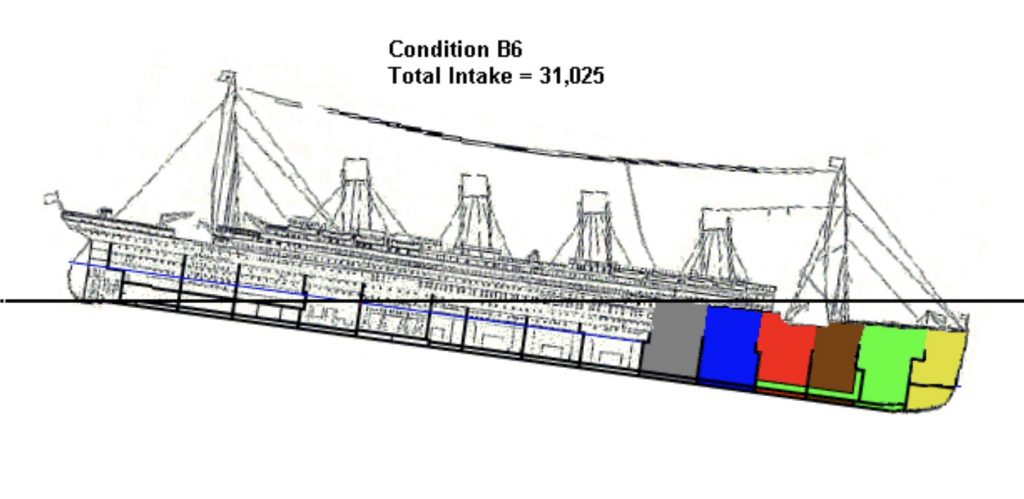
After the Titanic disaster, modifications to Olympic and Britannic included the stepped-up extension of the watertight bulkhead between boiler rooms 4 and 5 to the underside of B-deck.  The purpose of that particular change was to enable the ship to float theoretically with the first six watertight compartments up to and including boiler room 5 flooded but, even in that situation, the bow would have been submerged with the water up over the fore end of the superstructure.  

 
Above: Diagram depicting Edward Wilding’s ‘Condition B6’ with the first six watertight compartments – the forepeak, holds 1, 2 and 3, boiler room 6 and boiler room 5 – completely flooded.  (Sam Halpern collection) 


‘Niet Schuldig’: Studies in Language

‘Niet Schuldig’: Studies in Language


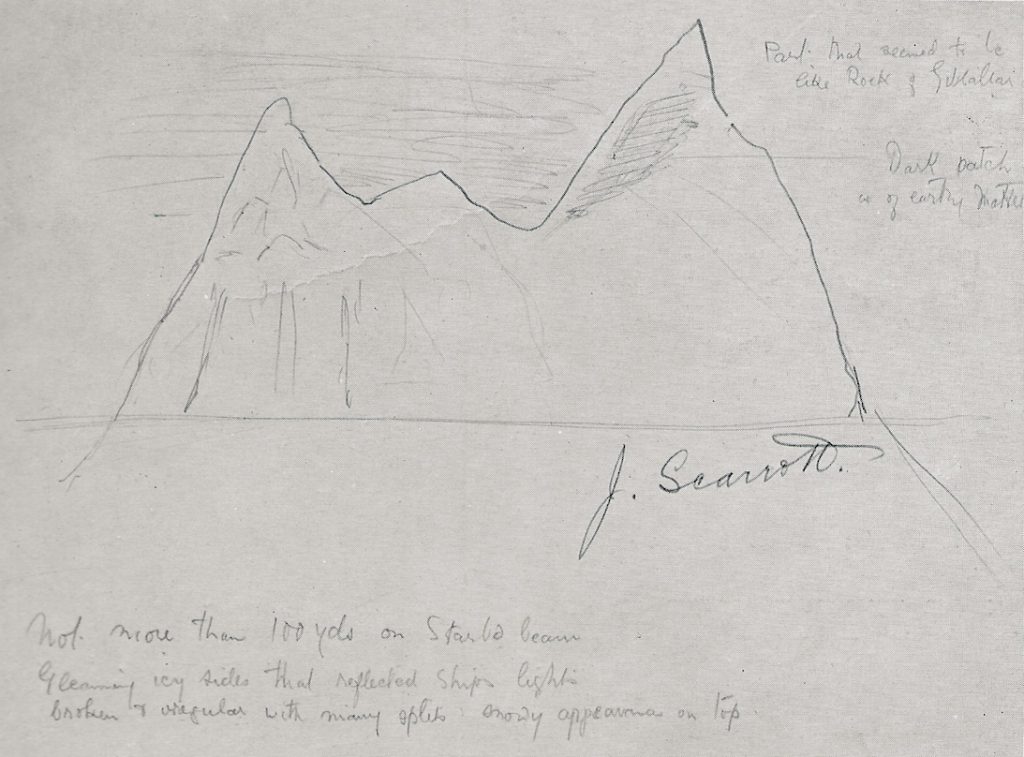
Above: Able Bodied Seaman Joseph Scarrott’s sketch of the iceberg which fatally wounded Titanic.  (The Sphere, May 1912/Author’s collection)


Several years ago, a friend of mine who is a native German speaker noticed the term ‘niet schuldig’ on an item of clothing I was wearing.  They asked me about it, because the German translation could have been taken as a reference to guilty rivets. (It would have been very badly written, lacking a capital ‘N’, using a singular rather than a plural, and using the male version: a better construct would use the female form and be ‘Nieten sind schuld.’)  In fact, the language was Dutch and the term translated as ‘not guilty’.  A key part of the confusion was that the word ‘schuldig’ is common to both languages and had the same meaning, whereas ‘niet’ was also common to both languages and had a different meaning!

Understanding the language something is written in is simply a starting point.  Even in modern American English and British English, misunderstandings can arise through different use of words.  An American’s definition of ‘fanny’ is very different to a British person’s!  It is also true that the meaning of some words or expressions may change over time or stay the same.

An example of this comes in relation to Titanic comes from the late American writer, David G. Brown, in the early 2000s.  He rightly argued about the importance of understanding changes in language over the years and highlighted that the meaning of words can change over time.  The problem was that he laid a wholly inaccurate argument on top of that.

David argued that the use of the word ‘struck’ or ‘strike’ in 1912 was used solely by mariners to describe a vessel striking something on its bottom.  His argument came from a definition in a dictionary published many decades afterwords. He used it to support his contention that Titanic‘s interaction with the iceberg was primarily a grounding event, arguing that if a survivor had used either word then they were deliberately indicating that they thought the ship had grounded on a portion of the iceberg .

It is important to be clear that this post is not an analysis or discussion of the grounding theory, which deserves serious discussion.  Instead, it is an analysis of a very specific claim. David’s argument that these terms were used exclusively to describe a ship touching bottom (i.e. grounding on an underwater portion of an iceberg) is demonstrably false.

There are numerous contemporaneous examples of sailors in both the merchant and royal navies using ‘struck’ or ‘strike’ to describe a contact with the ship’s side, either from two moving ships colliding, a ship being torpedoed, or a ship making contact with a mine.

These include the Olympic-Hawke collision in September 1911.  Hawke struck the White Star liner aft on the starboard side:

HMS Hawke log extract:

‘12.45. Helm jammed[,] full speed astern[.]

Struck SS Olympic on starboard quarter. Collision stations.’

And the accompanying entry in Olympic’s log:

‘12.46: Struck on starboard quarter by His Majesty’s Ship.’

Immediately before the collision, Pilot Bowyer had asked Captain Smith if Hawke was going to ‘strike’ Olympic.

Captain Smith later noted that the naval vessel: ‘turned very quickly, and struck us on the quarter – apparently to me, a right-angle blow almost.’

Chief Officer Wilde, First Officer Murdoch, Fourth Officer Alexander and Sixth Officer Holehouse all used the word ‘struck’ with reference to the collision and Fifth Officer Tulloch used ‘strike’.

A number of Hawke‘s crew also described the collision and used the same terminology.

Three years after the collision, Hawke was torpedoed.  A gunner reported ‘We were struck a little abaft the starboard beam by a torpedo’.

As another of many examples, in 1917 the White Star liner Laurentic’s acting captain concluded ‘that the ship struck two mines’.

Whether any individual Titanic survivor was correct or not in what they interpreted from their observations of the collision, it is factually incorrect to claim that the survivor’s use of either ‘struck’ or ‘strike’ meant that they were deliberately describing a grounding unless they specifically made this clear in their account.  (There was, for example, an account quoted in A Night to Remember where somebody in one of the boiler rooms thought the ship had gone aground off Newfoundland.)

David’s argument has undoubtedly seemed compelling to a number of people over the years and he certainly argued it passionately. However, the claims in that argument are demonstrably untrue.


Harland & Wolff Canteen Menus and Idle Workers

Harland & Wolff Canteen Menus and Idle Workers


This post is two short, edited extracts from my article ‘Thomas Andrews: In Court, In Rotterdam, In Belfast and Standing in: November 1911 to March 1912’ which was published in the Titanic Historical Society’s Titanic Commutator December 2024: Pages 18 to 28.  


CANTEEN MENUS AND IDLE WORKERS
On 6 February 1912, the Harland & Wolff managing directors meeting considered ‘the question of improving the Staff Dining Room menu’ which was ‘left to the Chairman and Mr. Andrews to deal with’. It is not clear specifically what needed to be improved with the existing menu options, but it was certainly something else adding to Andrews’ workload.

They also discussed the problem of workers ‘idling’ on Titanic:

Incidentally to the completion of No. 401 it was arranged that the managing directors should consider what was the best course to adopt to prevent the idling of the men on board this steamer, which has become very marked, and meet again on Friday, the 9th instant, at 12 o’clock to further discuss the matter…

STANDING IN FOR LORD PIRRIE
Lord Pirrie was not in the best of health in the early months of 1912. It fell to Thomas Andrews to stand in for him on at least one occasion. Late in March 1912, the Belfast Steamship Company’s Patriotic left on her sea trials. She proved herself ‘a handsome, commodious and seaworthy’ vessel, reaching eighteen knots on the ‘measured mile’. Lunch was served onboard afterwards.

Andrews rose to speak for Harland & Wolff. He said he was ‘very sorry that Lord Pirrie could not be present, as otherwise the duty with which he was entrusted would have been in much abler hands’. Harland & Wolff’s prosperity ‘was never greater’ and they were expanding elsewhere, but he was sure their headquarters would always be in Belfast. The workforce had reached over fifteen thousand men and he said that the total wages bill had just set another record:

A good deal of that had been involved in the completion of the two first class passenger ships – the Patriotic and the Titanic [laugher]. It was a heavy task for the firm to complete the two ships in one week.

He looked forward to the successful completion of Titanic’s own sea trials, scheduled for 1 April 1912…


Olympic & Titanic: Triumph and Disaster Pre-Orders

Olympic & Titanic: Triumph and Disaster – Pre-orders are open!


Olympic & Titanic: Triumph and Disaster will be published by the History Press in April 2026.


This hardback volume, similar in scale to the acclaimed Titanic: The ‘Ship Magnificent’ books, is 416 pages (including c. 160 black & white and c. 20 colour images).  The text contains a treasure trove of little known information and previously unpublished anecdotes.  Whether your interest is in the design and engineering, financial, social or technical aspects of these ships’ history, you will learn something new.

Check out the book page for a preview and further information.


Signed and personally inscribed copies are now available for pre-order through this website.  The intention is that all copies ordered in March will ship soon after the book’s official release and before the end of April.  If you want a personal inscription as well as a simple author’s signature, please make sure to specify this when placing your order.  (Due to the book’s size and value, it will be shipped by tracked UK and global shipping services only.)

April is ‘Titanic Month’ and lots of new posts are planned, including many showcasing the new book.   For all the latest news, be sure to follow Mark Chirnside’s Reception Room through this blog and on social media! 


RMS Olympic Steinway Association

RMS Olympic Steinway Association


The RMS Olympic Steinway Association is an Austrian-registered non-profit organisation with the goal of acquiring and preserving a former Olympic piano.  Their objective is to make sure that it can be enjoyed by the public for years to come. The piano’s serial number is 157550 and it is a 52″ Steinway & Sons Model K upright model.  

To learn more about their work, please visit the association’s website and watch the short video below:


Errore di Progettazione o Scelta Tecnica? Titanrick

Errore di Progettazione o Scelta Tecnica? Il Caso delle Paratie del Titanic con Mark Chirnside 


The second of my two recent podcasts with Titanrick for Curiositanic is now available (recorded in English with Italian subtitles). We discussed the watertight bulkhead configuration, why the watertight bulkheads were designed as they were and whether this design was flawed.  Another topic was the issue of Titanic‘s lifeboats and what happened to them.  We also looked at Britannic‘s size and what her true dimensions were.

This interview is not only a journey into the past, but also an invitation to historical reflection: understanding the Titanic means contextualizing information, avoiding anachronistic judgments and analyzing technical decisions in light of their time, also emphasizing the importance of research based on official documents, fundamental tools for distinguishing facts from legends.


Happy New Year – 2026

Happy New Year – 2026!

Wishing you all a happy and healthy New Year!

It’s not every year that I post a ‘Happy New Year’ message, but it seems appropriate as we enter 2026.

2025 was a very busy period in so many ways.  It’s great that the number of visitors to Mark Chirnside’s Reception Room increased by 115 percent compared to the previous year.  New features such as ‘FAQ Fridays’ in July were very popular and I have had a lot of positive feedback from readers who have enjoyed the Frequently Asked Questions blog posts.  They address common questions but also serve as a myth-busting tool, because they discuss topics which are often subject to inaccurate information and explain why that information is inaccurate, using the primary source evidence.  Sadly, the reality of modern media and the internet is that inaccurate, sensationalised information so often goes viral, but putting the available evidence out there does go some way to remedying that for the discerning reader who values quality of information rather than quantity.

It was great to announce in September 2025 that the new book, Olympic & Titanic: Triumph and Disaster, will be published by the History Press in April 2026 (UK release).  This book has been in the works for a long time but the completed manuscript was only submitted to the publisher at the start of May 2025.

It might be helpful to explain the process of taking a book from idea to reality.

Authors are typically self employed and so each book project is written under its own contract and to a particular specification.  The author and publisher will have already agreed a format (which might be a lavishly illustrated paperback book with fewer words or a large hardback book with a focus on the information in the text).  Common practice is that there will be a range of tolerance for both the word count and the number of illustrations.  For this book, the image count came in right in the middle of what had been agreed but the upper limit of the word count was 200,000 words.  The finished manuscript ended up one word short!
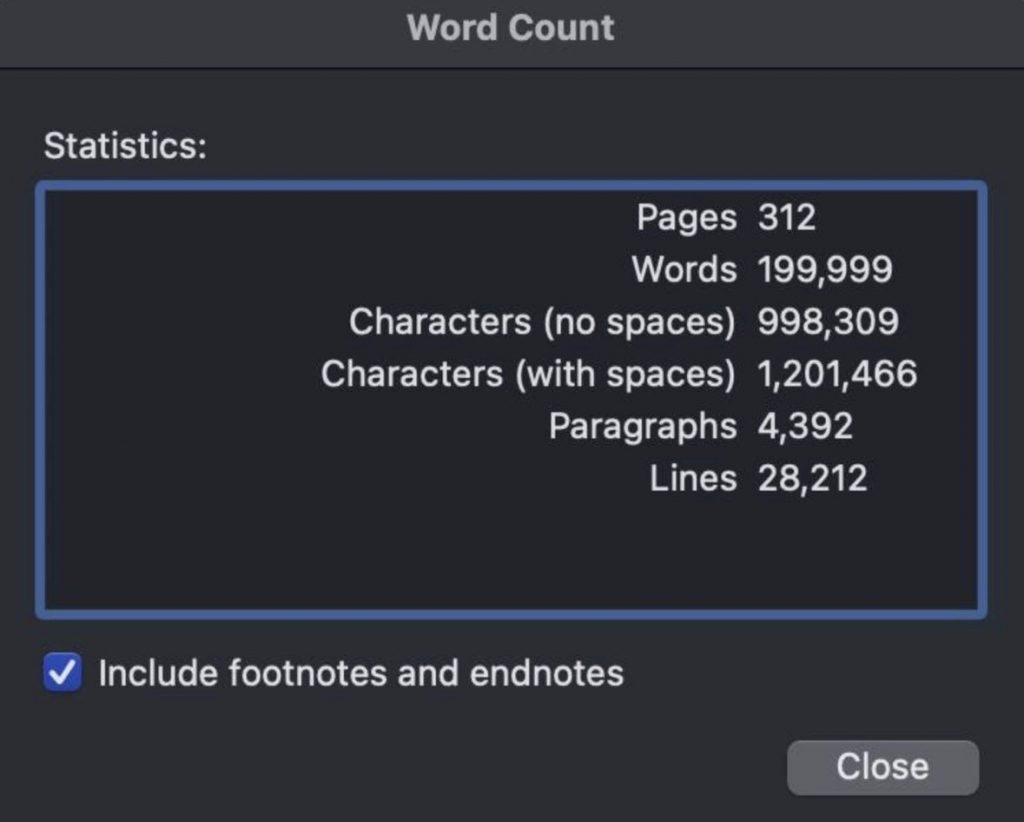
 

The complexity of a project such as this is only appreciated fully by those directly involved.  I was horrified to see I had burst through the maximum word limit and run to over 240,000 words.  This entailed slashing the manuscript before it could even be submitted to the publisher.  Cutting about 40,000 words required a disciplined editing effort on my part, but the end result was a sharpened focus on the key themes of the book.  (To help visualise the extent of the cuts, these words are the equivalent of the Majestic book.)  The cuts will not be wasted because they provide material for blog posts or articles in the future!

On submission of a book to the publisher, they will typically check over the manuscript and give it an initial read through to make sure that its content fits the original pitch.  They will map out how it will all fit together in the finished product and how many pages will be required, taking into account the word count, number of images and intended use of those images. (As the author, I personally find it helpful to make recommendations concerning each image submitted.  There might be some images which could be cut out if necessary, whereas another image might be rare or previously unpublished, meaning that it should be prioritised if space is at a premium during the book design process.  In other cases, images are directly referenced in the main text itself so making sure that they are used in the final book is essential!  The book designer will not necessarily be someone who knows the book’s subject and so it’s an important partnership between the author and designer to make sure we have a common understanding.)  In the case of this book, although the word count was (just) within the upper limit and the image count was in the middle of the range, the page count rose from the projected 368 pages to 416 pages (plus the colour section).  It’s a very big book!

Whipping the manuscript into shape typically involves a number of different editors.  They might come back to the author with queries if they feel a certain statement is unclear, or where a section of a chapter might benefit from being restructured.  In this case, I was relieved to hear that they thought the text was already in very good shape, but they made a number of recommendations which improved it a lot.

After months of work and queries back-and-forth, the author receives an initial set of page proofs to check over.  This is where they see for the first time how the text and images have all been moulded together into the book design template by the design and editorial teams at the publisher. Proofreading is a mammoth task and usually involves multiple sets of page proofs.  Initial comments / corrections are sent back to the publisher to be addressed; then a corrected set of page proofs is returned to the author to be checked and re-checked.  It is amazing how many errors come to light only on the third read-through!  A major challenge for the author is that they ‘know’ what they have written and so skim reading is not an option.  It is a very tiring, focused process to try and read what is actually on the to-be-printed page rather than what the author thinks it says.

This book was researched and written over an extended period of time.  One of my greatest pleasures was in learning new information about these ships from proof-reading my own book, because I ran across information again which I already knew but had slipped out of my memory!  I benefited from the input of a number of colleagues who kindly reviewed sections of text pertinent to their particular expertise before the manuscript was submitted to the publisher.  There were also others who were generous with their time and undertook pre-publication reviews based on the final product.  Some of these reviewers came back to me with specific queries and in many instances I checked and re-checked the source material underpinning a particular statement.  It goes without saying that any errors are the author’s ultimate responsibility.

Each book brings its own challenges.  My own experience is that there will always be something that is missed (hopefully a very small detail such as a comma being used somewhere instead of a full-stop), which can be frustrating given how hard all the individuals have worked to try and eliminate that sort of error.  Way back in 2006, when the first edition of the Majestic book was about to be signed off and sent to the printer, I realised to my horror that the page headers with the book title had ‘HMS’ Majestic rather than ‘RMS’.  It was a last-minute correction that saved a considerable amount of embarrassment!

In this case, one of the illustrations provided by a photo archive was incorrect.  The image (supplied directly to the publisher) showed the first class reading room rather than the first class smoke room. Although the archive reference number I had provided for the image was correct and I had fully intended to use a smoke room image, a well meaning individual at the archive had noticed that the archive catalogue description for that image incorrectly referred to the reading room and they substituted the image for the ‘correct’ one.  This necessitated sourcing the image again – and explaining that the ‘incorrect’ image was the one required!

Formatting rules can create complexity. Should a particular word be in italics or not? It’s often the case that foreign language terms (such as the name of a dish on a French menu) will be italicised. However, each publisher will have their own ‘house’ style guide to ensure consistency between all of their titles.  Some terms which are now in widespread use in English language publications are no longer appropriate for italics but should be formatted in roman.  Changing the formatting from the original manuscript to the text in the book design template can introduce inconsistencies if one term is changed but another is missed.  Therefore, it’s essential during the proofreading stage to make sure that all terms are formatted the same way.  In the case of original source quotations where I have emphasised a particular point in italics, it is always necessary to make sure that a notation has been included to explain it is the author’s emphasis (rather than the original source document) and that the italics made it through to the final book.

Ship names represent a particular problem.  By convention, they are always in italics but the formatting can be lost when the original manuscript is being transferred into the book design template.  The most obvious ones are easy to spot but reviewing the entire text to make sure any ship names have not been missed is always a challenge – and there is always one which will be missed.

Indexing presents its own challenge.  Indexing the content of the book can only be done very late in the process, because the layout needs to be 99 percent complete.  We need to have confidence that any page numbers will not be changing after the material has been indexed.  The process is laborious, but essential to help readers locate the material they want and to do justice to the sheer quantity of information in the book.  A whole series of decisions need to be taken.  Firstly, a judgement call on which subjects should be indexed.  Titanic is an obvious example of a subject which should be included, but such a large entry necessitates numerous sub entries beneath the main topic.  My approach was to cover the basic generalities first, then focus on areas where the book presents particularly important or new research and information.  Then there are other issues to consider – should a person’s title be used, or just their surname and first name?  What should be done in those instances where someone’s title changed?  For example, William James Pirrie only became a Lord in 1906.  He appears in the book decades before he had the title.  Then there are ship’s officers.  If an officer was promoted and appears in the text in both their junior and senior roles, which should be used?  Arguably, their most senior role, but it does create its own complications.  To keep things simple, I ended up using the simple surname, first name and/or initials for people’s index entries.  All of this minutiae might not be apparent to someone who picks up the book and skims the index for topics.

Another last-minute job is checking all of the cross references (‘see page X’), where the main text itself refers the reader to another section that is relevant, or to an image.  In some cases, image captions also refer the reader to the main text. Again, the final page numbers can only be confirmed once we’re confident nothing is going to be moved around or deleted for any reason.  For the final sign off before the book goes to print, the author and publishing team have to be as confident as they can be that no significant errors have been missed.

After weeks of intense collaboration on the page proofs, sending masses of corrections / comments back and forth, it was great to go on leave for Christmas, set the out of office email and drink some mulled wine!    


What’s planned for 2026?

There are more FAQs and other blog posts in the pipeline.  (If you have any suggestions for particular topics, do get in touch.  It might not be possible to respond to each individually, but all will be considered.)  April is naturally a busy Titanic month and you will see lots of new posts reflecting that.

Announcements about the new book and ordering options will all be published on this website – if you have not yet subscribed for regular updates via this blog, be sure to do so in order that you won’t miss out! 


FAQ: A Sound ‘Like a Cannon Shot’ – Why Did Majestic Crack?

FAQ: A Sound ‘Like a Cannon Shot’ – Why Did Majestic Crack?


On the night of Sunday 14 December 1924, the White Star liner Majestic (1922) was running through heavy seas en route to New York when a sound ‘like a cannon shot’ rang out.  Incredibly, the C-deck plating had fractured from the inside of the second funnel uptake on the starboard side, running right across the deck, past the second funnel uptake on the port side and out to the ship’s side.  The fracture then continued through the heavy plating at the side of the ship (the sheer strake) and partly down the ship’s side.  It was particularly serious because C-deck formed the ship’s strength deck and the sheer strake plating at the side of the ship was also specifically strengthened.


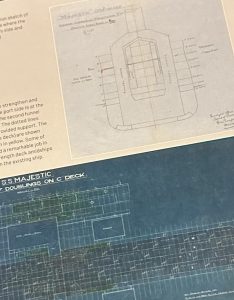
Above: Detailed blueprints and surveyors’ sketches showed the full extent of the damage and subsequent repairs (see RMS Majestic: The ‘Magic Stick’).  The sketch seen at the top of this extract, above, gives an idea of the split funnel uptake arrangement.  Unlike a traditional configuration with the ship’s funnel uptake extending directly upwards amidships, the designers chose to split the funnel uptake into two – one on the port side and one on the starboard side – to allow for spacious passenger accommodation amidships.


What had caused the problem?

The issue is explored in detail in RMS Majestic: The ‘Magic Stick’, however multiple factors were considered by the naval architectural firm Roscoe & Little, as well as the Board of Trade surveyors.  She had been designed and built in Germany by Blohm & Voss.  Roscoe & Little understood that the ship had been running at a deeper draught than her builders originally intended, increasing the stresses on the hull by 7-8 percent. (They put forward several schemes of repair work, one of which would simply restore Majestic to her original strength, but the White Star Line and Harland & Wolff thought this was inadequate because it would leave her 20 percent weaker than Olympic, which was taken as a benchmark example of a strong ship.)

The Board of Trade were surprised to receive test results on samples of the steel plating removed from Majestic‘s sheer strake.  They revealed a ‘surprising deficiency’ in the material’s ultimate tensile strength, because the steel bore a stress of only 23.2 to 25.4 tons.  The replacement plating was tested to 32.5 to 34.5 tons, which was in line with what it needed to be.  The samples of the original material which were tested had been almost 30 percent weaker by comparison.

The Principal Ship Surveyor was concerned that the split funnel uptake design involved not just cutting into the strength deck plating twice, but that sufficient ‘compensation’ (additional strengthening measures) had not been included in the design to make up for it. The position of the ship’s lifts (elevators) was criticised and there were also ventilator openings at the corners of the funnel uptakes.  The placement of the expansion joints also coincided with a weaker area of the deck. All of these features were far from ideal and served to collectively weaken the strength deck.

They did calculations which indicated that, owing to her greater weight and length, Majestic‘s tendency to bend (‘bending moment’ in naval architectural terms) was about 33 percent greater than Olympic‘s.  This should not have been a problem because ship designers took into account a ship’s bending moment in the structural design of the ship, but Majestic‘s strength had not been increased to the same extent.  She was, comparatively, significantly weaker.  The North Atlantic passenger liners all encountered particularly severe storms in the winter months and she should have been able to withstand this, but a combination of all these factors and the fact that Majestic had been driven at high speed put such a stress on her hull that it lead to a serious structural failure.

She was out of service for repairs over the course of several months early in 1925.  Harland & Wolff got to work effectively rebuilding the strength deck over a length about 233 feet.  This work included substantially thicker steel plating on C-deck, with some areas of double plates replaced with treble plating and other areas which were originally single plating doubled up to provide greater strength. It set her up for more than a decade of further service! 


Majestic’s Propellers

Majestic‘s Propellers

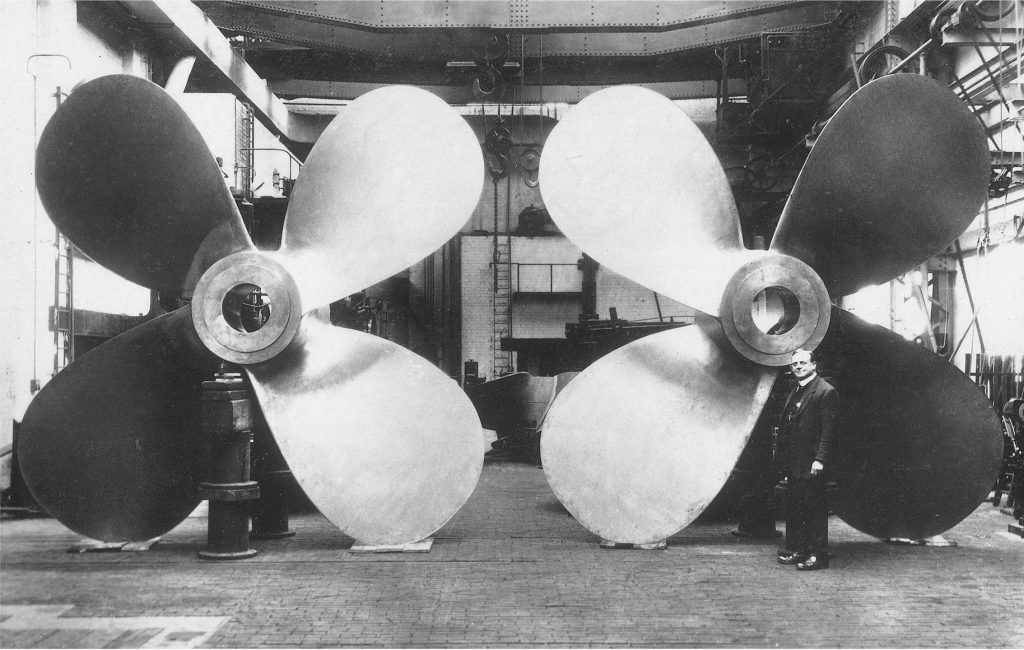
Bismarck/Majestic‘s construction was completed in Germany after the First World War.  She was a quadruple screw steamship and so her four propellers were an essential component of her propulsion system, but her builders Blohm & Voss were faced with many logistical challenges. One of them was shortages of various materials. In July 1920, Edward Wilding had reported that the ship’s propellers were ‘being made of cast steel, in view of the shortage of bronze’. This was only a temporary measure rather than a long term solution.  Majestic entered service for the White Star Line in May 1922 and her original propellers were replaced by a new set in November 1922.  She went through a number of different propellers during her career:   

A period postcard showing two of the ship’s propellers c. 1928.  The reverse reads: ‘Casting Weight 30 tons each; Finished weight 15. tons each; Diameter 16 feet; Revolving at 200rpm [revolutions per minute]; Each transmitting approx. 20,000shp [shaft horsepower], made of STONE’s Turbiston Bronze.’ (Author’s collection)


FAQ: Aquitania’s First Class Grill Room

FAQ: Aquitania‘s First Class Grill Room


Was Aquitania’s First Class Grill Room An a la carte Restaurant?

No.

Contrary to popular belief, Aquitania did not have an a la carte restaurant. Cunard’s attitude towards an extra-tariff facility of this sort was different to HAPAG’s or the White Star Line.

When Olympic entered service in 1911, she proved very popular with first class passengers. Her a la carte restaurant was so popular that additional tables were soon ordered, and it was enlarged during the ship’s 1912-13 refit. It was also a revenue earner for the White Star Line because passengers who used the restaurant paid extra to enjoy its facilities. The benefit of the restaurant was that a first class passenger could choose to eat when they wanted, rather than being limited by the sitting times in the main first class dining saloon. They also had a wider choice of dishes, which was equal to the finest restaurants and hotels ashore. One observer thought that the restaurant’s décor made it one of the nicest public rooms on the ship.

However, Cunard’s naval architect, Leonard Peskett, felt that the restaurant created ‘a new class of passenger’ within first class – people who stood aloof from other first class diners. This attitude continued into the post-war years. When the German liner Imperator joined Cunard’s fleet and was renamed Berengaria, her a la carte restaurant was removed and instead the room served as a ballroom; after the Cunard White Star merger in 1934, the a la carte restaurants onboard both Olympic and Majestic were closed down before the year’s end. (The galley equipment from Majestic’s restaurant was removed early in 1935.)

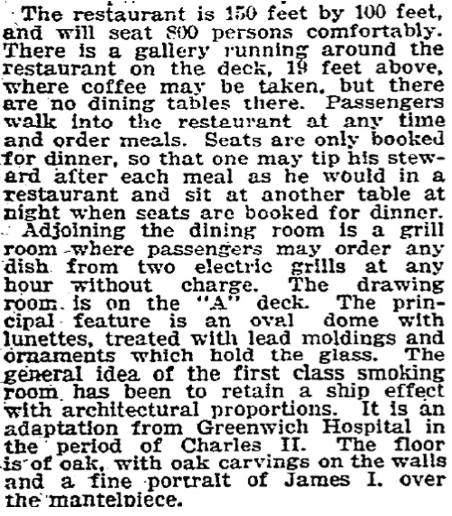
Aquitania’s arrangement was unique. The main first class dining saloon was designated as a ‘restaurant.’ However, an additional first class grill room was also provided aft of the dining saloon – on the port side.  This room is often mistaken for an a la carte restaurant. The New York Times reviewed Aquitania’s first class accommodation when she arrived in New York on her maiden voyage in 1914, writing:


When Aquitania made her maiden eastbound crossing in June 1914, some difficulties arose due to the large number of first class passengers.  One Cunard memo. noted:

Owing to the dining room now being called [a] restaurant, and it being advertised in New York that a la carte meals would be served, without charge, full advantage has been taken by the passengers. It has been one continuous meal, and I am afraid large numbers of crew will not sign on again.
…I would suggest that a notice be printed on the breakfast menu that no a la carte orders for luncheon can be taken after 10 o’clock, and on the luncheon menu that no a la carte dinner orders can be taken after 2 p.m. The menus are all of good variety, and to relieve the great pressure at luncheon, I put each day two dishes extra, marked as ‘special dishes’ and it met with a great success.

John Maxtone-Graham’s fine book, Crossing & Cruising, examines the grill room in detail.

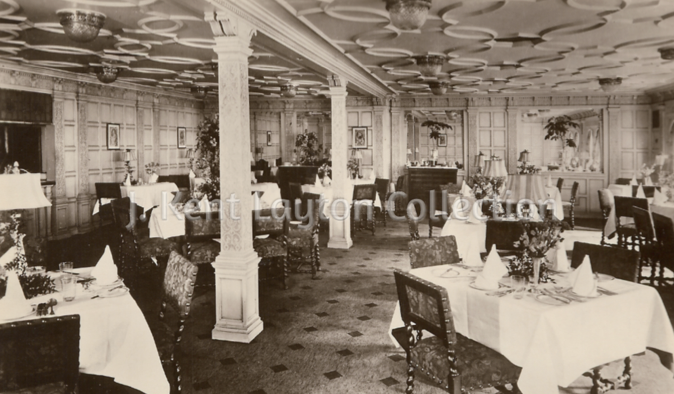
Above: Aquitania‘s first class grill room, pictured in the 1920s.  The decor had much in common with Olympic‘s first class dining saloon – so much so, that Cunard altered the original design slightly in July 1913, because they thought it looked too similar. (J. Kent Layton collection)


Why was Aquitania‘s First Class Grill Room removed?


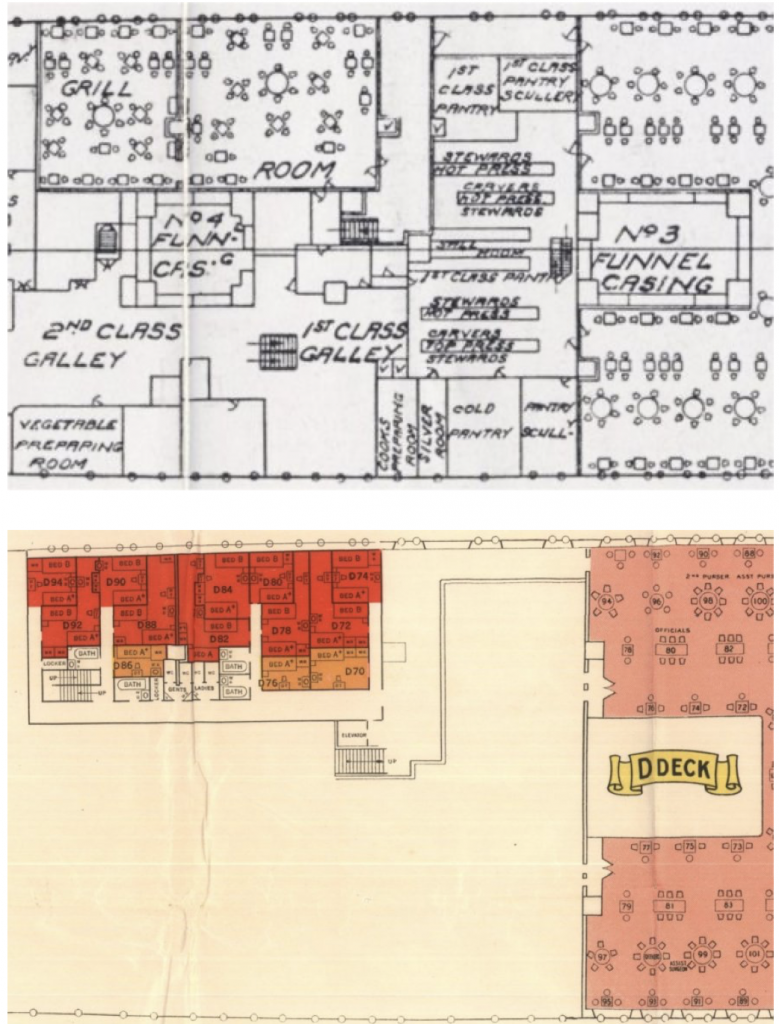
Below: Aquitania‘s first class grill room when she entered service and the same area after it was removed and converted to passenger staterooms in 1936. (The Shipbuilder, 1914/Author’s collection; and Aquitania Cruise Plan, 1938/Author’s collection.)

By 1935, the first class grill room was not as popular as it had been. First class passenger lists were not as high as they had been during Aquitania’s heyday. At a Cunard White Star  executive committee meeting in early September 1935, some defects were noted:

…very shabby appearance of the Ruboleum tiling in the grill room of the Aquitania, also in the corridor leading to that room. Renewal of this tiling was included in the schedule submitted for the vessel’s overhaul last winter but was deferred.
Removal and re-laying the tiling would cost approximately £335, but in view of the fact that the grill room is not very extensively used, it has been submitted that the deck be covered with carpet ex Olympic restaurant which is in quite good condition.

During a meeting in September 1936, Cunard’s Board decided that they needed to increase Aquitania’s tourist class passenger capacity to meet an anticipated increase in tourist class passengers in 1937 and beyond. Since the grill room was ‘not very extensively used,’ they chose to remove it:

It has been found possible, by converting the existing grill room on D-deck into passenger space, to provide for 44 passengers [sic]. The cost of the work is estimated at £7,000, and the passenger department is satisfied that this increase in the vessel’s earning capacity would produce £18,000 in the first year.

Although Aquitania’s first class (renamed ‘cabin’) passenger lists recovered in the late 1930s, they did not regain their pre-1931 level. In 1937, her highest cabin passenger lists were 436 westbound and 413 eastbound – less than her averages in the 1920s. They were easily accommodated in the main first class restaurant. In tourist class, Aquitania had a slightly better year in 1937, with her best performance for five years.  Third class numbers rose very sharply, to their best since 1924.


Mutiny on the Olympic


‘Mutiny on the Olympic’
(September 2025)

Olympic was preparing to sail from Southampton for New York on 24 April 1912, a fortnight after her sister Titanic had left the same port on her maiden voyage. Many lifeboats had been placed aboard but plenty of people were on edge following the disaster.

Minutes before she was about to depart, some of the ship’s crew went ashore and refused to sail. They expressed concerns about the ship’s lifeboats. Olympic was moved to a safe anchorage so that these concerns could be addressed but these efforts and the recruitment of replacement crewmen was of no avail. In fact, the replacement crewmen were then the cause of more unrest. These extraordinary events led to her voyage being cancelled and a number of her crewmen appearing in court.


Olympic & Titanic: Triumph and Disaster

Olympic & Titanic: Triumph and Disaster

Mark Chirnside’s eagerly anticipated new book, Olympic & Titanic: Triumph and Disaster, will be published by the History Press in April 2026!

This hardback volume, similar in scale to the acclaimed Titanic: The ‘Ship Magnificent’ books, will comprise of approximately 368 pages (including c. 160 black & white and c. 20 colour images).  The text (200,000 words) is the result of years of research and the use of substantial primary source material.  Needless to say, it contains a treasure trove of little known information and previously unpublished anecdotes.  Whether your interest is in the design and engineering, financial, social or technical aspects of these ships’ history, you will learn something new.

Signed and personally inscribed copies will be available for purchase through this website and we will be sure to keep you updated over the coming months.

If you can dream—and not make dreams your master;
If you can think—and not make thoughts your aim;
If you can meet with Triumph and Disaster
And treat those two impostors just the same


Rudyard Kipling.


It is impossible to understand Titanic without appreciating the broader context: the development of the White Star Line and its competitors in the preceding decades; Anglo-German competition; the British fear of the ‘American peril’ as foreign capital increasingly controlled British shipping companies; and the relentless advance in shipbuilding and technology. This definitive reference volume explores the lead up to the construction of Olympic and Titanic; providing a step-by-step account of the design process; looking at the financial, logistical and political obstacles they had to tackle; the ups and downs of Olympic’s maiden season in 1911 and 1912; and summarising Titanic’s disastrous end. Relying on extensive primary source research and presenting much unpublished data, this new book is not only a valuable reference tool, but provides an essential insight into understanding this period of history.

For all the latest news, be sure to follow Mark Chirnside’s Reception Room through this blog and on social media! 


A Captain’s Responsibilities

A Captain’s Responsibilities: In Charge of a Floating Town


A ship’s captain such as Captain Edward John (‘E.J.’) Smith was responsible for what was, ultimately, a floating town. Plenty of things could happen on a single voyage.  One of many unusual incidents occurred about two years before the Titanic disaster.  Early in 1910, the White Star liner Adriatic was leaving her New York pier when one of the ship’s stewards heard a revolver shot. One of the second class staterooms was found to be locked from the inside.  The ship’s crew forced it open to find a passenger ‘lying on the deck with a bullet wound in the right temple’. Captain Smith wrote in the log:

The revolver was found lying close to the man’s right hand. The ship’s surgeon was called and pronounced life extinct.

Edward Ettridge, who had adopted the stage name ‘Ed Beppo’ for his English music hall performances, had shot himself in Alfred Burgess’ stateroom. He was, briefly and understandably, mistaken for Burgess. One of the ship’s officers had to call for a tug to take the body off the ship. Smith signed the entry in the ship’s log that Ettridge had died of a ‘bullet wound in right temple’, countersigned by Purser McElroy and Chief Surgeon William O’Loughlin. (The story is covered in ‘The “Big Four” of the White Star Fleet: Celtic, Cedric, Baltic & Adriatic’.)

On the same round voyage, which took Adriatic from Southampton to New York and back again, there were a number of crew who either deserted, ‘failed to join’ or ‘left by consent’ at Southampton. After the westbound crossing, Sixth Engineer Arthur Ward had to remain in New York due to ‘suspected appendicitis’. Then there was the case of a trimmer who had to be ‘fined five shillings for disobedience to lawful commands’. He admitted ‘refusing to obey orders, on the plea that the duty took him to the engine room, and that he signed articles to work in the stokehold only’. Another trimmer was reported ‘off duty owing to an injury to his right great toe, caused by a piece of coal falling on the foot’. And they had to take on additional victualling staff to make up for an unexpected number of extra passengers.

Two years later, Captain Smith, Purser McElroy and Chief Surgeon William O’Loughlin all perished in the Titanic disaster.

Above: Captain Edward John Smith (1850-1912).  (L’Illustration, April 1912/Author’s collection)


Titanic: Metallo Scadente? Titanrick

Titanic: Metallo Scadente? Ce Lo Spiega Mark Chirnside


My recent podcast with Titanrick for Curiositanic is now available (recorded in English with Italian subtitles).  We discussed many topics related to the ship’s design and construction, debunking many inaccurate claims seen in modern day media reports. 

Was Titanic poorly built and with substandards materials who contributed to the sinking? Let’s find out with one of the world’s leading experts on the Titanic. 


The Perils of Using AI

The Perils of Using Artificial Intelligence (AI)

A common theme of mine is the danger of relying on secondary source information (such as claims made in books or television programmes) compared to primary source information (such as accounts from people who witnessed an event first hand or documentation produced by people directly involved in a ship’s construction).  We know from the study of primary source material that so many claims or popular beliefs about Titanic are not true.  Many of these are addressed in Frequently Asked Questions (FAQ) posts on this website.

The dangers of relying on secondary sources are also apparent from using Artificial Intelligence (AI) tools. I recently came across a post on Facebook about White Star’s Oceanic (1899).  Underneath, it had a prompt to use Meta AI to answer various questions.  In response to clicking on one of these, this tool claimed that Oceanic held the Blue Riband at the time she was launched.  This is simply not true.  She was not built to be the fastest liner afloat or to hold the Blue Riband, which was an unofficial speed record held by a succession of German passenger liners from 1897 to 1907.  Moreover, it would have been impossible for her to demonstrate any kind of speed at all until she had entered service.  At the time of launch, her propellers were fitted, but her propelling machinery and the key mechanical components to operate the ship were not yet in place!

Another example is a post I made recently on my Mark Chirnside’s Reception Room Facebook page.  In response to inaccurate (apparently AI-generated) information on another Facebook page, I shared a link to my article discussing Britannic‘s length and breadth.  My article provided detailed evidence demonstrating that, contrary to popular belief, Britannic‘s breadth had been increased prior to her keel being laid.  It had nothing to do with any of the design changes that followed the Titanic disaster (specifically, the inner skin running the length of the boiler and engine rooms).

Beneath my post, Meta AI once again had a series of prompts.  One of them was a question asking ‘How did Britannic‘s width change?’  I clicked on it and saw that it made exactly the same untrue claim that my article had already disproven, as well as adding further confusion by saying that she was ‘a few feet wider than its [recte: her] sister ships…’ In fact, she was only eighteen inches wider in total (1.5 feet).  This shows the challenge in providing accurate information to people when tools such as Meta AI generate so much inaccurate information.

Although tools such as AI potentially have their uses, it is important to verify any information obtained from them independently!


Adriatic & Amerika: Myth & Reality

Adriatic & Amerika: Myth & Reality

The order to proceed with Adriatic‘s construction was given on 23 August 1902.  Her keel was laid by Harland & Wolff about three months later but the order was then suspended on 19 January 1903. (The engine works were not ordered to resume work on her propelling machinery until July 1905.)  Meanwhile, construction continued at a slow pace on her hull.  The double bottom was not fully framed until 1 July 1903, several months later than might have been expected. In consequence of the suspension of the order and subsequent pace of construction, Adriatic entered service almost three years after Baltic, even though they were only laid down five months apart!


Above: Construction Chronology of Celtic, Cedric, Baltic & Adriatic.  (The ‘Big Four’ of the White Star Fleet: Celtic, Cedric, Baltic & Adriatic)


It has been suggested that HAPAG’s Amerika, completed by Harland & Wolff in 1905, utilised the hull originally intended for Adriatic.  There is no basis for this claim.  Baltic was not launched until November 1903, by which time the work on framing Adriatic‘s hull was well advanced.  Amerika was then laid down on the slipway vacated by Baltic. (She was shorter and slightly narrower than both Baltic and Adriatic.)

Nonetheless, Amerika introduced a significant number of features for her first class passengers.  In the context of increasing competition on the North Atlantic, White Star made sure that Adriatic‘s passenger accommodation would be improved significantly compared to her older sister ships. 


Read all the details in The ‘Big Four’ of the White Star Fleet: Celtic, Cedric, Baltic & Adriatic! 


FAQ: Was Third Class Empty on the Eastbound Crossing?

FAQ: Was Third Class Empty on the Eastbound Crossing?


No.

From 1907 to 1914, White Star’s Southampton to New York express service was operated by ships including Adriatic (1907-11), Majestic (1907-14), Oceanic (1907-14), Olympic (1911-14) and Teutonic (1907-11).  The total number of third class passengers carried westbound was 116,491 whereas the total number of third class passengers carried eastbound was 110,211.  (This data excludes commercial crossings made immediately after the outbreak of war in August 1914).

Total third class passenger numbers eastbound were actually higher than the westbound numbers in 1908, 1911, and the 1914 data up to August.  The data for 1908 is the most dramatic example of this, with 10,121 third class passengers carried westbound and 24,282 eastbound.  (Poor economic conditions in the United States led to a significant increase in eastbound passenger traffic.)

It is certainly true that many third class passengers travelled to the United States intending to start a new life there.  Nonetheless the westbound and eastbound third class passenger traffic was much more balanced than many people seem to think.

(As an aside, the White Star Line had a good intermediate or secondary service from Liverpool provided by the ‘Big Four’.  Their general manager, Harold Sanderson, thought that ‘the slower service…is the favourite service for the third class passenger’. He pointed out that the ticket costs ‘are slightly lower; they are lower than the Olympic’. The average third class passenger lists tended to be higher on the Liverpool to New York service, although that might also reflect that the ‘Big Four’ were newer and had superior third class accommodation to older ships such as Teutonic and Majestic.) 


Above: Adriatic was the largest ship in the White Star fleet from 1907 to 1911.  Although she was slightly faster and more luxurious than her three older sisters, the ‘Big Four’ were intended as intermediate ships.  She was transferred to the Liverpool to New York service shortly after Olympic was completed in 1911. Another distinction is that the ‘Big Four’ had much greater third class passenger capacities than the company’s express liners. (Author’s collection)


FAQ: Did the Enclosure of Titanic’s A-deck Promenade Increase her Gross Tonnage?

FAQ:  Did the Enclosure of Titanic‘s A-deck Promenade Increase Her Gross Tonnage?


No.

Contrary to popular belief, the enclosure of the fore part of Titanic‘s first class promenade on A-deck did not make any difference to her gross tonnage. 

Titanic’s gross tonnage (not a measure of weight but, rather, the total enclosed space) was calculated as 46,328.57 tons. By comparison, Olympic’s gross tonnage was 45,323.82 tons when she was completed in 1911. Titanic’s gross tonnage was therefore 1,004.75 tons greater than her older sister’s. It placed her as the largest ship in the world.

It is a popular myth that the enclosure of part of the A-deck promenade was largely responsible for increasing Titanic’s gross tonnage. In fact, her registration certificate (completed in March 1912) specifically stated that the ‘open space on promenade deck, abreast windows port side – 198 feet long’ was ‘not included in the cubical contents forming the ship’s register tonnage’ (the same applied for the starboard side).  (If it had been included in the gross tonnage calculation, it would have added 720.51 tons, increasing her gross tonnage to 47,049.08 tons.)

The real reason for Titanic’s increased gross tonnage was the expansion of the first class accommodation on B-deck at the expense of the original enclosed promenade, which accounted for the majority of the increase. This passenger accommodation counted as enclosed space, whereas the enclosed B-deck promenade on Olympic did not. Other changes, such as an enlarged officers’ quarters deckhouse, contributed to a much lesser extent as well.

In March 1913, Olympic’s own gross tonnage increased to 46,358.70 tons, following a major refit which included expanding the restaurant and adding a Café Parisien on the starboard side of B-deck. These modifications ensured that the remainder of the enclosed promenade space on this deck was now counted as enclosed space in the gross tonnage calculation. She emerged from the refit with a higher gross tonnage than Titanic, even though her A-deck promenade was never enclosed.


Larger Liners & Lifeboats: Carpathia & Olympic

Larger Liners & Lifeboats: Carpathia & Olympic


It is common to hear comments about the lifeboat regulations in force at the time of the Titanic disaster, which linked lifeboat provision to the size of the ship.  Famously, the rules had come into force in 1894 when the largest liners afloat were Cunard’s Campania and Lucania.  They provided for a scale of ship size based on gross registered tonnage and the largest category was ships of 10,000 gross tons and above.  By 1901, the largest ship afloat was double that; by 1912, Titanic was more than four times that.

However, it’s often overlooked that a ship’s gross tonnage was not necessarily the best guide to how many passengers and crew she would carry.  We can see an example of this in comparing Cunard’s Carpathia with Olympic as at April 1912.  The number of passengers and crew capacity did not correlate to the fact that Olympic was three times Carpathia’s size.  The reason for this is that the Cunard ship carried so many third class or steerage passengers, who were allocated significantly less space per person. 


Above: One of many slides from my September 2021 presentation at PRONI, Olympic & Titanic: ‘A Very Remote Contingency’ – Lifeboats for All.  (Author’s collection)