Olympic & Titanic: Triumph and Disaster – Chapter 4
Published on
Olympic & Titanic: Triumph and Disaster – Chapter 4
Chapter 4, ‘Forging Ahead’, explores the topic of speed and propelling machinery.
While it is well known that the White Star Line were not attempting to build the fastest liners afloat, they were nonetheless keen to make sure their new ships were competitive in speed and could provide a creditable express service. We read previously unseen correspondence from J. Bruce Ismay, who had voiced fears back in September 1902 that the newly formed IMM combine had a shortage of fast ships:
We must not forget that the IMM Co. has only two steamers that are really capable of doing 20 knots regularly, and it seems to me those responsible for the future management of the company will have to carefully consider if it is not almost necessary to do something to improve their position in this respect
The move of White Star’s express service to Southampton from 1907 meant that they were competing significantly for continental first and second class traffic, in particular. Their competition included Norddeutscher Lloyd, whose ships ran at around 22 1/2 to 23 knots. White Star intended to be somewhat slower but still competitive with that pace, while being significantly faster than intermediate services operated by the Hamburg America and Holland America Lines, which ran at around 17 to 18 knots.
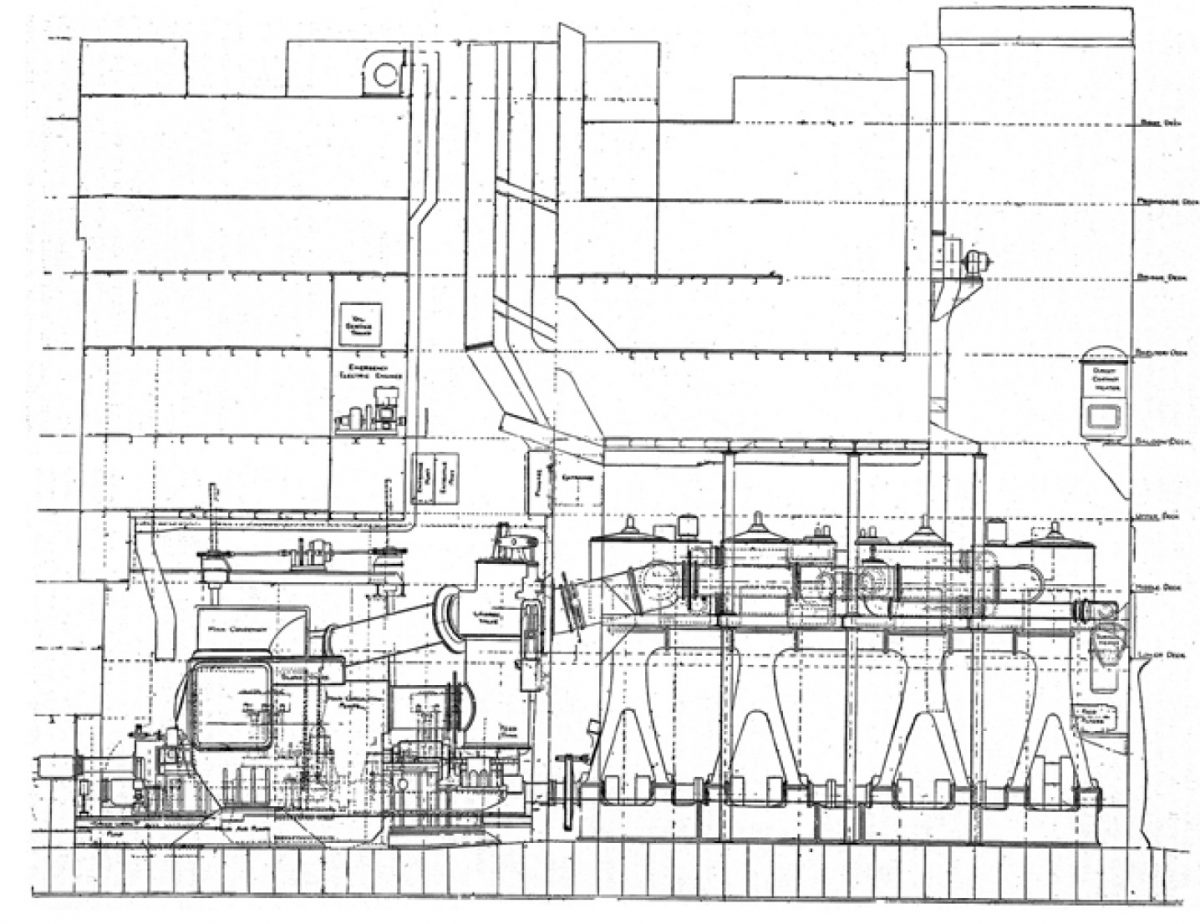
The development of reciprocating engines and the newer turbine technology is covered in some detail, including the adoption of the ‘combination’ propelling machinery which was ultimately chosen for their new liners. This included Harland & Wolff’s alliance with John Brown & Co. so that the Belfast shipyard could subcontract manufacturing of the turbine engines to their Scottish rival, until their engine works in Belfast had been developed further. We see the results of ‘combination’ propelling machinery on other ships and the benefits observed, including lower fuel consumption (and a corresponding reduction in running costs).
One of the topics which is not discussed as frequently is the subject of propeller design. At the time these ships were being designed and constructed, shipbuilders of the period were constantly experimenting with different propeller configurations to obtain the best results including reduced vibration and improved efficiency. We see this in the case of Cunard’s Lusitania and Mauretania in their early years of service, but Harland & Wolff also had access to the insights of turbine specialist Stephen Pigott, who was working for John Brown & Co. (Lusitania‘s builders). This is illustrated by a notebook from his papers, which was originally drawn to my attention by Joao Goncalves, and includes a comparison of different centre propeller configurations for Olympic and Titanic.
We also learn about the differences between ‘combination’ propelling machinery and how it worked astern, compared to an all-turbine arrangement. A turbine driven steamship required astern turbines to run astern. It is not widely appreciated that the lack of astern turbines on all four shafts on Lusitania and Mauretania caused operational difficulties, including that the remaining two propellers were still slowly moving ahead for some time after the two astern turbines had been activated on the two other propeller shafts.
Achieving a service speed of 21 knots with plenty of power in reserve was a significant achievement. The number of crew in Olympic‘s engine department trebled compared to the number required on Celtic (1901) and stood only ten percent below the number required on Mauretania. In fact, the number of engineers in the engine department on Olympic actually exceeded their counterparts on her Cunard rival…