Did You Know About the Electric Lighting in the Toilets?

Did You Know About the Electric Lighting in the Toilets?


In August 1911, Cunard’s naval architect Leonard Peskett was onboard Olympic to check out the competition.  One of the details he noticed was the sanitary ware, supplied by Messrs. Doulton and ‘equal in quality and similar in design to…the Franconia, the only difference being that the wash basins are fitted in marble slabs and the WCs are flushed by lifting a lever handle instead of pushing a button’.

He also noted the automatic electric lighting in the ship’s public bathroom facilities:

The electric lights in the WCs are put on automatically by closing the door.  When the door is closing it presses on a button fitted in the architrave near the top hinge of the door, and puts on the light, the light going out immediately the door is opened.  For WCs this is considered to be better than a switch, as so many lights are left on when not required.

This innovative feature reduced unnecessary use of electricity, because the toilet cubicles were only illuminated when they were in use and the door was closed.  (The Holland America Line’s Willem Piek Jr., by contrast, criticised this as ‘not pleasant and, in my opinion, not conducive to cleanliness’ in December 1911.)

Peskett thought that the third class sanitary accommodation was ‘a little better than usual [sic] provided by White Star. The WCs are of the pedestal type with levers at [the] side for flushing’.  There seems to be a modern-day misconception, seen in some online forums and memes, that the third class toilets all flushed automatically because the White Star Line did not think passengers would know how to operate them.  As Peskett’s comments confirm, this was not the case.   

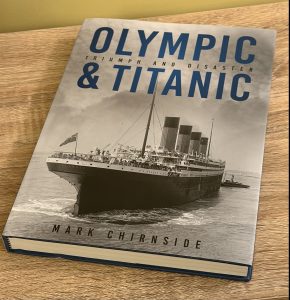
Further details in Olympic & Titanic: Triumph And Disaster


Above: Olympic & Titanic: Triumph and Disaster is filled with little known anecdotes and details which flesh out our knowledge of these ships.


A Voyage on Olympic: Willem Frederik Piek

A Voyage on Olympic: Willem Frederik Piek Jr.’s Notes for the Holland America Line, December 1911

A new article of mine, ‘A Voyage on Olympic: Willem Frederik Piek Jr.’s Notes for the Holland America Line, December 1911′ (external link) has been published on Encyclopedia Titanica.

Born in Amsterdam on 16 March 1874, Willem Frederik Piek Jr. became the head agent of the Holland America Line in New York, in 1912; four years later, he became a director of the company, serving in that position until 1935. In December 1911, he boarded Olympic at New York for an eastbound crossing (the passenger list also included ‘Mrs Piek’). Travelling first class, his objective was to check out what life was like onboard. How comfortable was her passenger accommodation? How was the White Star service? How might they lure away her passengers?

His meticulous notes, handwritten in Dutch, provide fascinating details of what it was like to sail on Olympic. They contain the sort of observations that cannot be found in period journals such as The Shipbuilder, or in chatty, casual letters home from passengers. It all adds to the social history of Olympic and provides a glimpse of what life might have been like onboard Titanic, such as first class passengers stealing spoons from adjacent tables, or maids and valets hanging around the companionways because they only had a dining saloon on C-deck.

One common factor when observers acting for one shipping line wrote about competitors’ vessels is that they often seemed very critical about particular aspects of a ship. This can also be seen in reports Cunard’s naval architect, Leonard Peskett, wrote about Olympic in August 1911 and Imperator in June 1913. If advertisements of the period extolled a ship’s virtues, then competitors’ criticisms provide a counterweight. The reality lies in between. Indeed, we also see positives such as the lack of items which rattled in first class staterooms.

This is believed to be the first time that his notes have been published. They illustrate the importance of diversifying beyond English language sources. His observations and a vast array of other hitherto unpublished material will be included in Mark Chirnside’s next book, from which much of this article is drawn from.

This article was first published in the Titanic International Society’s Voyage 128 July 2024: Pages 158-62. (A German language version was published in the Swiss Titanic Society’s Titanic Post 129 September 2024: Pages 125-30.)

A number of the locations that Piek referred to in his notes, such as the maids’ and valets’ dining saloon, can be seen recreated as they were on Titanic through Titanic: Honor & Glory’s DEMO 401 Update 2.0 Release Day Tour

Above: The Holland America liner Rotterdam (1908) was built by Harland & Wolff.  She introduced many innovations and set a number of new standards in passenger accommodation.  (Author’s collection)