‘Olympic & Titanic: “A Very Remote Contingency” – Lifeboats for All’

‘‘Olympic & Titanic: “A Very Remote Contingency” – Lifeboats for All’ 


My presentation in September 2021 at PRONI discussed the topic of lifeboats.  I set the scene by covering the key points about lifeboat provision during the decades preceding the Titanic disaster; the regulations in 1912 and how they had evolved; and how Harland & Wolff and the White Star Line exceeded the legal requirements for lifeboat capacity.


Contrary to popular belief, there is no evidence that Harland & Wolff recommended to the White Star Line that more lifeboats should be fitted.  What they did do is provide a new Welin davit design which would enable them to carry more lifeboats in the future, if the regulations changed.  They also provided four additional semi collapsible boats for each ship.  Comparing the number of lifeboats shown on the ‘Design “D”‘ concept which the White Star Line approved in July 1908 with Titanic as completed in April 1912, the number of lifeboats increased from 16 to 20.     

I closed the presentation by covering some examples of inaccurate claims about Titanic‘s lifeboats in the mass media.  One was a completely inaccurate characterisation of a Harland & Wolff drawing office notebook, which a television programme claimed was evidence that Harland & Wolff had intended originally for Titanic to be fitted with enough lifeboats for everyone (in fact, it was a document recording changes to Olympic‘s lifeboat configuration in the 1912-13 refit).  Another was a newspaper article mischaracterising notes which were authored by Board of Trade surveyor Captain Maurice Harvey Clarke.  They were written after the disaster, not before.   

Mark explores the issue of lifeboat regulation over the decades preceding the Titanic disaster and discusses the context immediately prior to 1912. He discusses the question of lifeboat provision for these new White Star giants and dispels a few longstanding myths and false claims made about Titanic’s lifeboats.


Presentation from the Archives: ‘The Chairman & The Commander: J. Bruce Ismay and Captain “E. J.” Smith’


My ‘superb’ presentation in September 2020 at PRONI discussed both J. Bruce Ismay and Captain Smith.  Key topics include J. Bruce Ismay’s correspondence several weeks before the Titanic disaster, when he writes about his daughter’s wedding coming up in March 1912 and explains that he will sail on Titanic on 10 April 1912, expecting to return to Southampton on 27 April 1912; Captain Smith’s ‘uneventful’ career is discussed in some detail, including the Hawke collision on 20 September 1911.   

A talk focusing on two of the key personalities in the Titanic story: the White Star Line’s chairman, J. Bruce Ismay, and the Line’s senior captain, ‘E. J.’ Smith. Mark explores some of the history of these two men in the years leading up to 1912, including little known anecdotes and events – as well as some of the misconceptions surrounding them.


Presentation from the Archives: ‘An”Olympic” Challenge: “We Have Reached the Limit…’


Building the largest ships in the world wasn’t simply a question of the shipbuilding process itself.  There were all sorts of other practical challenges to consider, including financing them, insuring them, expanding the port and docking facilities to operate and maintain them, and powering them across the North Atlantic. My presentation in September 2019 at PRONI discussed a number of these key issues and highlighted just how many logistical challenges the White Star Line was faced with.  


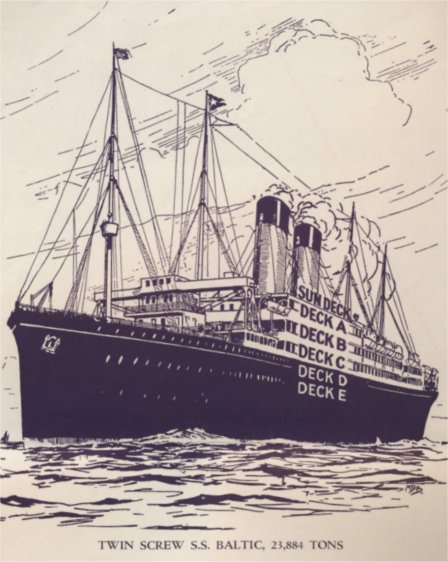
Presentation from the Archives: ‘The “Big Four”: Celtic, Cedric, Baltic & Adriatic’


The White Star Line’s Celtic (1901), Cedric (1903), Baltic (1904) and Adriatic (1907), collectively known as the ‘Big Four’, served for a combined 110 years. Together they carried around 1.5 million passengers on the Liverpool to New York and Southampton to New York routes during their time in service.


My presentation on 11 September 2017 at PRONI gave a comprehensive overview of all four ships’ histories, from conception and construction through to their successful commercial careers on the Liverpool and Southampton to New York services; cruising; war service; and Celtic‘s survival of both a mine explosion and torpedo attack in 1917 and 1918.